


Dry contact fiber optic transceivers in buildings are suitable for remotely transmitting discrete information such as equipment operation, liquid level alarms, and door status. They can connect scattered contacts to a receiving system, but they will not automatically measure temperature, complete timed programs, or become a building management platform. The plan should clearly define the meaning of each status and how disconnection is handled.
1. Which Signals Can the Link Carry?
Equipment operation feedback, water tank high-level contacts, in-cabinet fault relays, and door magnetic contacts can all serve as dry contact objects that need to be verified. Before transmission, confirm whether the signal source truly provides a passive contact (dry contact) or a powered output, and determine the electrical conditions of the receiving system input; the same business name does not mean the same interface.
A temperature controller can have both a continuous measurement value and an over-temperature alarm contact. A pure dry contact interface can transmit the alarm status that matches its conditions, but it cannot thereby obtain the current temperature number. Similarly, meter energy data, camera images, and access card information are not things an ordinary switch contact can express.
Writing each channel as “where it comes from, when it is valid, and how the receiving end handles it” is more useful than listing broad categories like lighting, air conditioning, and security. Whether it is closed or open under normal conditions, whether communication abnormalities are indicated, and whether recovery needs confirmation should be determined at the design stage, to avoid changing the business interpretation only after construction.
2. How the building system obtains this status
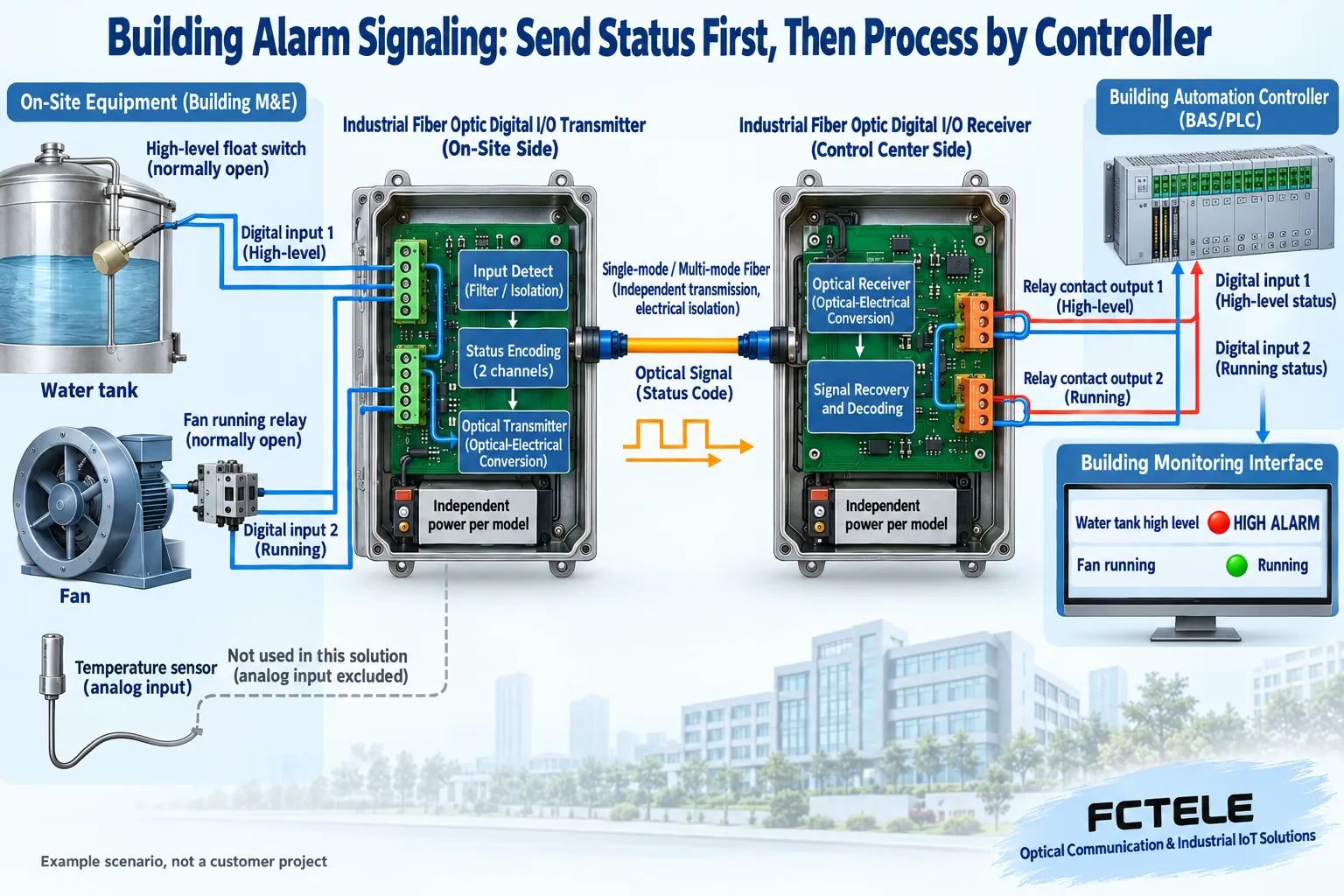
In a point-to-point solution, the field signal is detected at one end, sent over fiber to the other end, and then output to the controller’s digital input. The controller is responsible for identification, logic processing, recording, and display. The fiber optic transceiver is only a status channel; it does not automatically become a gateway supporting some building protocol just because it is connected to a building system.
If the receiving end is a relay passive contact, the input detection loop permitted by the controller should be used; if it is an electronic output, check the level, common terminal, and current conditions. The receiving system has its own acquisition cycle, and the screen also has a refresh interval, so a remote status change and the operator seeing the change are not necessarily simultaneous.
For channels that require remote operation, commands and feedback should be marked separately. Sending a start/stop command does not prove the equipment is actually running, and a change in the feedback contact does not necessarily prove that all operating conditions are normal. The necessary control conditions are implemented by the controller and process plan; a single communication output must not bypass the existing on-site protection.
3. Centralized aggregation is different from simple point-to-point
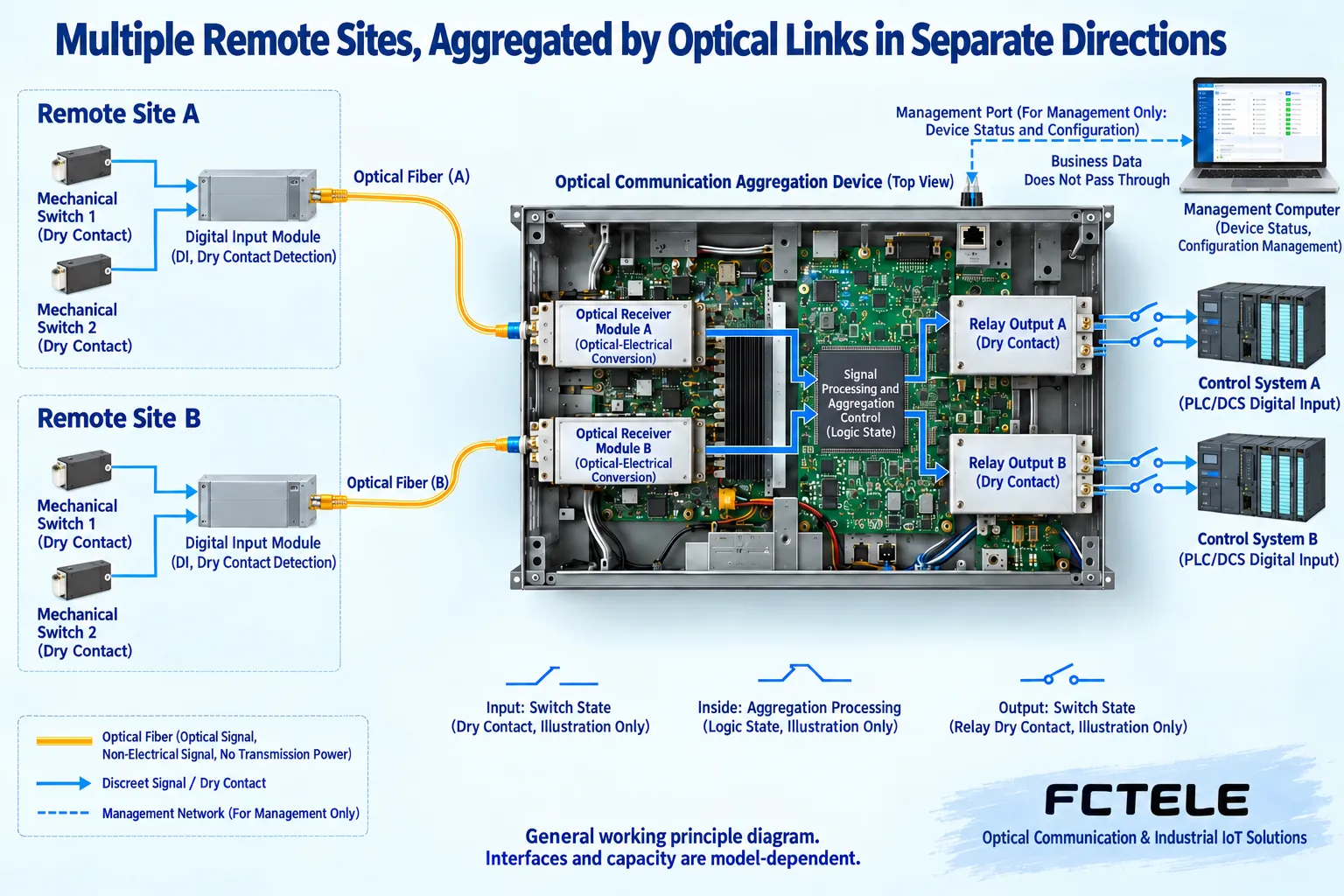
If one equipment room has only a few contacts, low-channel products such as Feichang FCP-K1/2 can be considered; when multiple locations need centralized access, the focus is the number of remote ends, the channels at each location, and the central capacity. You cannot select a pair of devices based on the total point count and then assume it can connect any number of scattered nodes.
The product description of the Feichang FCP-F28K128 describes central and node devices; the center can connect multiple optical directions, the nodes provide corresponding dry contact channels, and there is network management functionality. This type of architecture is different from ordinary point-to-point products. The total capacity statements in different paragraphs of its page need to be verified against the delivered configuration; the numbers in the model name alone cannot be used as a guarantee of available point count.
Ordinary dry contact fiber optic transceivers also do not automatically have SNMP, WEB management, or Ethernet services. Whether a management interface is needed should be chosen according to operations and maintenance questions: which optical paths and which statuses need to be viewed, whether remote operation is allowed, who can operate, and how duty personnel are notified when there is an abnormality.
4. Why power supply still needs to be considered for in-building cabling
The fiber segment avoids directly connecting the electrical references of two locations with long signal copper wires, and is suitable for remote status transmission across floors or different equipment areas. However, the devices at both ends, the sensors, and the receiving loop still need power, and short on-site copper wires may still be subject to interference. Fiber cannot replace load power, nor can standardized grounding be canceled just because the link is resistant to interference.
After selecting the fiber type, connectors, and optical module pairing, the actual line conditions must also be checked. Reserve channels, wiring labels, and maintainable positions; do not hide connectors in areas that cannot be inspected. The metal parts and protection of outdoor or cross-building optical cables are handled by the corresponding cabling project; do not hand all risks to the fiber optic transceiver.
5. How to distinguish alarms from disconnection
If the output enters a preset state after communication is interrupted, the receiving system may interpret it as equipment normal or alarm. Duty personnel should be able to distinguish equipment status from communication status, to avoid the situation where a real remote change is no longer transmitted while the screen still continuously displays “normal.” The supervision capability required by the system must be provided jointly by the equipment and the upper-level solution.
Disconnecting one input line, stopping node power, and interrupting the optical path are different fault tests. Record the output and display under each condition, and whether it automatically returns to real-time status after recovery. For alarms that require confirmation, the latch and acknowledgment logic in the controller must also be accepted together; do not only test whether the light turns on and off.
6. Preparing the building I/O point schedule
The point table includes location, signal source model, contact or level type, transmission direction, receiving address, and application meaning. Check point by point during construction, and change status point by point during commissioning; when two-way operation is required, additionally verify that commands and feedback each reach the correct location, to prevent testing multiple channels at the same time from masking numbering errors.
When handing communication alarms to the duty system, also check its acknowledgment and reset process. No one handling it at night, status recovering but the alarm still latched, and the original status continuing to display after a node goes offline may produce different operations and maintenance consequences. Write out these processes during design, and during testing have the receiving end execute them according to actual operating steps and keep records.
Before delivery, also test the actually supported conditions such as primary/backup paths, disconnection, and power recovery, and save the configuration. Systems such as fire protection, life safety, and dangerous actions follow their corresponding requirements; ordinary status communication cannot replace dedicated safety functions. The examples are used to explain the architecture and are not a real customer case or a universal construction drawing for all buildings.
Sources:Feichang FCP-K16G product description;Feichang FCP-K1/2 product description;Feichang FCP-F28K128 aggregation product description. The illustrations explain general mechanisms; they are not actual product photos, measured waveforms, or certification documents.
Translated from the Chinese technical article. Source first published: 2024-03-22. Source last revised: 2026-10-13T12:21:24+08:00. Read the Chinese source
