


4G solves the problem of accessing the network through a cellular network. A router is responsible for sending IP data to the appropriate next hop; an IoT acquisition gateway may also read field devices, interpret data, and convert application formats. These functions can be installed in the same device, but you cannot judge just by the name “gateway” or “industrial router.” When selecting a model, first ask: can the field data already be understood by the server, or does it still need acquisition and conversion?
1. First, break down the word “gateway”
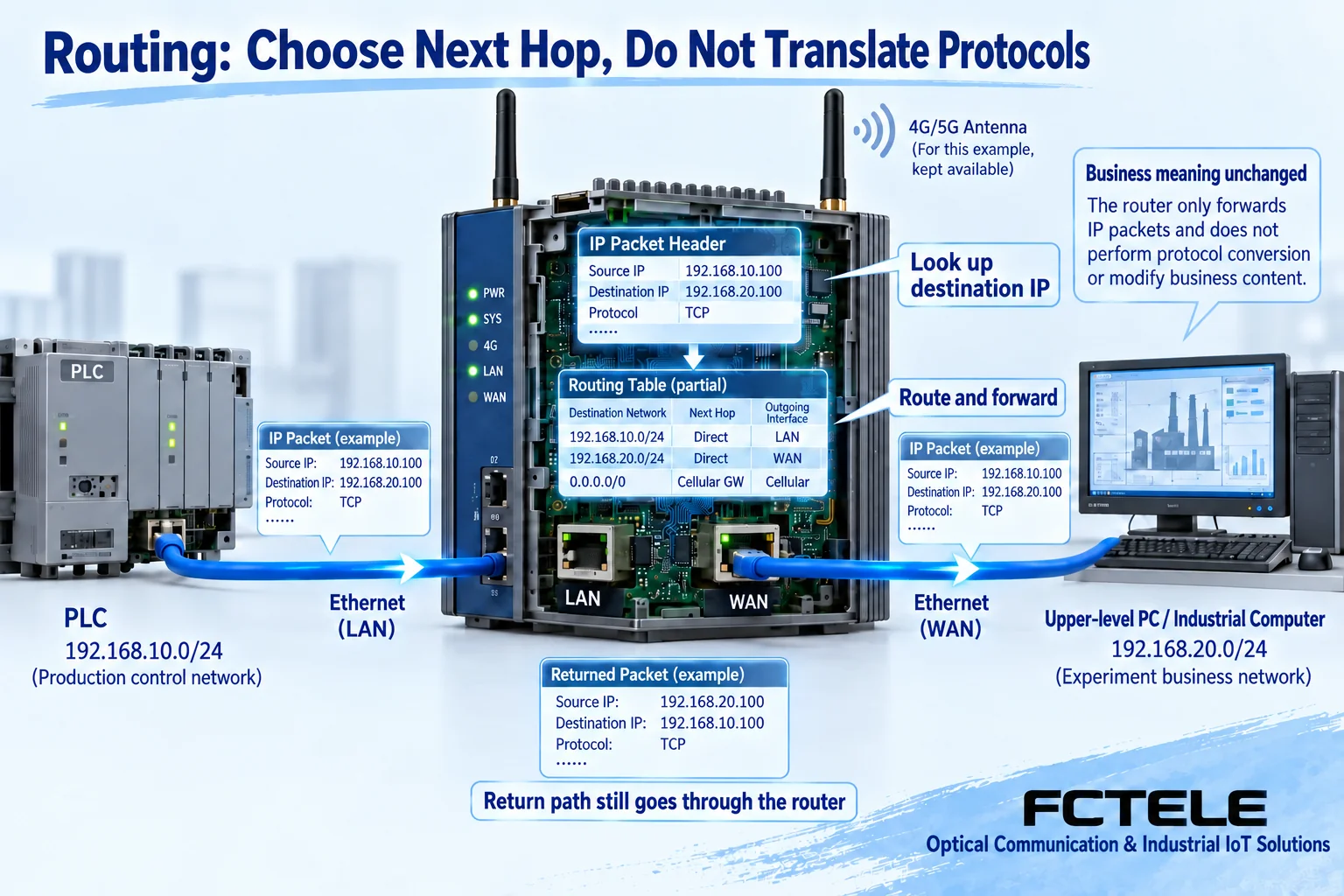
The default gateway in a computer’s settings is usually the next-hop address used when leaving the local IP network. It is not a “universal protocol translator.” For example, a computer hands data that is not in the local subnet to a router, which continues forwarding it. This process does not require the router to understand temperature values, device registers, or control commands.
An IoT gateway in a product name may refer to a device that connects instruments, controllers, and platforms. In addition to networking, it may also be responsible for actively reading, protocol conversion, field mapping, uploading, or caching. Different manufacturers and models use the same name, but the actual functions provided may differ. Therefore, you cannot classify all gateways as belonging to the same network layer, nor can you say that “a gateway is essentially just an IP address.”
If factory communication is compared to delivering goods, routing is like choosing the next leg of the transport route, while acquisition and conversion are like unpacking and reading the shipping list, organizing the contents, and changing them into the format required by the receiver. This metaphor only distinguishes responsibilities. It does not mean that conversion will definitely be faster, nor does it mean that all protocols can be translated into each other.
2. How a router connects different networks
Suppose a laboratory PLC is on one IP subnet and a maintenance computer is on another subnet. The PLC determines that the target is not local based on the address and mask, and hands the data to the configured default gateway. The router checks the destination IP and routing table, determines the output interface or next hop, and then sends it over the corresponding link. The reply from the other side must also have a correct return path.
Here, IP is network addressing information, and MAC is the address used by an Ethernet link. When routing passes through different Ethernet links, the link encapsulation may change; but ordinary routing will not automatically turn a Modbus register into a temperature field specified by the platform. A device can forward application messages, but that does not mean it understands or rewrites the meaning of the application.
An industrial router can use a wired or cellular uplink. “Industrial” and “4G” are not the same classification. For a 4G uplink, you also need to check the module standard, applicable region, carrier network, SIM card, access parameters, and antenna conditions. The fact that a web page can open only shows that one access path is available; it does not prove that the remote side can actively access field devices.
3. What else does an acquisition gateway do?
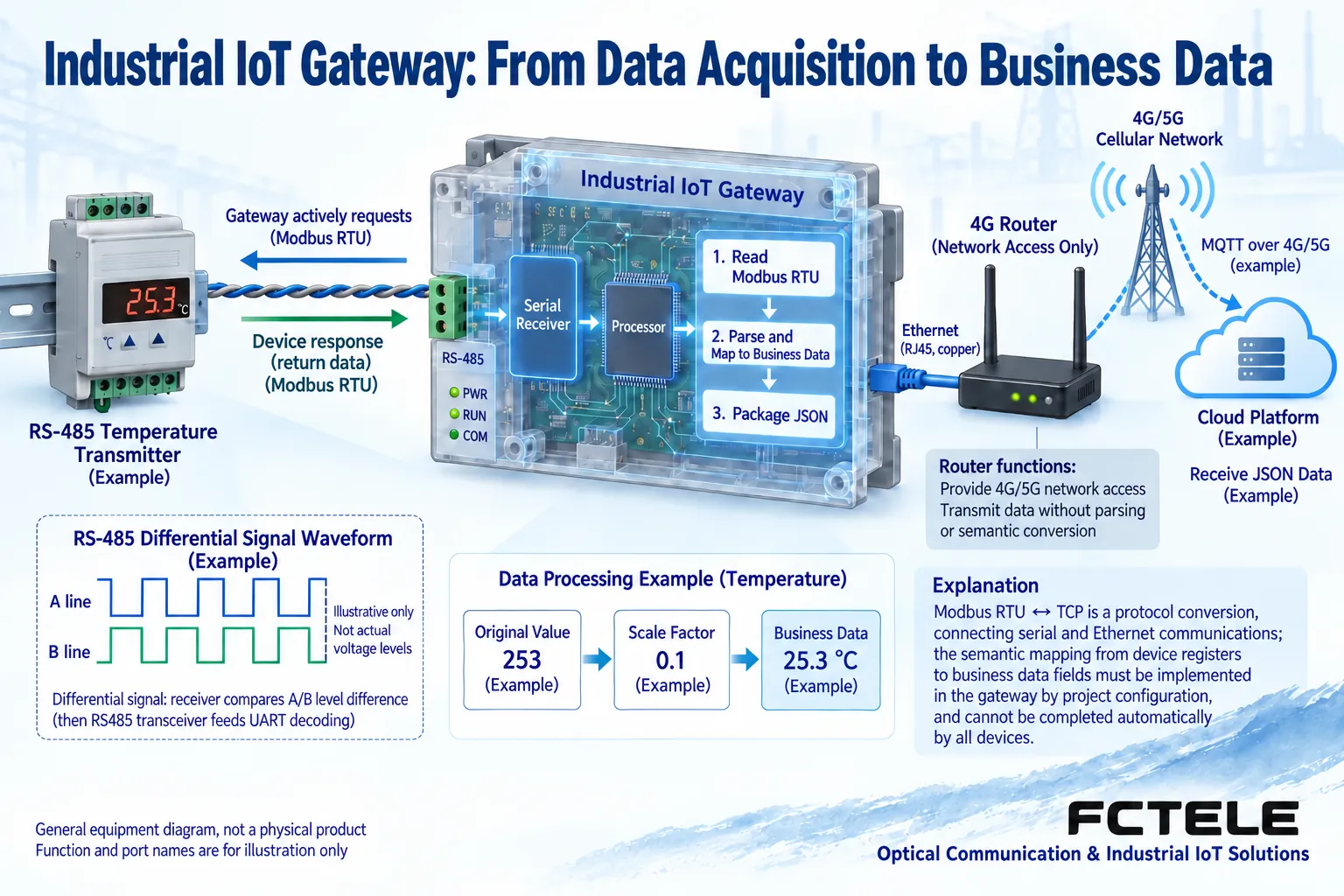
If a field temperature instrument only has an RS-485 interface, and the platform requires data in a specified format, simply providing a 4G network is not enough. RS-485 specifies the electrical transmission method; it is not responsible for explaining which register represents temperature. The gateway must also read according to the instrument protocol and confirm the station number, serial parameters, register address, data type, and conversion method.
For example, if the manual specifies that the raw value of a certain register is 253 and the conversion factor is 0.1, the gateway can then represent it as 25.3 degrees Celsius. This value is a hypothetical example and cannot be applied to all instruments. If any one of byte order, signed/unsigned representation, scaling, or units is misunderstood, the network may work normally while the reading is wrong.
After that, the device may organize the value into the fields required by the platform and send it. JSON is a data expression format; MQTT is a message transfer protocol. They are not synonyms. The platform must also agree on device identification, topics, authentication method, field names, and the meaning of time. The mere phrase “supports MQTT” cannot prove support for all the acquisition, parsing, and platform interfaces required by the project.
You also need to distinguish transparent serial transmission, Modbus RTU to TCP conversion, and Modbus data to JSON. Transparent transmission mainly sends bytes to the other end, where the remote program interprets them; protocol conversion must handle two communication forms; field conversion further interprets service data. These three tasks may be completed by different operating modes, and the actual configuration must be checked. They cannot all be called automatic conversion of any protocol.
4. Check with Feichang Technology product information, not by guessing from the name
In the Feichang Technology product center, the rack-mounted remote measurement and control service terminal order table lists FCT-6700-G4-CN. The page separately describes serial ports, discrete and analog I/O access, Ethernet and 4G uplink, and lists working functions such as Modbus RTU to TCP conversion, MQTT transparent transmission, and Modbus to JSON. This shows that one device can simultaneously handle field access and network upload, but these functions cannot therefore be extended to all industrial routers.
For a specific project, you should still obtain valid documentation for the ordered variant and confirm how each mode is selected, whether they can be used at the same time, data point configuration, and platform integration conditions. Promotional descriptions such as “always online” or “seamless” on the page should not be used as an engineering guarantee that communication will never be interrupted; actual disconnection, switching, and recovery must be accepted according to the business requirements. The illustrations use generic devices and do not pretend to be the actual product or internal circuit of that model.
5. How the two types of requirements lead to device selection
If the PLC already provides Ethernet services compatible with the platform and only cross-subnet or remote maintenance is needed, focus on checking routing, uplink, security policies, and remote access methods. If the field device only has serial ports or I/O, and the platform needs standardized readings, focus on checking acquisition interfaces, protocols, data mapping, and upload modes. You can also use a separate acquisition gateway plus a router, but you must also consider power supply, installation, configuration maintenance, and fault location.
NAT changes the presentation of addresses or ports, a firewall allows or denies communication according to policy, and a VPN provides a controlled communication channel. They are not the same capability. You cannot assume that control services are secure just because the device can connect to the network. Remote management should limit the access scope and retain configurations and logs. Do not directly open the field control interface to all external visitors just for troubleshooting.
6. Verify data first, then verify the remote link
For initial commissioning, first use a single instrument and a short link to verify readings, record the raw register and conversion result, and then check the fields received by the platform. When control output is required, first clarify allowed operations, field interlocks, and authorization windows. Do not turn a communication test into an unapproved start/stop action.
Then verify network addresses, routing, return paths, and application connections. If “it can ping but data is not reported,” distinguish between network connectivity and application authentication, topic, or field errors. If “uploading is normal but remote access is impossible,” check the remote access conditions and do not immediately remove all security policies. Back up before changes, change items one by one, and keep a rollback method.
Finally, test disconnection and recovery according to project requirements: whether data is discarded, how caching is handled, whether data is repeated after recovery, and whether control commands expire all need to be checked against the actual model and platform logic. 4G is only an uplink method; it cannot replace data correctness, business continuity, and security acceptance. This is how you know whether you bought just a network connection or a complete business link that includes acquisition and conversion.
References and notes:Feichang Technology remote measurement and control service terminal product information;RFC 1812 router requirements;Modbus Organization technical notes. The two schematic diagrams are general mechanism illustrations, not product photos, measured evidence, or certification evidence; ordering, wiring, and deployment are subject to the actual model, valid manuals, and approved acceptance results.
Translated from the Chinese technical article. Source first published: 2021-03-22. Source last revised: 2026-10-13T11:40:22+08:00. Read the Chinese source
