


Verifying the origin of an optical module cannot rely only on anti-counterfeit stickers, reading a vendor name, or measuring normal optical power. Whether the origin is genuine, whether the host is compatible, and whether performance meets the order are three different questions. A reliable method is to link the procurement channel, physical markings, manufacturer verification, and functional testing under specified conditions, and to keep traceable evidence, rather than using a single “label-checking trick” to judge all modules as genuine or fake.
1. First clarify which kind of “genuine” you mean
A third-party compatible module can be a product genuinely sold by its manufacturer, but it does not thereby become an original-brand module of the host brand. Used, refurbished, new, and unknown-origin are also different states. The contract should specify whose product is to be purchased or authorized, whether third-party compatibility is accepted, whether refurbished is allowed, and what warranty and support are required. Without a clear procurement target, it is easy to mix price, brand, and compatibility conclusions together during acceptance.
Abnormal appearance and function can indicate risk, but they cannot independently prove counterfeiting. Conversely, being able to establish a link and read information does not prove that the origin meets the order. You cannot claim that a certain sticker necessarily represents a genuine product, and you certainly cannot judge all different series that lack a certain sticker as fake. The exact identification method should come from the documentation for the corresponding manufacturer, series, and batch.
2. How identification information is read by the host
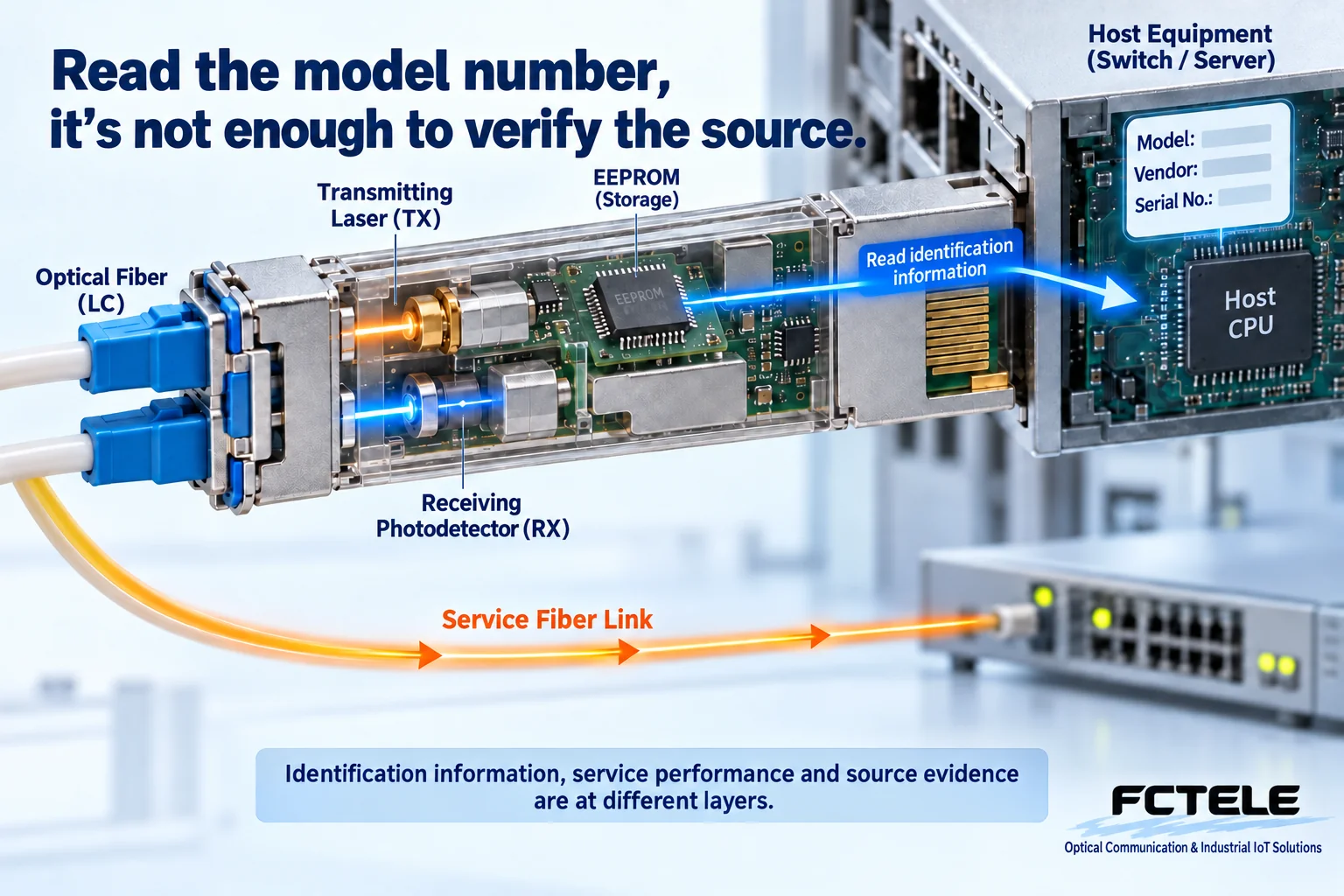
Some pluggable modules have circuits that store identification information. The host reads the model, manufacturer field, serial field, and supported capabilities through the corresponding management interface. Fields may differ between packages and management specifications, and the host display method may also change with version. Reading this content helps check the order and compatibility data; it is not a comprehensive authentication by the device of the supply chain origin.
The module’s service path is another matter: the host’s electrical signal drives the light source, and the remote detector receives the light and recovers the electrical signal. The identification path may work, while the service path may still fail due to optical, rate, or host condition mismatches. The device accepting the module’s identification code also cannot automatically prove that its components, performance, warranty, and authorized origin all meet requirements.
3. How labels and appearance should be used
Check the complete model, serial number, batch, and their correspondence with packaging and delivery lists, and record the appearance of the housing, latch, contacts, and optical ports. Missing information, contradictions, or abnormal repetition in the same batch require further verification with the supplier. During inspection, do not damage labels or open the module, otherwise evidence may be lost and subsequent service handling may be affected.
Some manufacturers have dedicated security markings and verification channels, but the specific location, style, and handling process cannot be applied across brands. Cisco Brand Protection page Introduces its channels, optical module security markings, and verification entry points. This can only be used to understand that manufacturer’s explanation, and cannot be used to assert that Feichang Technology or all suppliers use the same labeling system.
Do not use a laser pointer to shine into the module looking for “hidden writing,” and do not use an ordinary magnifying glass or your eyes to observe interfaces that may emit light. Label inspection does not require putting yourself at risk from unknown light sources. Necessary optical end-face inspection should be performed by qualified personnel using suitable tools, according to equipment and site safety procedures.
4. Origin evidence needs a continuous record
Before purchase, confirm the supplier’s identity, clarify the model and product status, and keep quotations, orders, invoices or delivery receipts, and actual service commitments. When verifying with the manufacturer or authorized channel, provide the relevant serial numbers, orders, and photos, and avoid sending materials to unknown personal addresses. When customer or network information is involved, submit only what is needed for verification, without management passwords and unnecessary production configurations.
A supplier’s verbal promise cannot replace records that can be matched to the physical item. When origin materials and physical labels do not match, first keep the original packaging and isolate the item pending verification, request clarification, and then decide whether to connect it to service. Do not, in order to save time, first mix it into the spare parts warehouse and then try to find the disputed module from a batch of similar metal boxes.
5. Performance testing answers a different set of questions
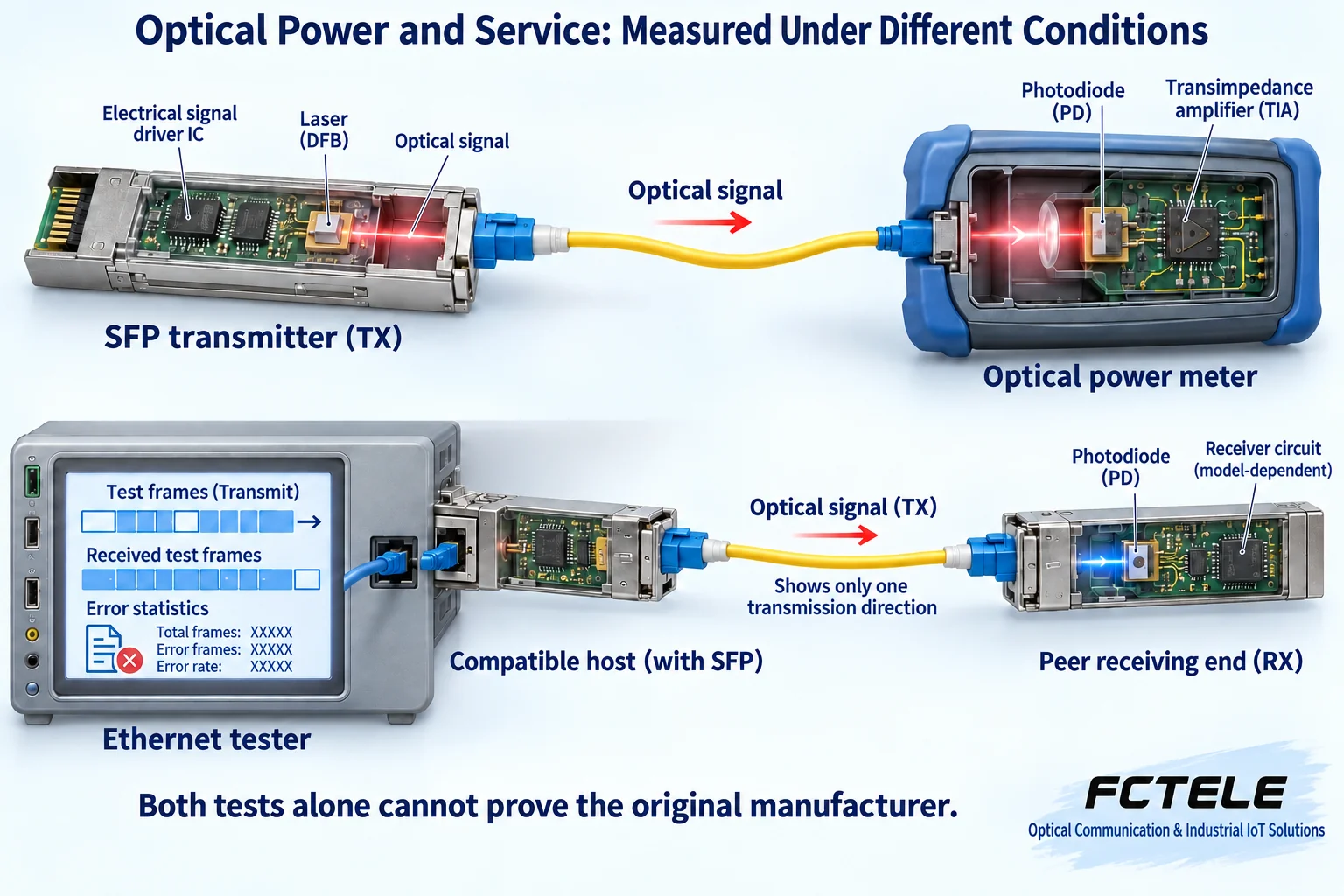
Functional acceptance first confirms host identification and support, then checks the rate, fiber type, wavelength, and transmit/receive direction at both ends, and verifies the upper and lower limits of received power. When measurement is needed, record the instrument, wavelength, measurement point, and conditions. A measured power value can only be compared with the parameters of the corresponding model; not all modules have the same normal range.
Then verify service and error statistics under the host, software, peer, and load conditions in the project. Short-term connectivity does not mean stability under full load and environmental changes; a single failed test also cannot directly lead to the conclusion that the origin is counterfeit. First rule out line contamination, configuration, host support, and measurement errors, then ask the supplier to handle it according to the evidence.
6. Put Feichang Technology equipment matching requirements into physical terms
Feichang Technology OEO product category in the FCM-OEO uses two SFP optical interfaces, and its use involves optical path conversion and regeneration within its supported range. When purchasing modules for this kind of equipment, the supplier should clarify the host version, service on both sides, and module combination, and provide order configuration and support basis.
Having an SFP slot does not mean all modules are approved, nor does it mean third-party modules automatically receive the same warranty. Host matching, optical interoperability, and product origin are confirmed separately. This article does not fabricate a unified Feichang Technology anti-counterfeit database, an all-brand compatibility promise, or a true/false judgment for a particular batch; when in doubt, check with official service channels based on the actual model and order.
7. How to protect evidence and service when a doubt is found
Create an independent record for the item pending verification, noting the time received, physical photos, label information, and origin credentials. Do not scrape off labels, write unknown information, or open the housing. If it has already been installed, first record the symptoms and diagnosis, then replace it with a known-good spare within an approved window; pay attention to anti-static, hot surfaces, and optical safety, and do not repeatedly insert and remove it in a production system, creating new faults.
Suppose a new module can be identified but continuously produces errors under load. Keep the host version, both-side models, optical path, and error changes, and confirm whether the problem follows the module. Submit the test abnormality together with the origin evidence to the supplier, but do not publicly claim that a certain brand or batch is fake before verification is complete. Being able to clearly distinguish “an abnormality has been found” from “origin still needs confirmation” allows handling to be stable and reviewable.
8. Form three layers of conclusions at delivery
The final record should separately state origin verification, compatibility verification, and performance acceptance: which credentials correspond to the physical item, which set of equipment and versions were confirmed to be supported, and under which optical paths, loads, and time conditions the tests passed. If any item is missing, keep it in a pending-confirmation state, and do not cover all issues with one overall green check. When replacing spares, upgrading firmware, or changing routes later, the affected conditions can also be re-verified without guessing from scratch.
Documentation note: The above manufacturer pages are used respectively for the corresponding product structure and brand verification process, and cannot replace each other. The two figures are general principle illustrations, not physical identification, customer testing, or manufacturer certification proof.
Translated from the Chinese technical article. Source first published: 2020-11-24. Source last revised: 2026-10-13T10:45:04+08:00. Read the Chinese source
