


SNMP / COUNTER WRAP AND SAMPLING
Does negative port traffic prove a link failure?
No. A monitoring platform may subtract two cumulative readings and obtain a negative result when a finite counter wraps to zero. Resets, changed objects and missing samples can also invalidate the calculation. Identify the object, confirm continuity and compare actual sampling intervals before calculating an average. A traffic graph alone cannot prove whether an application stopped communicating.
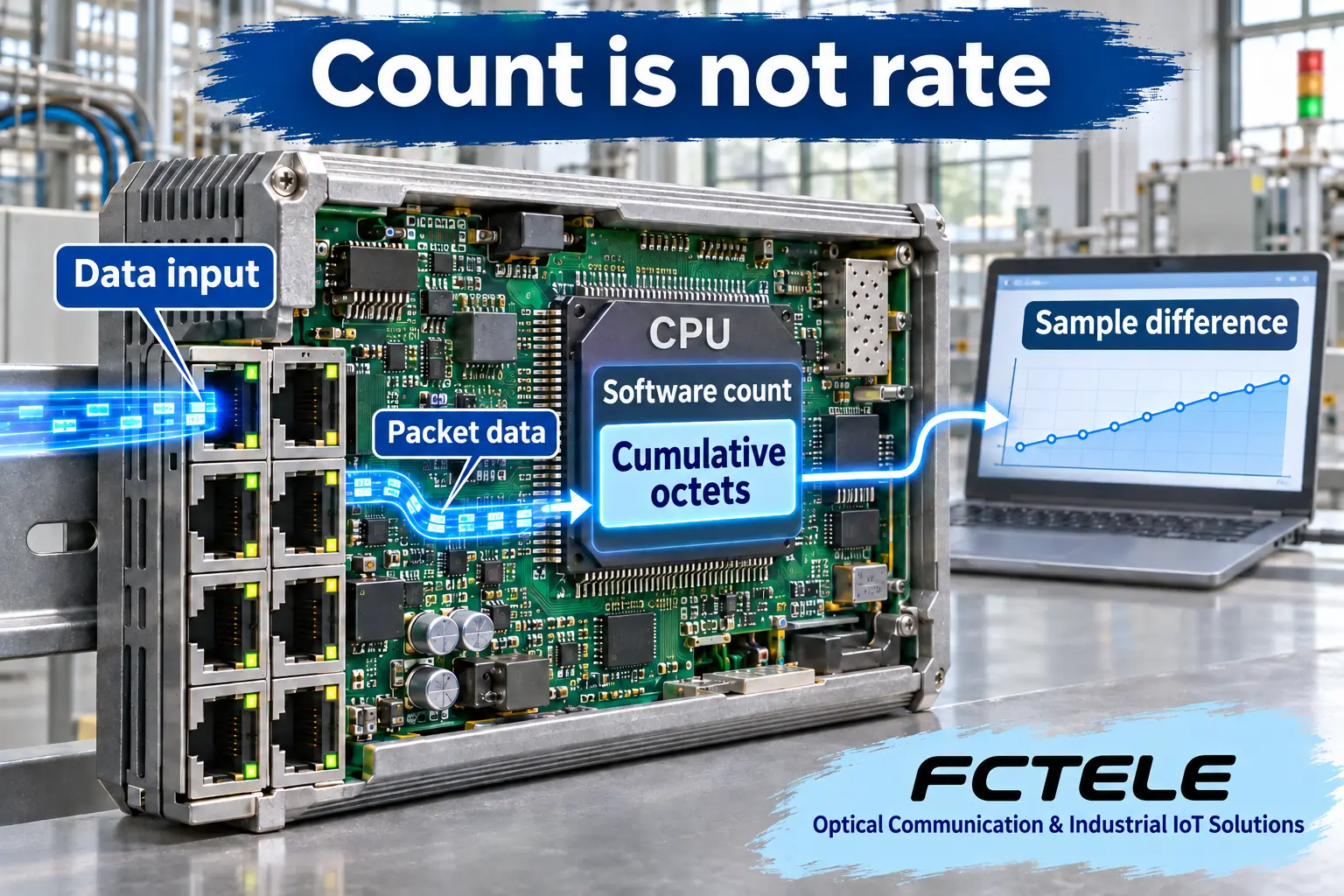
01 · Count versus rate
Read the same cumulative object at two valid times. Its increase divided by actual elapsed time gives a window average, rather than an instantaneous rate.
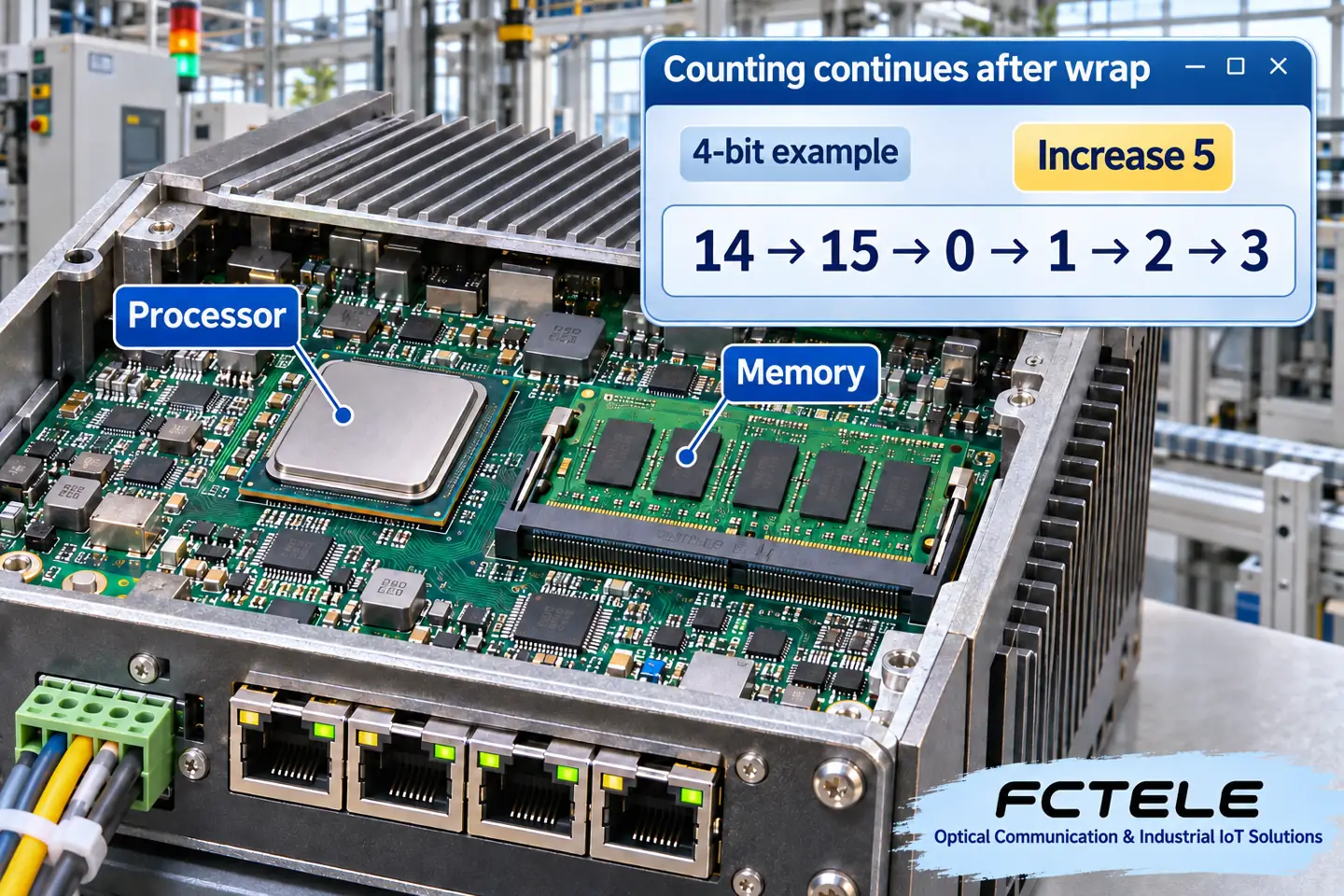
02 · A finite counting cycle
This four-bit teaching example increases by five. The same endpoints can hide an extra full cycle; infer the increase only with continuity and a bound below one cycle.
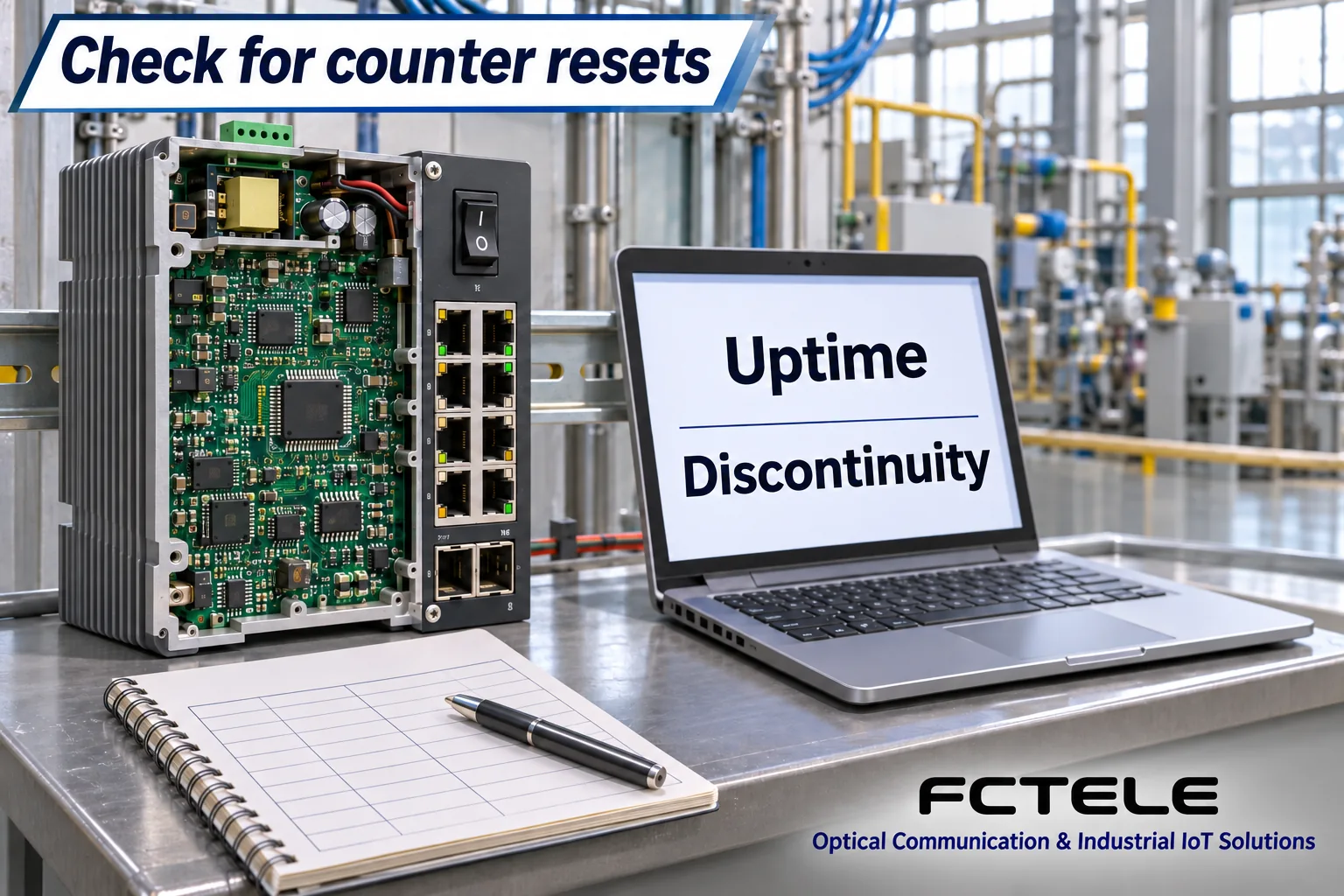
03 · A reset breaks continuity
Check interface identity, uptime and available discontinuity evidence. Do not join an unexplained reset to the previous sequence or replace every negative result with zero.
Identify the object
Save interface identity, direction, units and the returned counter type.
Retain timing evidence
Compare successful sampling timestamps, missing samples and discontinuity information.
Validate the interval
Establish continuity and a growth bound; otherwise preserve a gap and start a new baseline.
Selection and verification checklist — expand
| Check | What to confirm | How to verify |
|---|---|---|
| Object | Same interface and units | Retain object identifier and returned type |
| Continuity | No unexplained reset | Compare uptime, logs and supported discontinuity objects |
| Sampling | Growth below one full cycle | Use actual successful intervals and a justified growth bound |
An industrial switch continues forwarding, but the monitoring graph suddenly shows a negative value or an unexpected trough. This does not necessarily mean a link failure. A platform often reads cumulative octets, compares successive samples and calculates an average rate. When a finite counter reaches its limit and resumes from zero, ordinary subtraction can become negative. Distinguish normal wrap, counter reinitialization and incomplete sampling before drawing a conclusion from the graph.
A cumulative count is not a rate
SNMP, the Simple Network Management Protocol, allows a manager to read management objects. An interface octet counter reports an accumulated quantity, rather than the number of bits passing each second at that instant. A platform retains previous and current values and their sampling times, then calculates an average from the increase and actual elapsed interval. Octets and bits require different units and must not be mixed.
If the same receive counter increases from 1000 to 1600 over two seconds, with continuity and no wrap, the increase is 600 octets and the average is 300 octets per second. This describes the sampling window, not every instant inside it. Averaging can conceal a short burst that still affects queues or application latency.
Confirm direction, units and counting boundaries. Do not subtract an outbound counter from an inbound counter or combine packet and octet counts. Objects representing different interface layers can also have different meanings. Establish interface identity and the exact object before comparing samples, so a change in measurement scope is not mistaken for changing traffic.
How a finite counter returns to zero
Counter32 is an unsigned 32-bit counter type with a maximum value of 4294967295. Further increments wrap to zero and continue upward. This does not mean traffic travels backward or automatically indicate packet loss. Check the definition and returned type of the specific object, rather than guessing from a column heading.
For a visible teaching example, use a four-bit counter representing 0 through 15. Starting at 14, five increments pass through 15, 0, 1 and 2 before reaching 3. Ordinary subtraction gives negative eleven. If there has been no reset and the increase is known to be less than one full cycle, the increase can instead be understood as the distance to 16 plus the distance to 3: five. Four bits is an illustrative width, not a product parameter.
The condition matters: no additional complete cycle can be hidden inside the window. The same pair, 14 and 3, could also result from 21 or more increments. Two isolated readings cannot reveal the number of cycles. Even a current reading greater than the previous reading does not prove that no wrap occurred. Adding a constant only when subtraction becomes negative does not solve every undercount.
Match the sampling interval to counter growth
Faster growth leaves less history within the same width. At an assumed increase of 125 million octets per second, a 32-bit octet counter spans approximately 34 seconds per cycle. This assumes a counting rate; it is not a gigabit device throughput measurement or a claim that every protocol layer counts the same bytes.
A platform obtaining only one successful sample per minute could cross more than one cycle and fail to reconstruct the increase from two values. Consider timeouts, retries, scheduler delays and temporary loss of communication as well as the configured polling interval. A fixed setting does not guarantee the same actual interval between every pair of saved samples.
Shorter polling can reduce ambiguity but adds management requests and processing load. Check for suitable high-capacity objects, such as the interface extension table’s 64-bit octet counters, and confirm support across protocol version, permissions, objects and platform parsing. Sixty-four bits is still finite, and it does not repair resets or wrong-interface samples.
In the four-bit example, if each of the five increments represents one octet and the valid samples are two seconds apart, the average is 2.5 octets per second, or 20 bits per second. If 21 octets actually arrived, the final reading would be identical but the average would be 10.5 octets per second. Without knowing how many cycles occurred, simply adding one cycle cannot establish the correct result.
A smaller value can also mean discontinuity
Reinitialization of a device or management agent, recreation of an interface object, or another condition allowed by its definition can interrupt the sequence. Treating a new sequence as an ordinary wrap can manufacture traffic that never occurred. Separately verify whether a GUI statistics-reset action affects the SNMP object; CLI and management counters do not necessarily reset together.
Correlate uptime, startup or interface-change logs and available counter-discontinuity information. Standard interface objects include information for identifying discontinuities, but verify that the deployed device provides it and the platform reads it correctly. Uptime itself has a representation range: a decrease alone does not prove a reboot.
Preserve raw values and mark an unexplained interval unknown or invalid, then establish a baseline from new continuous samples. Do not replace every negative result with zero traffic to improve the graph’s appearance, or turn an incomplete interval into a definite outage. Both lose evidence needed for diagnosis and capacity planning.
Verify one unexpected trough from the raw samples
Record the device, interface identity, object name, returned type, raw values and sampling times. Confirm that both values refer to the same object and that interface numbering or collection templates did not change. Check missing samples, timeouts and the actual interval.
Retain the original returned value before floating-point rounding or signed-integer conversion. A platform that treats an unsigned cumulative value as signed may show a negative number before the standard counter has actually wrapped. Check acquisition and storage types before changing the device or applying wrap correction. Preserve sufficiently precise integers and timestamps, then use a consistent calculation to distinguish an object event from a platform-processing error.
Also distinguish the platform’s request time, the device’s counter snapshot and receipt of the reply. Network waiting and device update timing can introduce differences. Ordinary polling is not precision timing of every octet; average traffic does not establish the delay of each control packet. Use an appropriate observation method when detailed application timing evidence is required and keep those measurement purposes separate.
Next correlate operating state and discontinuity information to determine whether continuity and less-than-one-cycle growth are established. Only then calculate the cross-zero increase using the object’s width and convert it into an average rate. If the conditions are unknown, retain the gap and collect further samples. Compare the resulting trend with link state, error counters and application records. An unusual graph is a clue, not a replacement for checking whether service actually stopped.
FCTELE managed industrial-switch documentation lists SNMP and port-statistics capabilities as real deployment context. This article does not promise every model’s MIB objects, counter widths, refresh intervals or reset behavior. Retain model and firmware identity, object lists, collection configuration, exception-handling rules and validation records at handover. Customers should know both what a graph measures and which intervals cannot be reconstructed accurately.
Sources and scope
IETF RFC 2578: Counter32 and Counter64 · IETF RFC 2863: Interface MIB and discontinuity · Cisco: SNMP counter FAQ · FCTELE managed switch documentation (Chinese)
Four bits is an illustrative width. Verify the actual MIB, types, refresh and reset behavior.
Translated from the Chinese technical article: Read the original Chinese article.
Common questions
Does a smaller reading prove wrap?
No. Reset or object changes are also possible. Check continuity, interface identity and the actual sample interval.
Does adding one cycle always give the right increase?
Only when there was no reset and the interval increase is known to be less than one cycle. Multiple cycles cannot be reconstructed uniquely from two readings.
Do 64-bit counters eliminate every gap?
No. They extend the range, but resets, missing samples, access rights and interface identity still require correct handling.
Further reading
FCS and error counter diagnosis (Chinese) · SNMP management basics (Chinese)
