

CLASSICAL CAN / REMOTE REQUEST
Does an acknowledged remote frame guarantee data?
No. A valid remote frame asks for a data frame with an agreed identifier. Acknowledgment confirms valid reception by a node, not application handling by a particular source. The target still needs suitable receive matching and configured hardware or software response logic. Verify both ends and distinguish a genuine response from an existing cyclic message. These illustrations are conceptual, not measurements or wiring instructions.
01 · Request versus data
A remote frame requests data for an agreed ID. The later data frame carries the bytes; these example values do not define a product command.
02 · Reception versus response
Receive matching and response generation are separate. Check actual hardware or software support, configuration and application data.
03 · Arbitration at RTR
With identical format and ID at simultaneous start, dominant data RTR=0 defeats remote RTR=1. An internal request attempt is not a complete received frame.
Recover the frame
Record ID, format, RTR and DLC, keeping remote data empty.
Trace the target
Compare receive records, response configuration and pending transmission.
Separate observations
Keep ACK, internal attempts, bus frames and application results distinct.
Selection and verification checklist — expand
| Check | What to confirm | How to verify |
|---|---|---|
| Frame | Classical CAN, correct format and type | Inspect raw decoded fields at the target segment |
| Response | Configured hardware or software mechanism | Compare target logs and transmit queue |
| Forwarding | Both directions and filters | Test the delivered repeater version with agreed messages |
An analyzer shows a remote frame, and the sender reports no acknowledgment error. Why is the required instrument data still missing? In Classical CAN, requesting a kind of data, receiving a valid frame, and returning application data are separate events. A remote frame requests transmission using an identifier; it does not automatically turn the receiving device into a server with an answer ready. Diagnosis must follow the frame type, receive configuration, response logic and subsequent transmission, rather than stop at a communication LED.
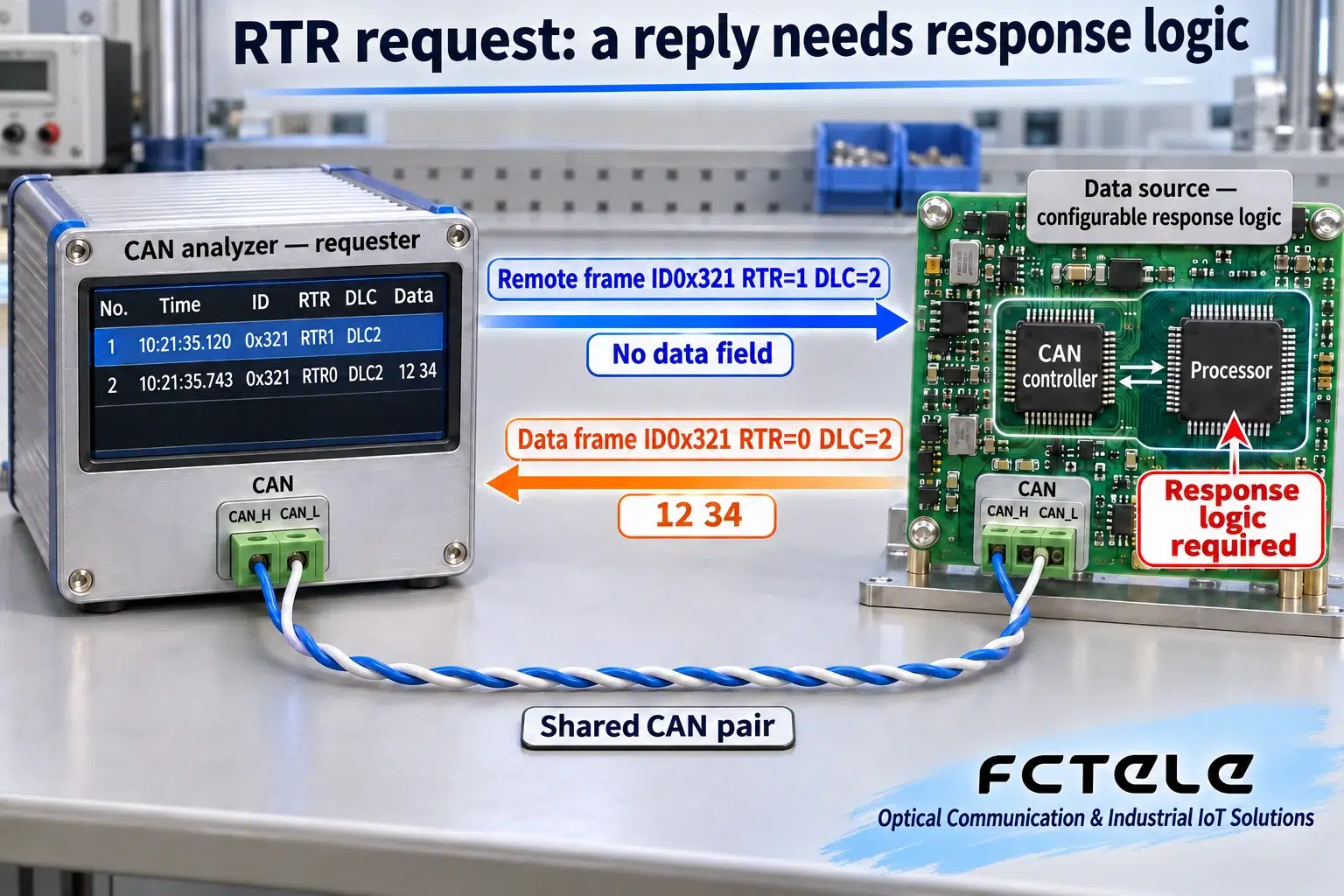
The remote frame requests data; a later data frame carries it
CAN devices exchange messages as frames. The identifier, or ID, participates in bus arbitration and is commonly used by an application to identify a class of data. It should not automatically be interpreted as a device address. In Classical CAN, the Remote Transmission Request bit, RTR, is dominant logic 0 in a data frame and recessive logic 1 in a remote frame. Check the format and RTR before deciding whether a record carries data or requests it.
Consider a hypothetical 11-bit standard-frame system where both sides associate ID 0x321 with a status value whose response has two bytes. The requester sends a remote frame with ID 0x321, RTR=1 and DLC=2. That request has no data field. A corresponding reply, if produced, is a separate data frame with ID 0x321, RTR=0 and DLC=2; only that frame could carry the two example bytes 12 34.
These identifiers, lengths and bytes are explanatory assumptions, not commands or measurement ranges for an FCTELE product. Their application meaning still requires the actual protocol. Do not fill an empty remote-frame data column with 00 00 and then treat those bytes as data transmitted on the wire. The remote frame and subsequent data frame are separate transmissions, each requiring an opportunity to use the bus.
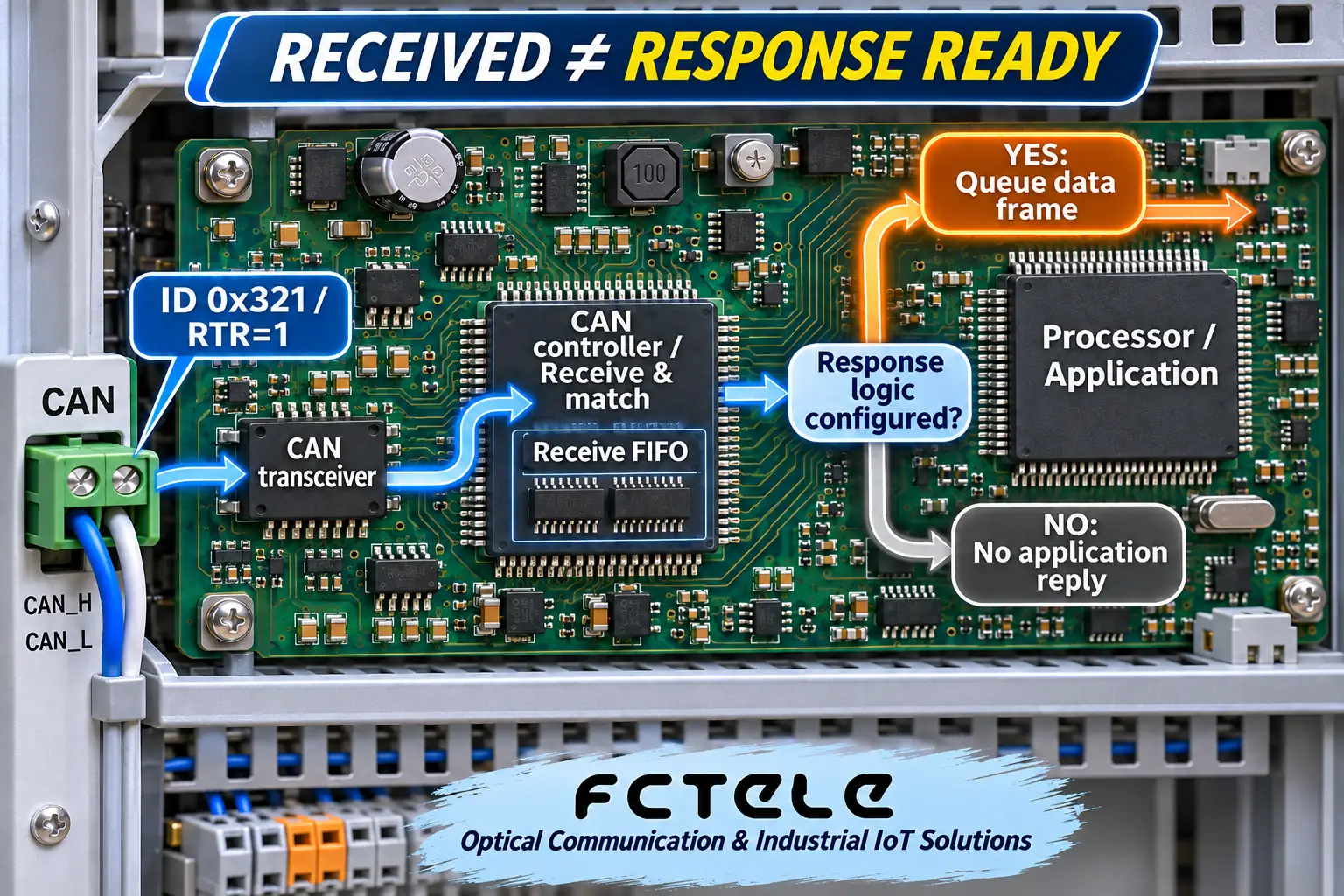
A valid-frame acknowledgment does not prove application handling
The CAN acknowledgment mechanism indicates that a receiving node correctly received the frame. It is neither a directed business reply nor proof that an actuator completed an action. A node can acknowledge a valid frame without passing that ID to its application. With other nodes on the bus, an acknowledgment at the sender is especially insufficient to identify the intended data source as the responding node.
Separate two questions: did the request form a valid CAN frame, and did the intended source receive and handle the request? Protocol errors and acknowledgment information help with the first. Target-side receive records, controller state or application logs are needed for the second. A requester-side screenshot saying transmission succeeded normally leaves the business response unproven.
A frame-level repeater adds another boundary: it can receive a message on one segment and transmit it again on another. An acknowledgment on the first segment does not prove that every filter allowed the request through, or that a matching source responded on the next segment. Bit-level transparent transmission and protocol-level forwarding operate at different layers; an LED on one side cannot establish the complete request-and-response sequence.
The target needs a configured mechanism that produces a reply
CAN defines the expression of a remote request. It does not choose the application variable, units or update policy for the answer. Some controllers offer a configurable remote-request response mechanism; other systems use processor software to receive a request and construct a data frame. Support, activation and the source of response data must be checked against the actual controller, driver and device protocol.
Trace a generic processing path: the transceiver presents bus states to the CAN controller; the controller identifies a valid frame and applies receive matching; configured hardware or application software then produces a pending transmit message. Allowing an ID into a receive buffer does not configure a corresponding transmit object. Equally, preparing a cyclic data frame does not establish support for remote triggering.
Filters may consider the ID, 11-bit versus 29-bit format, and data versus remote frame type. Two software displays showing 0x321 do not establish an identical match if one uses standard format and the other extended format. Write down the complete matching conditions instead of repeatedly changing only the ID until some data happens to appear.
If a device uses cyclic publication or a manufacturer-defined request command, the correct approach may be to consume its cyclic frame or issue the specified application command in a data frame. RTR is a Classical CAN request mechanism, not a universal read instruction implemented by every CAN device. A new cable or repeater cannot supply an application function absent from the target.
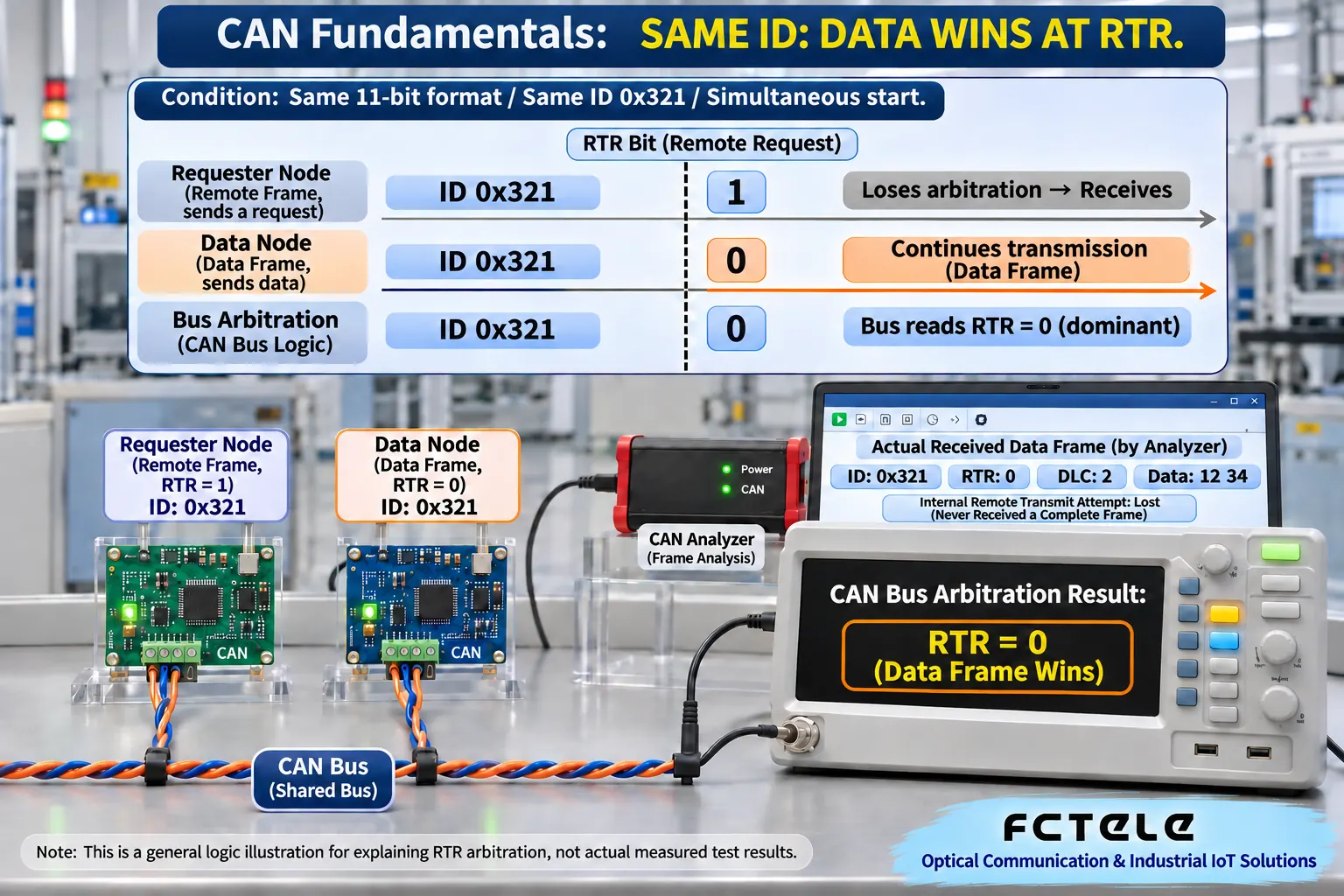
What happens when the request and data start together?
Two nodes can begin transmitting when the bus becomes idle. If they use the same 11-bit standard format and the same ID, but one requests data while the other already has the corresponding data frame ready, their identifier bits match and arbitration continues to RTR. The data sender transmits dominant 0; the remote requester transmits recessive 1. The dominant bus state prevails.
The requester sends recessive but reads dominant, so it loses this arbitration attempt and becomes a receiver while the data frame continues. This is not two complete frames appearing sequentially on the wire. A requester-side transmit-attempt log must not be mistaken for an analyzer receiving a complete remote frame. Distinguish an internal attempt from an actual decoded bus frame.
The result has specific conditions: identical frame format, identical ID and a simultaneous arbitration attempt. Different IDs may decide the winner earlier in the identifier field. Comparing standard and extended formats also involves their format-related arbitration bits. Do not generalize the phrase data has priority without checking these conditions. Align the start and relevant fields before locating the decision.
Collect records that distinguish different missing-reply cases
In an authorized test network, establish the expected frame format, ID, length and source node first. Save requester-side records together with target-side receive and transmit records. If tools do not share a synchronized clock, subtracting their timestamps cannot establish an accurate end-to-end response time.
If the target receives no matching remote frame, check wiring, bit rate, frame format and filtering. If it receives the request but creates no pending reply, investigate response support and application configuration. If it submits a data frame but no output follows promptly, inspect arbitration load, transmit queues and error state. Similar symptoms can therefore require changes at different locations.
Also determine whether nearby data belongs to an existing cyclic publication. A matching ID appearing shortly after a request does not by itself prove RTR caused it. Where test conditions allow, compare request enablement, cyclic behavior and target logs against the agreed response mechanism. Do not use the hypothetical IDs and bytes here as production control commands.
Repeater selection and protocol boundaries
The FCTEL FCC-1200-N1N1 addresses same-rate bit-level transparent isolation for Classical CAN. The FCC-1300-N1N1 provides message forwarding with independently configured rates, filtering and conversion. These products address connectivity or forwarding; they do not generate application answers on behalf of an endpoint. For remote frames, verify the delivered version’s forwarding, filter and conversion behavior, and test both request and response directions.
Distinguish Classical CAN from CAN FD before connecting equipment. Do not apply Classical CAN remote-frame rules directly to FD frames. Controller support, application response behavior and correct intermediate forwarding are three separate checks. Separating them turns a vague LED-on/no-data complaint into a cause that can be independently verified.
Sources and product documentation
NI: CAN Frames · Analog Devices AN-1123: CAN Implementation Guide · FCC-1200-N1N1 · FCC-1300-N1N1
Translated from the Chinese technical article: Read the original Chinese article.
Common questions
Why is the data column empty when remote DLC is 2?
A remote frame has no data field. DLC describes the requested data-frame length; the two bytes belong in a later corresponding data frame.
Does ACK prove the intended device will reply?
No. ACK concerns valid-frame reception. It does not prove that the intended application received, handled or answered the request.
Can a repeater create a missing RTR answer?
No. A repeater provides connectivity or forwarding. The endpoint still needs response support and configuration, and both directions need verification.
Further reading
Transparent versus protocol CAN repeaters (Chinese) · CAN bit stuffing (Chinese)
