


DHCPv4 / LEASE LIFECYCLE
Why can LINK stay up after the address expires?
The physical link and the software lease are separate states. A client first seeks renewal from its original server, then broadcasts for rebinding if needed. The old address remains usable until expiry unless another condition invalidates it. Compare client state, captures and server records before blaming a periodic application outage on DHCP.
01 · Separate layers
A working physical link does not prove that the IP address remains valid.
02 · Follow the lease
With default ratios and no ACK, renewal starts before expiry; a missed T1 reply does not immediately invalidate the address.
03 · Correlate observations
Align clocks and client identity, then verify where a request or response was last observed.
Confirm the address
Record configuration mode, address and supported lease fields.
Trace both directions
Compare requests and ACKs at authorized capture points.
Prove recovery
Observe an updated lease and business transfer across renewal.
Selection and verification checklist — expand
| Check | Confirm | Verify |
|---|---|---|
| Timing | Actual lease, T1 and T2 | Client state and ACK options |
| Path | VLAN, relay and server | Matched captures and logs |
| Recovery | Address and application | Renewal plus reconnect test |
A serial server works after startup but becomes unreachable hours later while its Ethernet LINK light remains on. Besides checking serial wiring and TCP, check whether its IP address is still valid. DHCP, the Dynamic Host Configuration Protocol, supplies an address and network settings for a lease period. A client tries to extend that period; failed renewal can eventually require it to stop using the address. Put acquisition, renewal and the application outage on one timeline before assigning a cause.

A working physical link does not prove a valid address
The Ethernet physical-layer circuitry exchanges signals with its peer and establishes the link. LINK usually describes that layer, rather than proving that the IP configuration, gateway, server and application session all work. The DHCP client is network software running on a processor. It maintains an address, its configuration source and timer state. The lease can therefore expire while the cable remains connected and the physical link stays up.
FCTELE’s Chinese product page for a single-port RS232/RS485 serial server lists DHCP and TCP Server and TCP Client networking capabilities. Once serial data enters an IP network, its delivery depends on network addressing as well as serial settings. This article explains generic DHCPv4 behavior; it does not establish the model’s lease length, firmware implementation or available status fields. Check those against the exact product and firmware documentation.
A lease is not a timer attached to every Ethernet frame. A switch may continue forwarding frames even when a device may no longer use its former IP address. Conversely, an application outage does not prove lease expiry. Power problems, port losses, duplicate addresses and a server closing a connection can look similar. A failure repeating every few hours is a clue to investigate, rather than a diagnosis.
What is exchanged when the address is acquired?
A client without a usable address normally starts with DHCPDISCOVER. A server can propose configuration in DHCPOFFER; the client selects an offer using DHCPREQUEST, and DHCPACK confirms it. The four message names are often abbreviated DORA. This is a protocol exchange establishing configuration, rather than an arbitrary broadcast becoming an address. Receiving an offer alone does not complete usable configuration.
In a capture, the transaction identifier, xid, and the client identity help correlate requests and responses. DHCP options also carry message type, server identification and lease information. The address, subnet mask, gateway and DNS each serve different purposes; seeing an IP address is insufficient. Applicable address-conflict checks also matter. An address found to conflict cannot simply be treated as a normal working business address.
Discovery can reach a server in the broadcast domain. Across subnets, ordinary routing does not automatically deliver every broadcast to a DHCP server; a correctly configured relay is normally needed. VLAN membership, permitted links and DHCP Snooping trust policy can also affect requests or replies. Distinguish the client, Layer 2 forwarding, Layer 3 relay and server. Supporting DHCP does not mean every device allocates addresses.
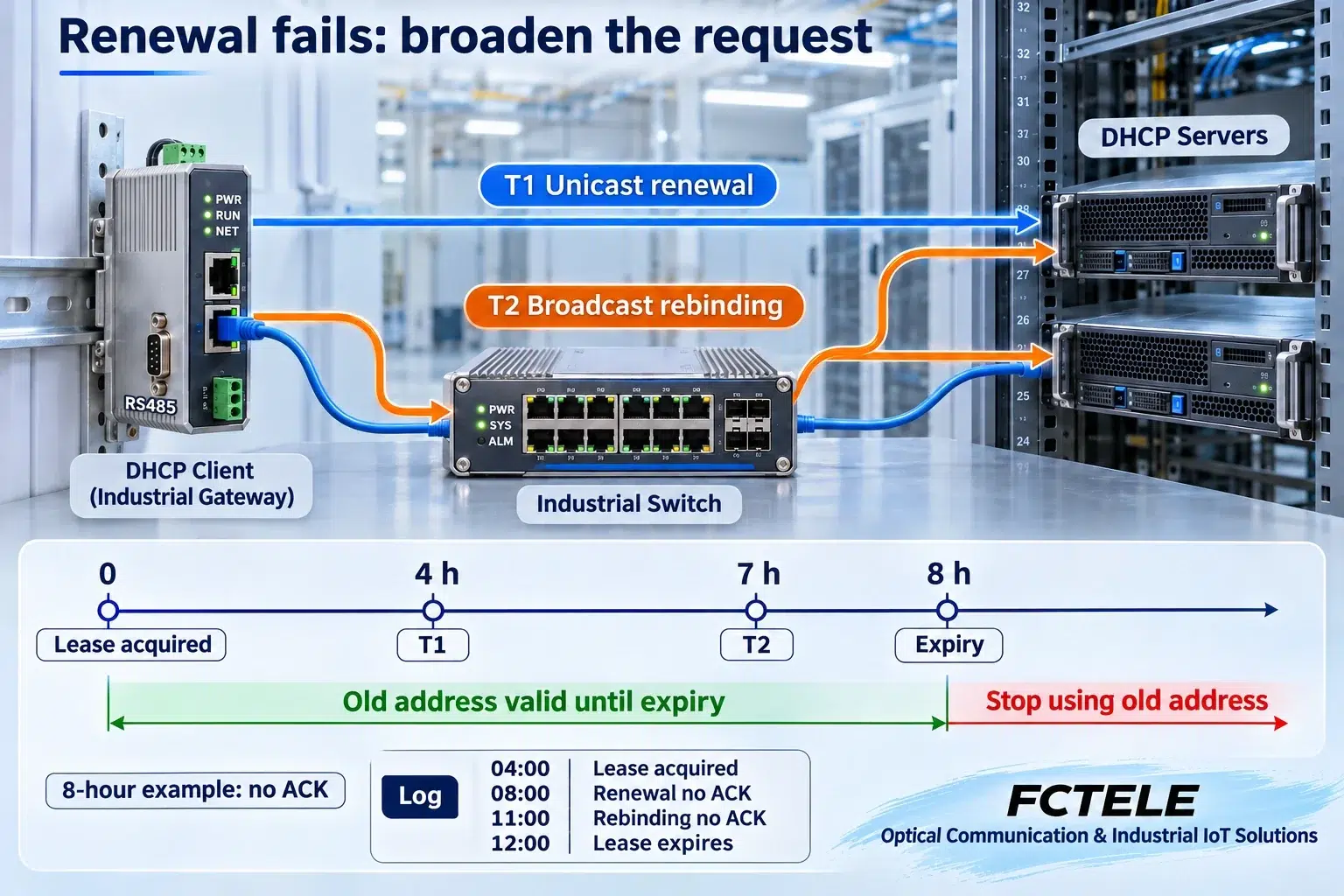
T1 and T2: contact the original server, then broaden the request
After obtaining a finite lease, the client attempts renewal at the specified time. At T1 it normally unicasts DHCPREQUEST to the original server, seeking to extend its existing configuration. A valid ACK lets it arrange its timers using the updated lease. A healthy network should not disconnect the application merely because T1 has arrived. A missed unicast reply does not immediately invalidate the old address.
If renewal is still unsuccessful at T2, the client enters rebinding and broadcasts a request to reach a server that can provide service. The request scope changes while the old lease still has time remaining. Default T1 and T2 values are approximately one-half and seven-eighths of the lease respectively, but the server can provide other values. These teaching ratios are not fixed settings for every FCTELE device. Successful renewal also starts an updated timing reference rather than continuing an obsolete failure timeline.
For a reproducible example, assume an eight-hour lease acquired at 04:00, default ratios and no later ACK. T1 is at 08:00, T2 at 11:00 and expiry at 12:00. The old lease remains valid between 08:00 and 12:00. If it cannot be extended before expiry, the client must stop using that address and return to acquisition. These are hypothetical teaching times, not field logs or product defaults. They do not imply that each phase sends only one packet.
Why can startup work while later renewal fails?
Acquisition and renewal may take different packet paths. Successful startup broadcast does not prove continued unicast reachability to the original server. Server migration, gateway changes or differences in access-control rules can become apparent during renewal. Whether the later T2 broadcast traverses the correct VLAN and reaches a suitable relay is another question. Yesterday’s successful acquisition does not verify today’s renewal path.
A request may reach the server while its reply fails to reach the client. Check address pools, lease bindings, client identity and network policy together. A server-side record does not demonstrate that the client received an ACK. If an explicit DHCPNAK rejects the configuration, do not keep reasoning as if the client will merely wait for the old lease to expire. Follow the actual state change and reacquisition.
Obtaining an address again does not automatically resurrect an old TCP session. A serial client that initiates connections must establish a new session. When a host connects to the serial server, it must locate the current address. A managed address reservation or a properly planned static address can help provide a stable business endpoint, while avoiding conflicts with the dynamic pool. A reservation still relies on DHCP exchanges; it is not a static configuration bypassing the server.
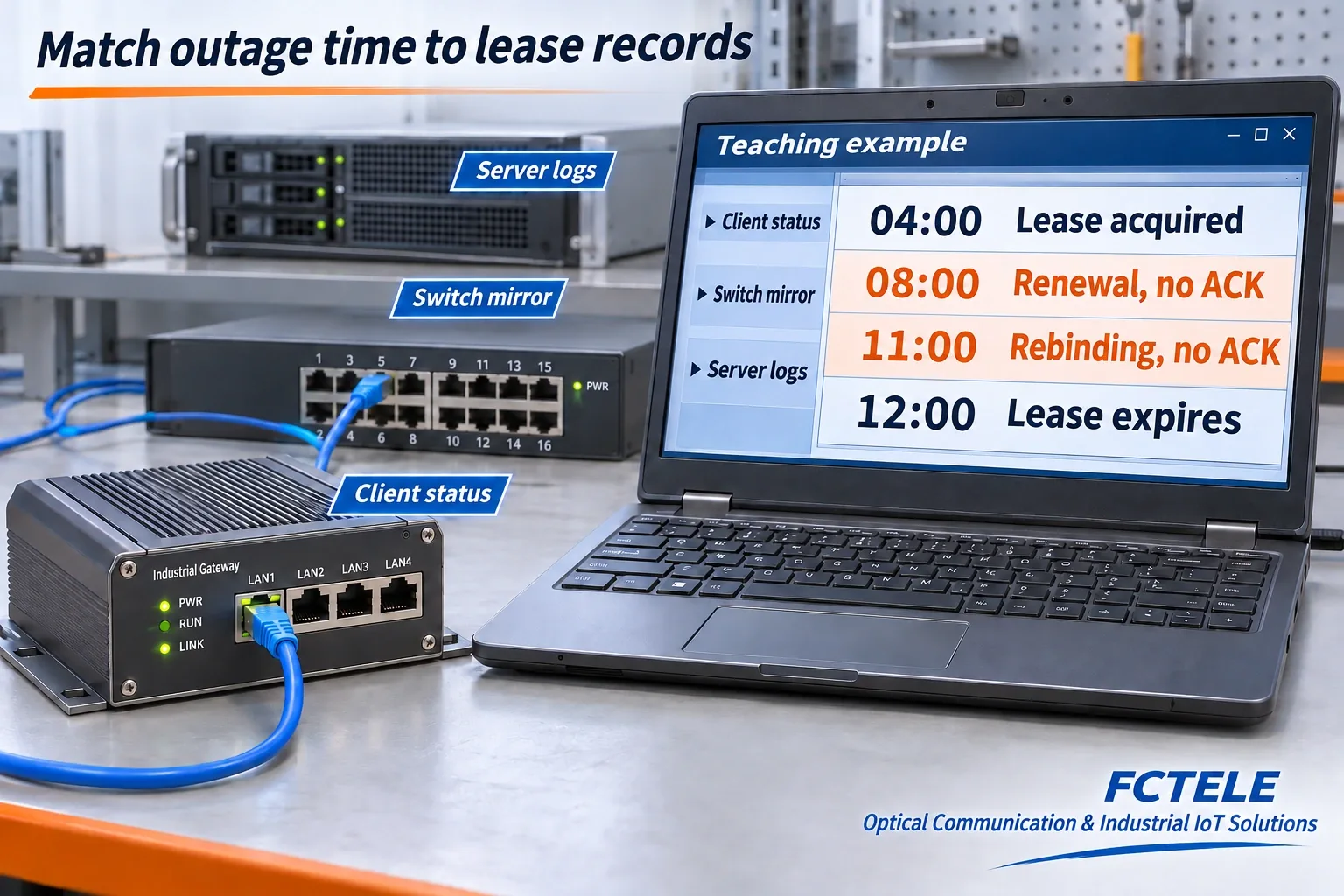
Correlate three observations through one complete incident
Save whatever the client exposes about its address, configuration mode, lease start and end, and state transitions. First establish whether address use really stopped. During authorized maintenance, observe client-side requests and replies through a supported switch mirror, and compare server logs. Verify mirror capability, capture direction and timestamp resolution for the actual devices. Do not inject forged DHCP messages or arbitrarily shorten production leases to provoke a fault.
Walk through the eight-hour example: at 08:00, was a Request sent to the original server, recorded there, and answered by an ACK that reached the client? At 11:00, did rebinding broadcasts appear? At 12:00, did the address state change? Align the three clocks or record their offsets. Transaction identity, client identity and observation location should support one another before a missing reply is assigned to a particular path segment.
After repair, verify across a genuine renewal point rather than accepting one successful ping after reconnecting a cable. Record a new ACK, updated lease validity, application reconnection and continued transfer. If the address remains valid but serial data is absent, return to serial reception, packetization and application behavior. Lease evidence explains the IP configuration lifecycle; it does not replace acceptance of the complete industrial communication path.
Also separate addressing from naming. A host connecting to an obsolete IP and a name resolving to an obsolete address are different observations. Record the device’s actual address, the host’s connection target and name-resolution results to distinguish lease, endpoint-location and naming issues. Restarting triggers multiple processes, so temporary recovery alone does not identify the failing one.
Record the VLAN at each observation point, which side contains the gateway, and the capture port. Broadcast visibility differs between locations. Not seeing a broadcast at the server does not prove the client never sent it. With these location conditions documented, the timeline becomes evidence another engineer can review.
Sources and scope
IETF RFC2131: DHCPv4 client states · Microsoft: DHCP basics · Microsoft: DHCP troubleshooting · FCTELE serial server documentation (Chinese).
Generic DHCPv4 behavior does not establish a product timer, firmware implementation or interface. Eight hours is a teaching value.
Translated from the Chinese technical article: Read the original Chinese article.
Common questions
Should business communication stop immediately at T1?
T1 alone does not invalidate the old address. Renewal occurs while lease time remains; explicit rejection or other faults require analysis of actual client state.
Does a reservation remove the need for the DHCP server?
No. A reservation is a server allocation policy; the client still obtains and maintains its configuration through DHCP. Static addressing is a different configuration.
Does recovery after restart prove a lease fault?
No. Restart triggers multiple recovery processes. Compare address state, requests and ACKs with application logs, then verify across a genuine renewal point.
Further reading
Serial server network settings (Chinese) · DHCP Snooping and trusted ports (Chinese)
