

Industrial Ethernet problems often come from bandwidth congestion, Layer 2 loops, link quality, power supply and the electromagnetic environment, as well as application timeout settings. A lit network light only shows the local connection status; it does not prove that the business service is reliable. Troubleshooting must separate the physical link, switch forwarding and the application, and use data to prove which layer has the problem.
Describe the problem first, instead of replacing the switch first
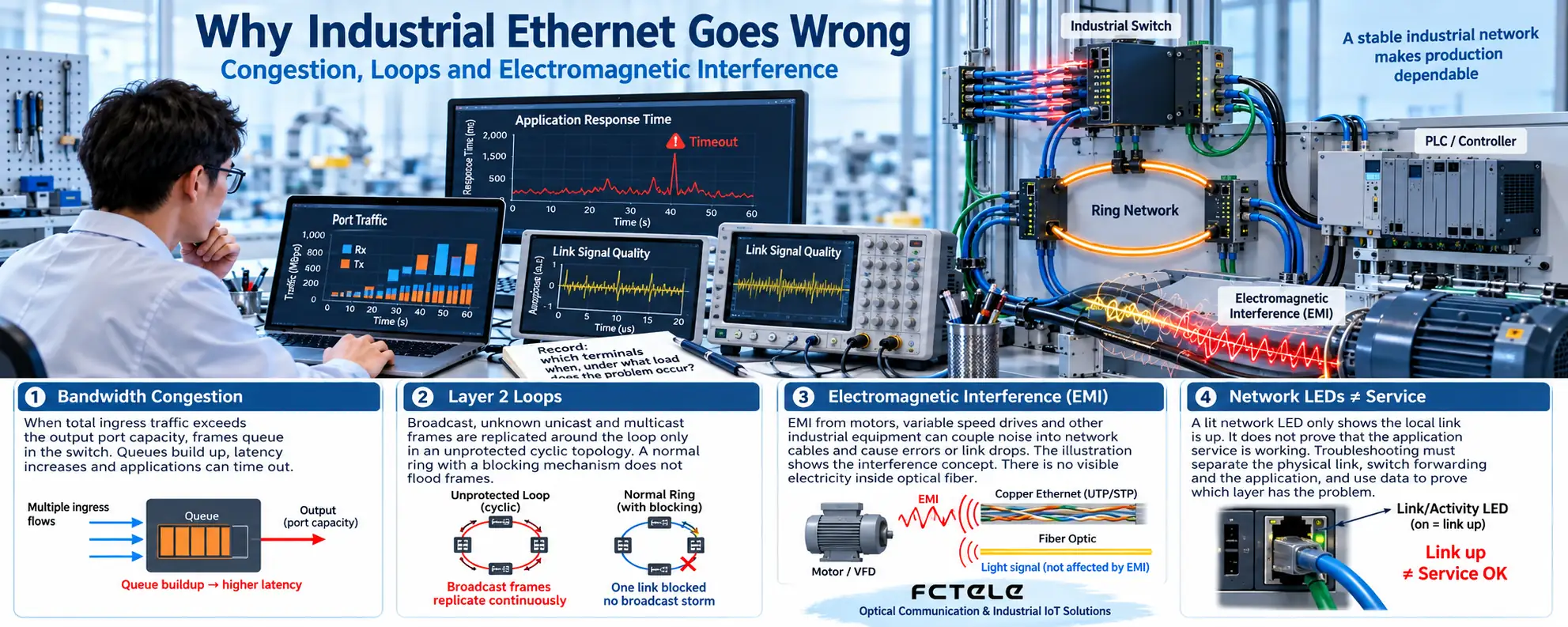
Record which terminals, at what time, and under what load the problem occurs: do all services stop together, is only video stuttering, or is one instrument timing out? These symptoms point to different fault scopes. When a fault affects multiple devices at the same time, pay attention to the shared uplink, power supply and central node.
Keep timestamps, port status and application logs to avoid losing key evidence after a restart. A single failed Ping cannot show that an entire switch is damaged; continuous successful Ping also does not prove that the control cycle, video recording or large file transfer meets requirements.
Congestion happens where traffic converges
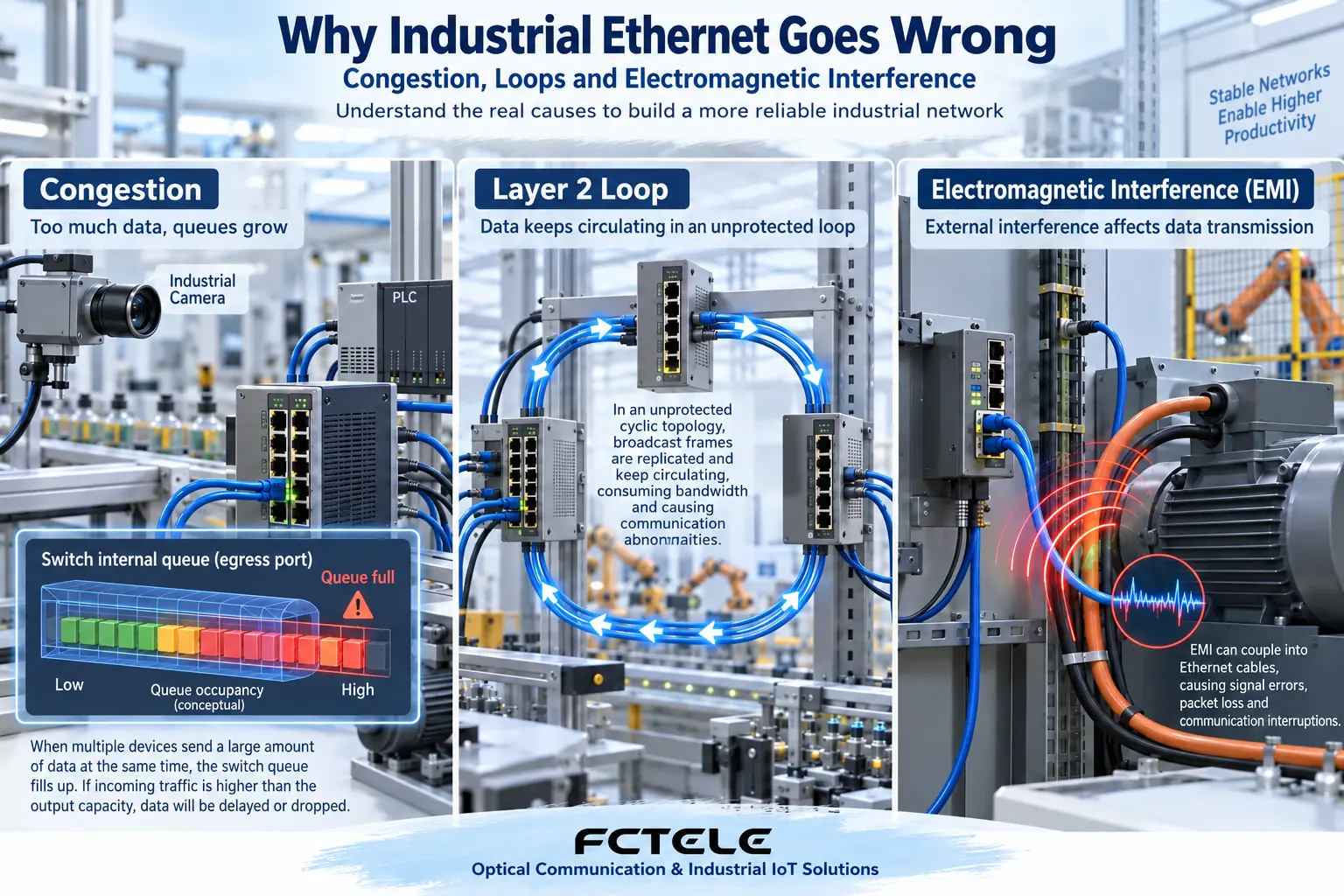
When multiple access ports send traffic to one uplink at the same time, and the instantaneous demand exceeds the serviceable capacity, queuing and even packet loss occur. Average traffic may not be high but bursts can still exist, so you cannot look only at the whole-day average. When video, backup and control share a path, check service concurrency and egress queues.
Priority helps arrange services according to policy, but it cannot create extra physical capacity. Before setting it, clarify the service requirements and observe actual latency and packet loss; do not mark all traffic as the highest priority, otherwise the distinguishing effect is lost.
Ring wiring does not mean redundancy is already in effect
A loop in a Layer 2 network may cause broadcast or unknown-destination traffic to be forwarded repeatedly, causing a storm. Backup physical links need to be managed by mechanisms such as spanning tree, ring networks or correct aggregation. Plugging in both cables does not mean the network automatically understands that they are backups.
Protocols, roles and port configurations need to be consistent with the topology, and private schemes also require confirming compatibility boundaries. Protection functions may control the scope of impact, but they cannot replace correct design. Do not casually connect a closed loop on a production network for testing; fault testing should be done in an isolated environment.
How link quality relates to the environment
Copper cable quality, loose connections, bending stress and on-site interference may increase errors or reconnections. Check port CRC, errors and link changes, and judge correlation together with power supply and the start-stop times of variable-frequency equipment; related symptoms still need further testing before the cause can be stated.
A fiber signal path can avoid some copper line problems, but the power supply, grounding and other copper ports at both ends are still affected by the environment. Fiber end-face contamination, loss and receiver overload also need to be checked. You cannot understand “fiber is used” as meaning the whole system is immune to interference.
Application timeouts are sometimes a problem outside the network
Device processing time, server load, serial port packaging and connection re-establishment all affect response. Compare actual request and response times, and check whether the application correctly frames, retries and handles exceptions. Normal switch forwarding does not mean the terminal can complete the command in time.
Repeated sending of control commands especially needs caution; after the network recovers, residual or retried commands may cause repeated operations. The application should determine idempotency and confirmation methods, and should not rely on the switch to automatically understand business semantics.
Build an evidence chain for layered troubleshooting
First keep a baseline, then check power and links, then analyze forwarding, traffic and errors, and finally check application timing. Change only one key condition at a time and record the effect, so conclusions can be verified again, instead of changing many parameters and judging by feeling.
Delivery should keep topology, port tables, configurations, load tests and recovery records. You can refer to Industrial switch selection methods Turn the discovered problems into clear requirements, and do not use unproven promises such as “industrial-grade must not lose packets.”
Translated from the Chinese technical article. Source first published: 2019-08-21. Source last revised: 2026-10-13T22:35:50+08:00. Read the Chinese source
