


FCTEL Original Technical Article · FCTEL Technical Team
First published: 2026-10-09 · Last modified: 2026-10-09
A switch port can stay up while an application still loses frames. The reason may be a short burst arriving faster than one egress can transmit. Flow control is a neighbor-to-neighbor request to pause new traffic for a moment. This guide explains the queue, the pause frame and the limits of the mechanism in plain English.
Open the original image for detail. Scroll horizontally to read the diagram labels at full size.
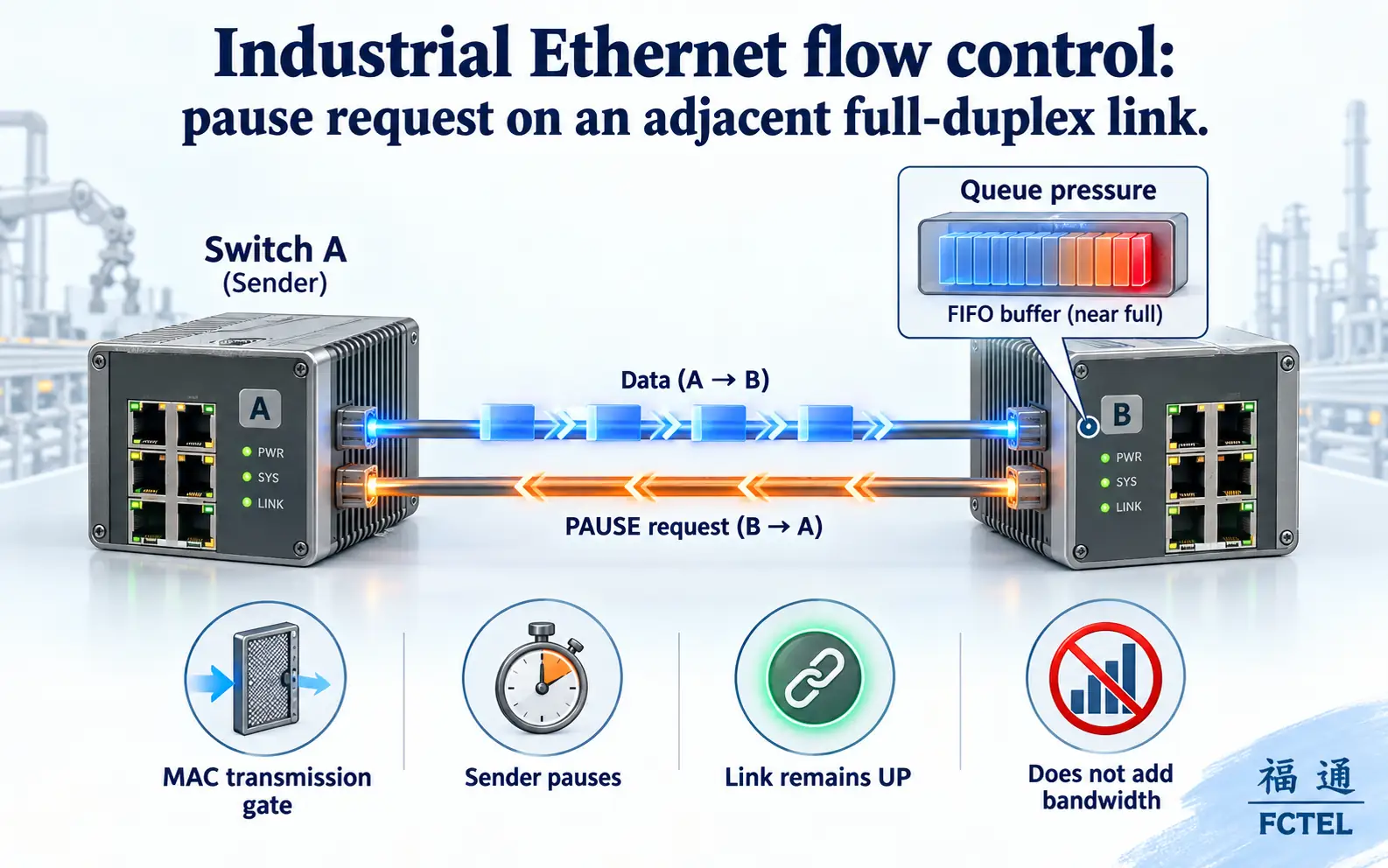
See congestion as an output queue
A switch does not always transmit a frame the instant it arrives. It reads the destination, selects an output and places the frame in a queue. Several inputs can briefly target one slower output, so the queue grows even when the long-term average is modest. When the queue is full, new frames are discarded. Flow control buys drain time; it does not make the link faster.
This is different from replacing a cable or adding bandwidth. A link fault, optical mismatch or duplex error cannot be repaired by a pause request. The mechanism only helps when both ends understand it and the link is full duplex.
How an 802.3x pause frame works
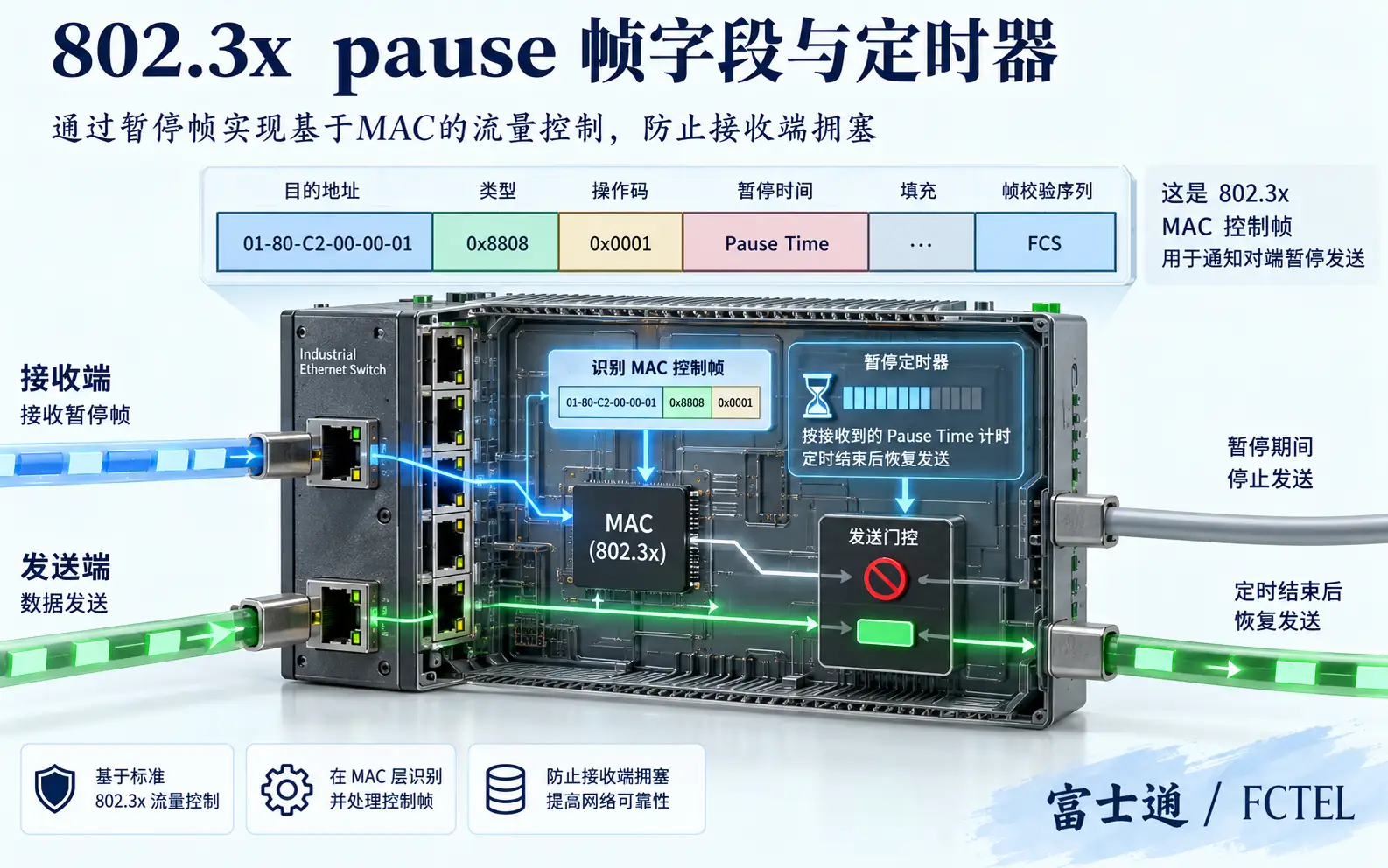
A receiver under buffer pressure sends a special MAC control frame to its directly connected sender. Type 0x8808 identifies MAC control and opcode 0x0001 identifies the pause operation. A pause-time value tells the sender MAC to hold new traffic briefly while frames already on the wire finish.
The timer is a device counter, not a promise of a fixed number of seconds. It counts down according to the implementation clock, then transmission resumes. A receiver may send another request if pressure remains. Field names and units must be checked in the model manual.
The frame affects one adjacent full-duplex link. It does not perform end-to-end scheduling, change an IP address, repair fiber or reorder application messages. A peer that does not support or enable receive flow control may ignore it.
Open the original image for detail. Scroll horizontally to read the diagram labels at full size.
What changes in an industrial topology
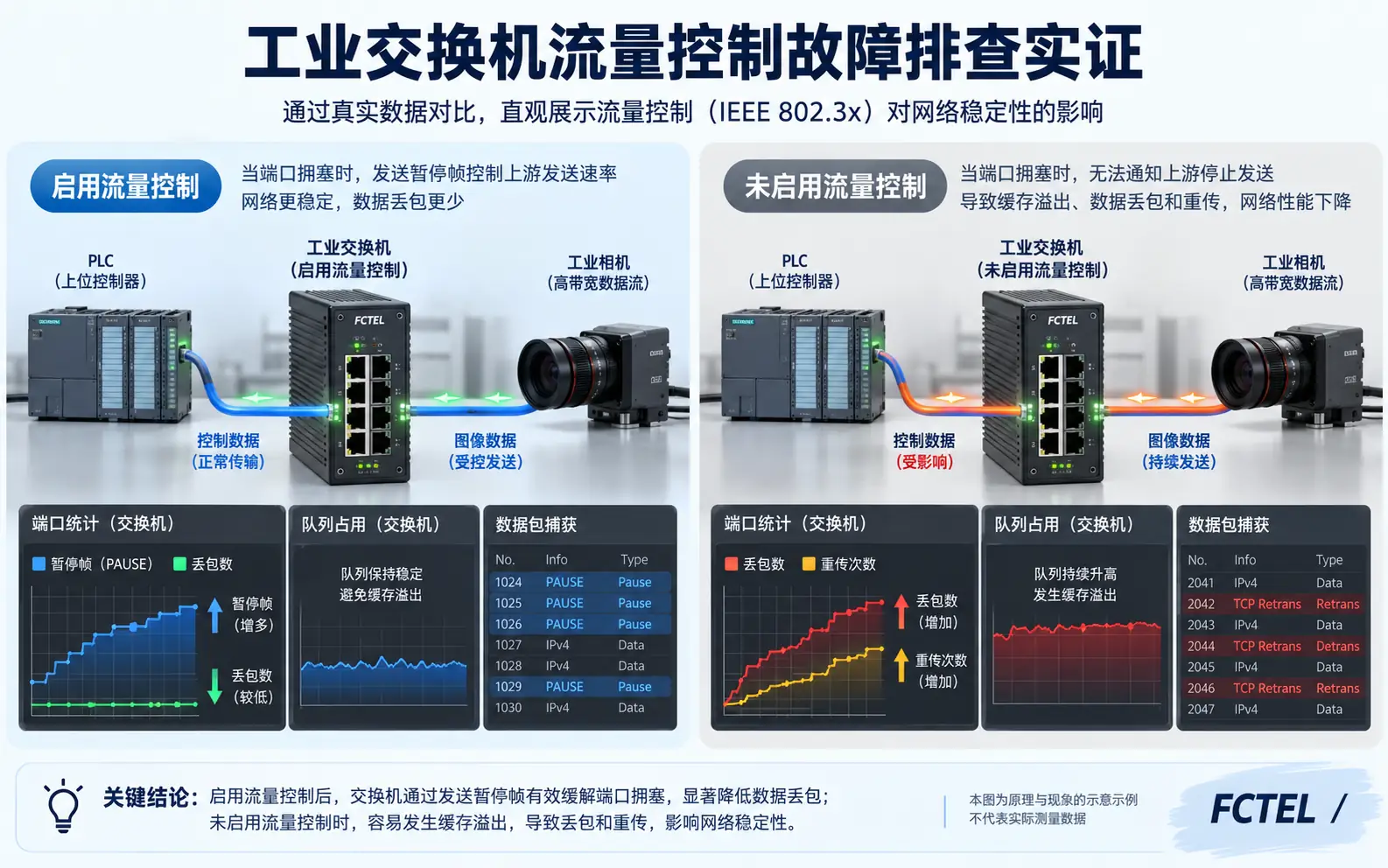
PLC, camera and uplink traffic can meet at one congested egress. The receiver sends a pause request to its neighbor, which gates new traffic in that direction; other uncongested ports can continue. If pressure moves upstream, the effect can propagate as backpressure. Drops may fall, but control traffic can wait longer.
Flow control is therefore a design choice. Check priorities, queues and port rates for a mixed control, alarm and video network. FCTEL product documentation lists port flow control, storm suppression, statistics, VLAN and mirroring on a managed industrial switch; the exact pause behavior must be confirmed for the chosen model and firmware.
A fiber uplink does not change the logic: an SFP converts the signal, while the switch MAC still handles queues and control frames. Draw every hop and direction before deciding where a pause request can travel.
Open the original image for detail. Scroll horizontally to read the diagram labels at full size.
Troubleshooting without a formula sheet
Check speed, duplex and the electrical or optical medium. Then compare egress drops, queue state and pause-frame counters over the same test window. A capture should confirm direction and fields. If pauses rise while drops fall, the system is trading time for buffer space; if pauses are frequent and control response slows, find the burst source or downstream bottleneck.
Separate control messages that must arrive promptly from monitor traffic that may wait and ordinary data that can be retransmitted. Do not disable flow control or unplug a live production line casually. In an approved window, record counters, application response and recovery before and after the change.
The key questions are: which egress filled first, who requested the pause, which direction did it travel, and did the control service remain within its acceptance target? Evidence is more useful than a single green link LED.
Technical references: RFC 826: Ethernet address resolution. Related FCTEL resources: Technical Articles and industrial switch product documentation (Chinese).
