


Choosing an industrial switch is not just about asking “aluminum case or steel case.” The enclosure must carry the device, transfer heat out, protect the ports, and work together with the mounting and grounding plan. Material is only one factor. This article focuses on enclosure structure and selection. Do not infer IP rating, communication speed, or network reliability from the appearance of the enclosure.
1. From chip to air, heat needs a complete path out
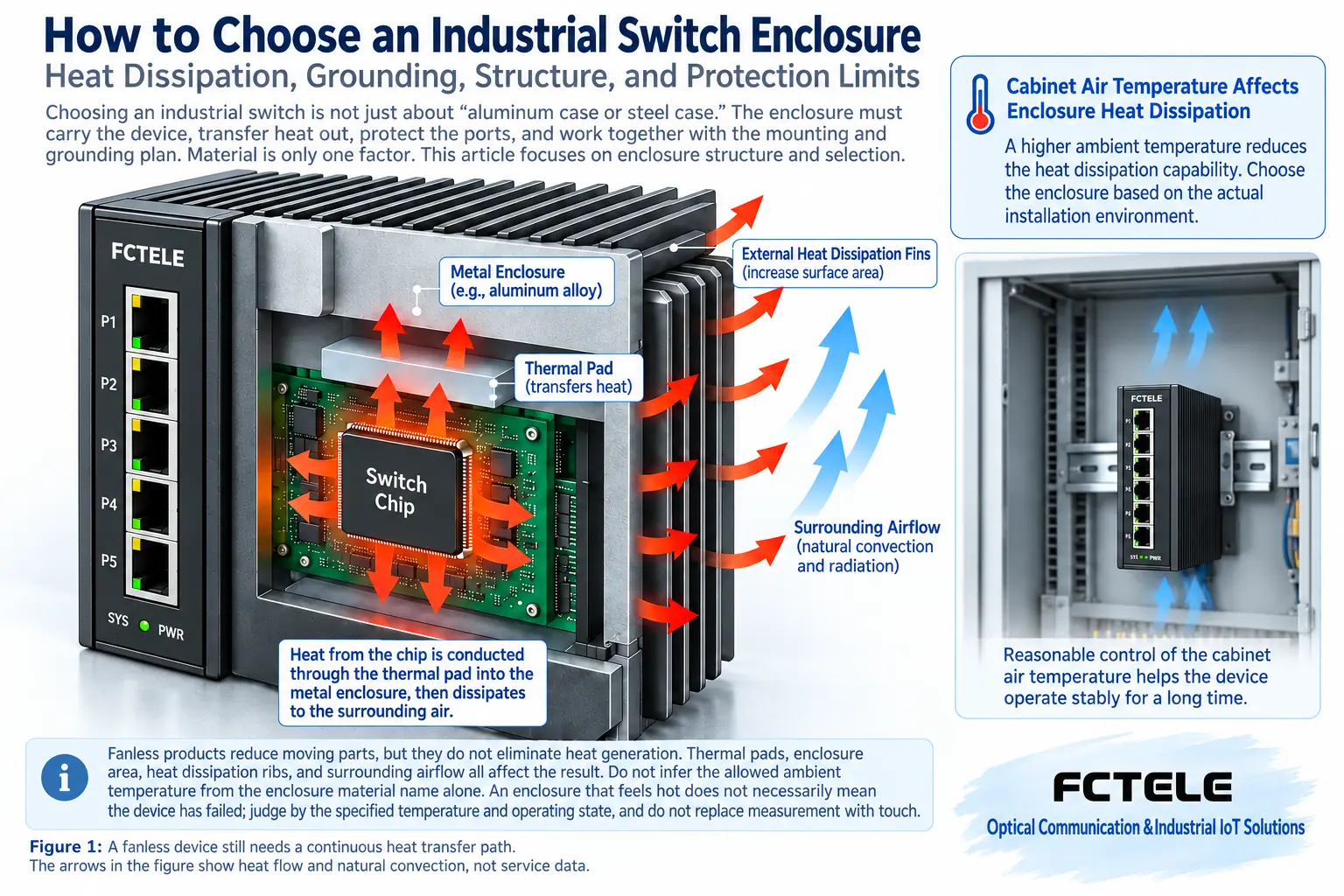
Switch chips, power conversion circuits, and power supply components generate heat when working. Heat first moves from the component to a thermal contact surface, then into the enclosure, and finally dissipates to the surroundings through convection and radiation. Fanless products reduce moving parts such as fans, but they do not eliminate heat generation. The contact of thermal pads, the enclosure area, heat dissipation ribs, and surrounding air flow together affect the result. You cannot estimate the allowed ambient temperature just from the name of the metal material.
Aluminum is often used for enclosures that balance heat conduction and weight. Steel structures can provide different mechanical and manufacturing characteristics, but actual performance depends on the design, thickness, connection method, and surface treatment. Mounting a very good metal enclosure tightly against a heat source, or covering the heat dissipation surface with an unsuitable box, can weaken the design effect. An enclosure that feels hot does not necessarily mean the device has failed; judge by the specified temperature and operating state, and do not replace measurement with touch.
2. Look at the mounting structure, not just the outer size
DIN-rail clips, wall-mount holes, and fasteners must match the on-site mounting method. Device weight, mounting surface stiffness, cabinet door movement, and vibration can all affect fastening reliability. After the clip is attached, check locking according to the manual. Do not let the device hang from network cables or power cables. Leave insertion and removal space and the allowed bend radius in front of the ports to avoid squeezing the plug when the cabinet door closes.
Cables should have independent strain relief: use suitable cable ducts, clamps, or fixing points to bear the pulling force, rather than letting the RJ45, SFP port, or power terminal bear the weight of the entire cable. Fiber optic cables must not be sharply bent just to make the cabinet neat; copper cables must not be crushed by cable ties. The wire diameter and tightening requirements that terminals can withstand must be checked in the model documentation. Too loose can cause poor contact, and too tight can also damage the structure.
Suppose a switch is installed in a cabinet that vibrates frequently. Even if the enclosure is very thick, mismatched clips and unsupported cables can still cause ports to loosen. During selection, the mounting accessories, vibration conditions, and cabling method should be confirmed together. Do not treat a “rugged enclosure” as a complete mounting solution. If vibration capability involves test levels, request the corresponding complete product report, and do not treat general marketing as proof.
3. How metal enclosures and grounding work together
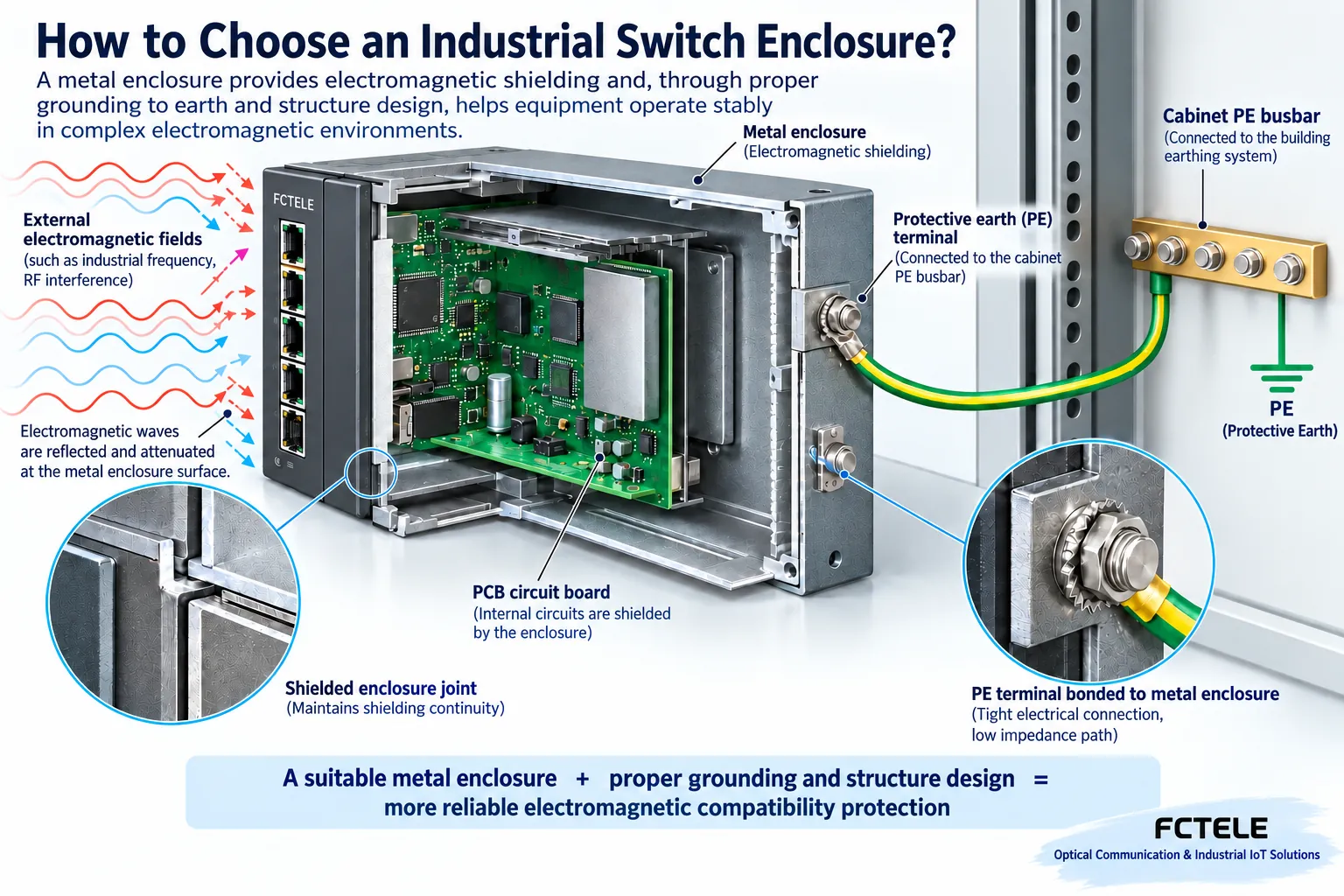
Electromagnetic interference can be conducted through cables or coupled as electromagnetic fields. A continuous conductive enclosure and reasonable port design can be part of a shielding structure, but seams, openings, and connection paths all affect the result. A metal box is not a universal shield. It cannot automatically eliminate all interference, and it certainly cannot guarantee protection from lightning strikes.
Equipment with a protective grounding terminal should be connected to the corresponding grounding system according to the manufacturer and on-site electrical codes. Protective grounding and signal ground are not two names that can be swapped at will. Do not treat any screw as a grounding terminal, and do not disconnect required protective grounding just to eliminate interference. How shielded cables are terminated also depends on the equipment at both ends and the overall system design. Do not apply an unconfirmed “single-end grounding” slogan to every scenario.
4. Protection and heat dissipation can constrain each other
Ventilation holes help air exchange, but they can also become paths for dust and water to enter. Sealed enclosures reduce some entry paths, but they need to remove heat through the housing or other means. Therefore, the protection rating cannot be directly inferred from “has holes,” “no holes,” or “is aluminum.” The IP rating should be based on the marking and report of the complete product. After installation, ports, seals, and openings are equally important.
If an ordinary switch is placed in a high-protection box, the internal temperature may be higher than the external environment. Power supplies, other equipment, and sunlight all increase the heat load. The box design must address waterproofing, condensation, and heat dissipation at the same time. When necessary, use a justified cabinet thermal management solution. Do not drill holes in a certified enclosure and still claim the original rating is unchanged. If the allowed humidity of the device states non-condensing, pay special attention to alternating hot and cold conditions.
Corrosive environments also require checking surface treatment, fasteners, and port materials. Problems caused by salt spray, chemical cleaning agents, and long-term moisture are not directly answered by a general IP rating. When choosing an enclosure, ask the supplier to explain applicable conditions, maintenance methods, and relevant test scope. Without evidence, do not describe any metal enclosure as corrosion-resistant or all-weather outdoor capable.
5. Beyond the enclosure, also check the actual service capability
Whether an industrial network recovers in time depends on the protocol, topology, fault type, and device configuration. It is not determined by the aluminum case itself. Absolute statements such as “all systems require less than ten milliseconds” in the original text should not be carried over. TCP/IP compatibility also cannot be summarized as guaranteed interoperability for all industrial applications; ports, rates, VLANs, and service protocols still need to be checked separately.
The Feichang Technology managed switch detail page lists fanless, DIN-rail or wall mounting, and IP40 information, which can be used as a reference for in-cabinet structural selection. That page also lists VLAN, logging, and ring network related functions, but these are capabilities in different dimensions and should not be derived from the enclosure. Specific port count, temperature range, power supply conditions, and accessories should be confirmed by the delivered model documentation. Do not treat one detail page as a guarantee for the entire series.
Before purchasing, it is recommended to list the mounting location, surrounding temperature, cabinet space, heat dissipation clearance, dust and moisture, vibration, and grounding requirements, then check the complete product structure and corresponding documents. After delivery, check whether fasteners, terminals, and the enclosure are deformed. After installation, check cable stress and cabinet door clearance. During operation, observe temperature and communication status. Acceptance is passed by installation, thermal management, and service together, not just by whether the enclosure looks nice and solid.
The valid reminders about materials, structure, and operating environment in 1555 and 2212 are merged into this article; they overlap with the main body of this article and are no longer kept as separate list items. The complete explanation of IP rating and the test boundaries of environmental adaptability are expanded separately, to avoid answering different questions with “industrial-grade enclosure” in one article.
Sources:Moxa industrial network reliability material;Feichang Technology managed switch details. The illustrations are generic mechanism diagrams and do not represent the internal structure or certification of a specific model.
Translated from the Chinese technical article. Source first published: 2019-11-25. Source last revised: 2026-10-13T17:34:48+08:00. Read the Chinese source
