


An industrial Ethernet switch is itself a type of network switch, not a device completely different from a network switch. It still forwards data according to Ethernet rules, and the industrial design mainly relates to the applicable environment, installation power supply, and maintenance conditions. When selecting a model, communication capability, site conditions, and management functions should be considered separately. You cannot infer just from the word “industrial” that the device is necessarily faster, safer, or able to translate all industrial protocols.
First clarify which two objects are being compared
Network switch is a broad name that can include devices used in offices, data centers, and industrial sites. Industrial switches are usually designed for specific site conditions, such as DIN-rail mounting, a corresponding DC power supply method, or a temperature range, but these capabilities are not the same on all models. Setting a broad category against one of its subcategories easily creates conceptual confusion.
A more meaningful comparison is to have two candidate devices face the same set of requirements: how many electrical ports and optical ports are needed, how large the actual traffic is, where it will be installed, how it will be powered, and who is responsible for maintenance. Office equipment may complete the same data forwarding task in a suitable environment; industrial equipment also cannot skip bandwidth and interface compatibility checks just because its enclosure looks rugged. The comparison should be tied to model and version, not product name.
How data frames travel through the two types of devices
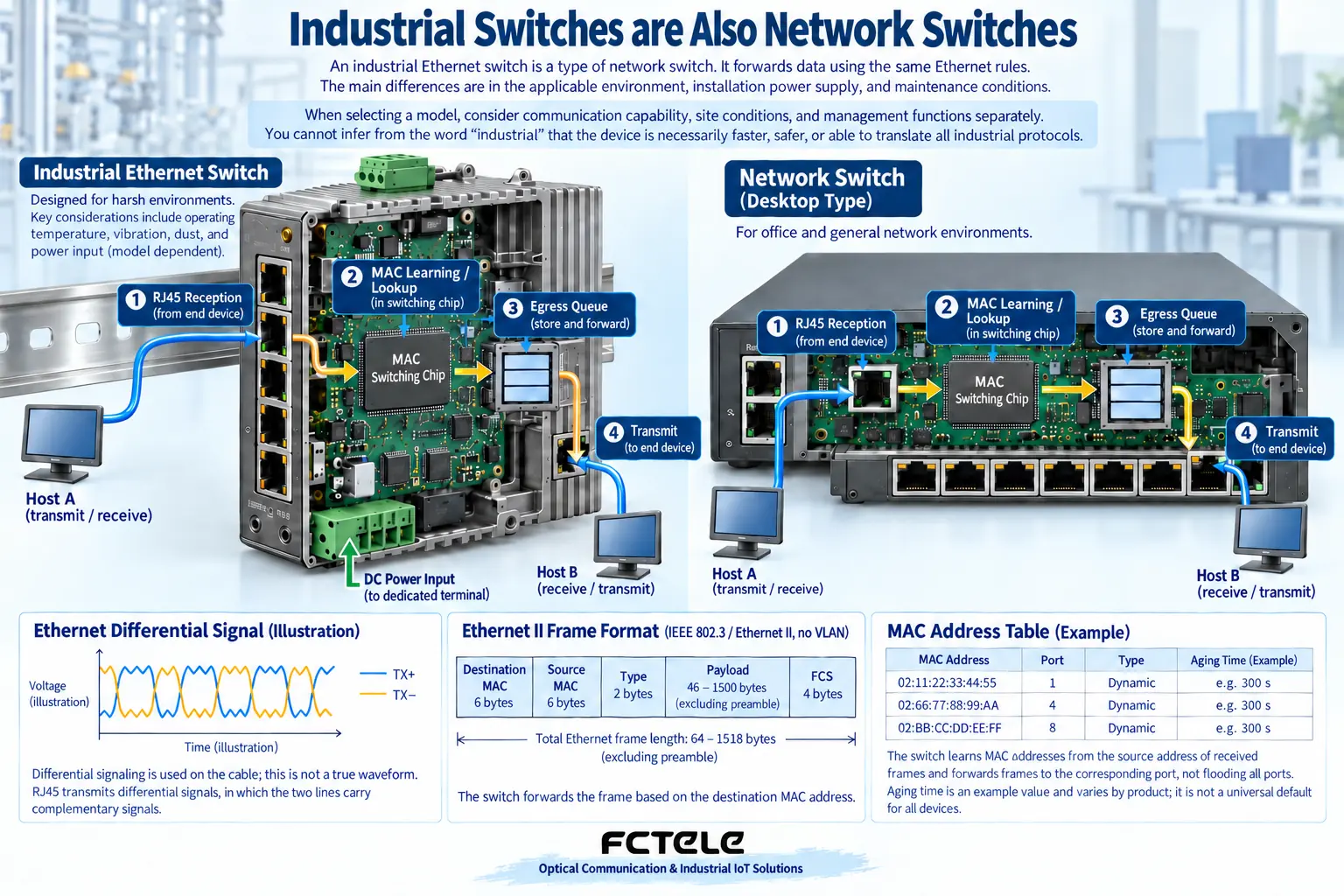
Ethernet data is usually organized into frames, which contain a source address and a destination address. A switch learns from the source MAC address of a received frame which port a device is located on, and then decides, based on the destination MAC, in which direction to send the frame. MAC can be understood as a link-layer address, but it is not the computer’s IP address, nor is it the asset number on the device enclosure.
When the destination address is known, the frame is usually forwarded to the corresponding port; when the destination location has not yet been learned, it is sent according to the rules to other permitted ports within the corresponding broadcast domain. Broadcast frames also have their own propagation scope. Industrial devices still follow these mechanisms; they do not read the factory process and automatically judge production instructions every time a frame is received. Whether a control protocol can pass through transparently and whether special functions are needed should be confirmed again according to the actual network requirements.
Full duplex does not mean it will never wait
Modern switched Ethernet often uses full-duplex connections, meaning that sending and receiving on the same link can occur at the same time. Under normal full-duplex conditions, the collision mechanism from the shared-medium era should not be applied to all faults. Slow network performance is not necessarily line collision; it is more likely that data from multiple ingress points needs to be sent out from the same egress point at the same time.
Suppose several cameras all transmit data toward the same uplink port. The uplink capability is limited, so the switch can only arrange for them to be sent one after another. Short bursts can be temporarily stored in the buffer; when the egress capability is continuously exceeded, queuing increases and packet loss may even occur. An industrial enclosure will not eliminate this mathematical limit. Port rate, aggregated traffic, and sustained load all need to be calculated; you cannot look only at the switch’s nominal internal total bandwidth.
Which site problems does the industrial attribute mainly solve?
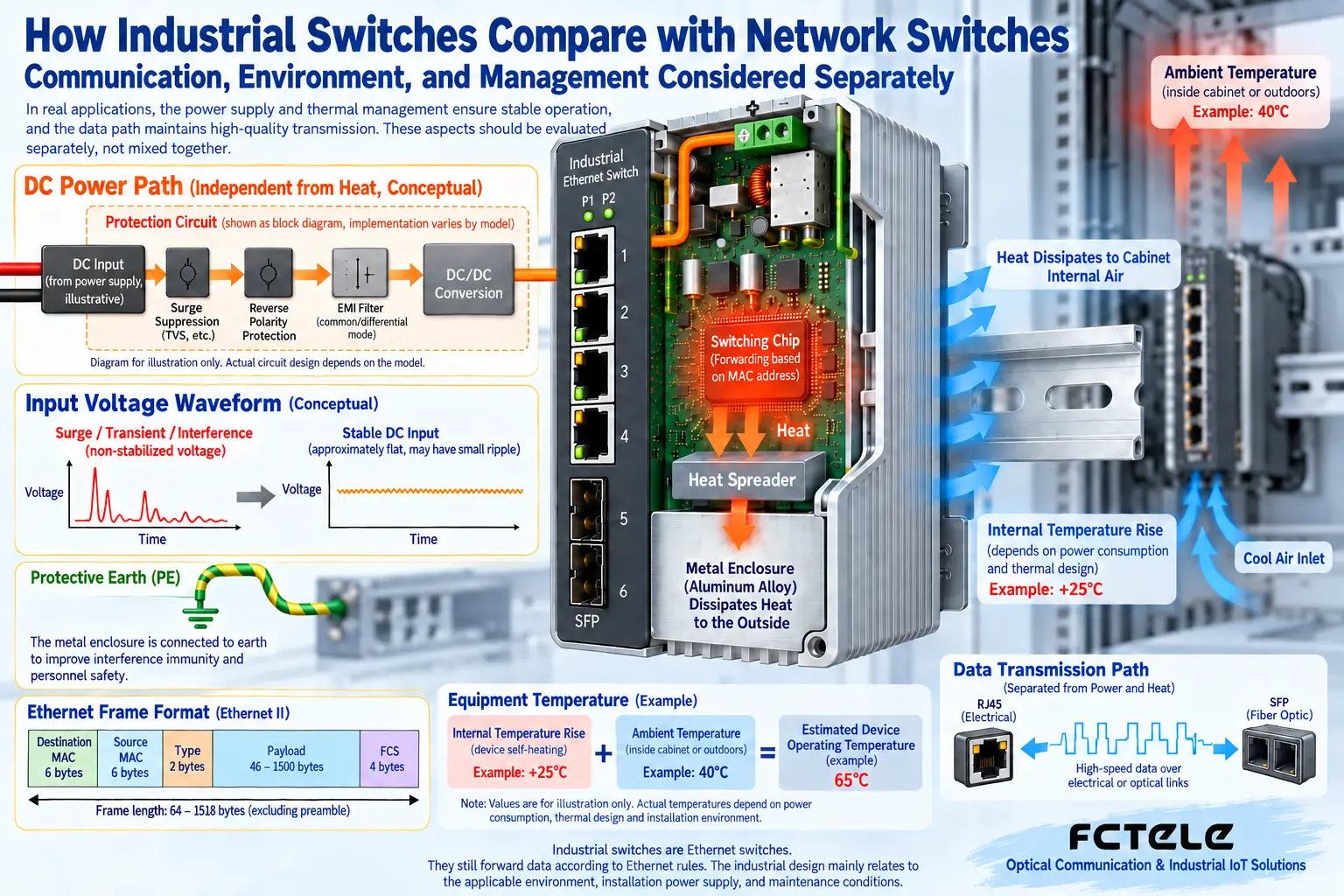
A control cabinet may have a relatively high ambient temperature, local heat sources, power supply fluctuations, or electromagnetic interference. Device selection requires checking the operating temperature, allowed power supply range, installation spacing, and corresponding test conditions. Wide-temperature design means operating under specified conditions; it does not mean that heat dissipation is unnecessary, nor does it mean that it can be installed in any sealed space.
Enclosure protection, vibration resistance, electromagnetic compatibility, and explosion protection are different indicators. A certain IP rating cannot automatically prove that it can be rained on, immersed in water, or used in a hazardous area; a certain electromagnetic compatibility description also cannot replace all site certifications. The data for the exact model and the applicable standards should be checked, and where necessary, a qualified cabinet, grounding, and power supply protection should be used together. Descriptions in general articles cannot be treated as guarantees for an entire product series.
Internal heat and external disturbance are different paths
Chips and power supplies generate heat during operation, and the heat needs to pass through the circuit board, enclosure, or air to the environment. The higher the external ambient temperature, the smaller the heat dissipation margin may be. A device without a fan still needs suitable heat conduction and air conditions; heat from other devices in the installation space will also affect it, so you cannot measure only the temperature in the room.
Power supply surges, grounding problems, and interference from nearby high-voltage equipment belong to other paths, and improving ventilation cannot replace electrical treatment. On site, power supply, wiring, and protection should be designed according to the device manual and electrical safety requirements. Optical fiber can prevent the fiber core itself from forming a conductive connection, but metal armor, power supplies, and cabinets may still be involved in electrical problems, so you cannot say broadly that there is no interference once optical fiber is used.
Managed is not the only form of industrial equipment
Unmanaged devices usually complete basic forwarding with less configuration and are suitable for scenarios where the requirements are clear and the functions are sufficient; managed devices may provide port observation, VLAN, spanning tree, or other management capabilities. Whether these functions can be supported depends on the actual model. You cannot assume that all industrial switches have them, nor can you directly equate being manageable with being capable of Layer 3 routing.
The Feichang Technology website separately lists unmanaged industrial switches and managed industrial switches. Taking the STP, RSTP, and corresponding power supply design explicitly listed in its managed model details as an example, these functions can support specified redundancy and maintenance schemes, but the ordering version and networking conditions should be checked. The reason to choose managed should be that the site needs the corresponding capability, not simply treating the number of functions as a measure of quality.
Redundant links and redundant power supplies solve different faults
An extra physical link can provide a backup path, but if ordinary Ethernet is directly connected into a closed loop, a broadcast storm may occur. Mechanisms such as spanning tree control which paths are allowed to forward and reconverge after a fault. Whether recovery meets business requirements needs to be considered in terms of devices, protocols, topology, and applications, and no promise should be made of zero packet loss or instantaneous recovery under all circumstances.
Dual power inputs, on the other hand, address power supply path problems. If the two inputs ultimately come from the same power source that is prone to failure, two sets of terminals do not equal a completely independent safeguard. Link backup also cannot solve damage to the terminal itself. The possible fault locations should be drawn out, different measures should be chosen for different risks, and authorized recovery tests should be arranged.
How should a control cabinet project make a choice?
Suppose several terminals need to be connected inside a control cabinet and connected to a control room via optical fiber. The first step is to confirm the terminal electrical port rate, uplink optical port compatibility, and actual business traffic. The second step is to check the maximum temperature inside the cabinet, power supply conditions, and installation space. The third step is to confirm whether error counters need to be viewed, services need to be isolated, or redundant paths need to be established, rather than first specifying that a certain marketing name must be used.
If basic forwarding and environmental conditions are both satisfied, a simple model may already be sufficient; if maintenance requires remote status viewing, or the topology requires spanning tree control, then a model supporting the corresponding functions should be selected. If the business is sensitive to interruption, a test method also needs to be designed, and the actual recovery performance recorded. The assumptions in the article only explain the selection order; they do not prove that a specific product has passed site acceptance.
Acceptance looks at the complete system, not just the device label
After installation, port negotiation, optical links, bidirectional services, and sustained operation performance should be confirmed. Check whether queuing packet loss occurs under high load, record environmental and power supply status, and verify the permissions and maintenance process for the management entrance. Disconnection and power-off tests for important networks should be carried out under authorized maintenance conditions, to avoid affecting production just to verify redundancy.
Finally, keep the device model, firmware, connection relationships, and test records. The value of an industrial switch lies in the design and capabilities that match site requirements, not in treating the industrial name as the answer to all problems. Only by asking the four questions of communication, environment, management, and recovery separately can an explainable and verifiable choice be made.
Verification materials:Ethernet working mechanisms;Feichang Technology managed industrial switches. The diagram explains general mechanisms and is not a wiring diagram for a specific model.
Translated from the Chinese technical article. Source first published: 2020-07-07. Source last revised: 2026-10-13T20:43:40+08:00. Read the Chinese source
