


“Why do some industrial switches have a five-year warranty while others have a three-year warranty?” This is not a question that can be answered just by looking at the housing or the operating temperature. A warranty is an agreement about after-sales responsibility and the scope of handling. Reliability is the ability of the device to keep working under specified conditions. Life involves component aging and maintenance. The three concepts are related, but they cannot replace one another. When buying and maintaining equipment, you should ask clearly about the service terms and also check the electrical, thermal, and environmental conditions the device actually withstands.
First, separate the term, scope, and handling method
Even if both say “five years,” you still need to check the applicable models, the start date, the proof required, how a fault is determined, and how after-sales handling is done. Repair, replacement, spare units, and response arrangements are not all automatically included by one word. You cannot treat “replace only, no repair” from an old article as a uniform promise for all current products, and you cannot assume that “industrial-grade” means the warranty period must be longer than that of commercial equipment.
The Feichang Technology mini managed four-copper-port, two-optical-port product page lists a five-year warranty statement. This is the product information provided on that page. When purchasing, you should write the specific supplied version, warranty scope, and handling process into a valid order or contract and confirm with after-sales. This is especially important when power accessories, optical modules, or different configurations are involved; you cannot infer on your own that they enjoy exactly the same conditions. This article discusses technical understanding and verification methods. It does not replace specific service agreements.
How does a switch work, and why does it generate heat?
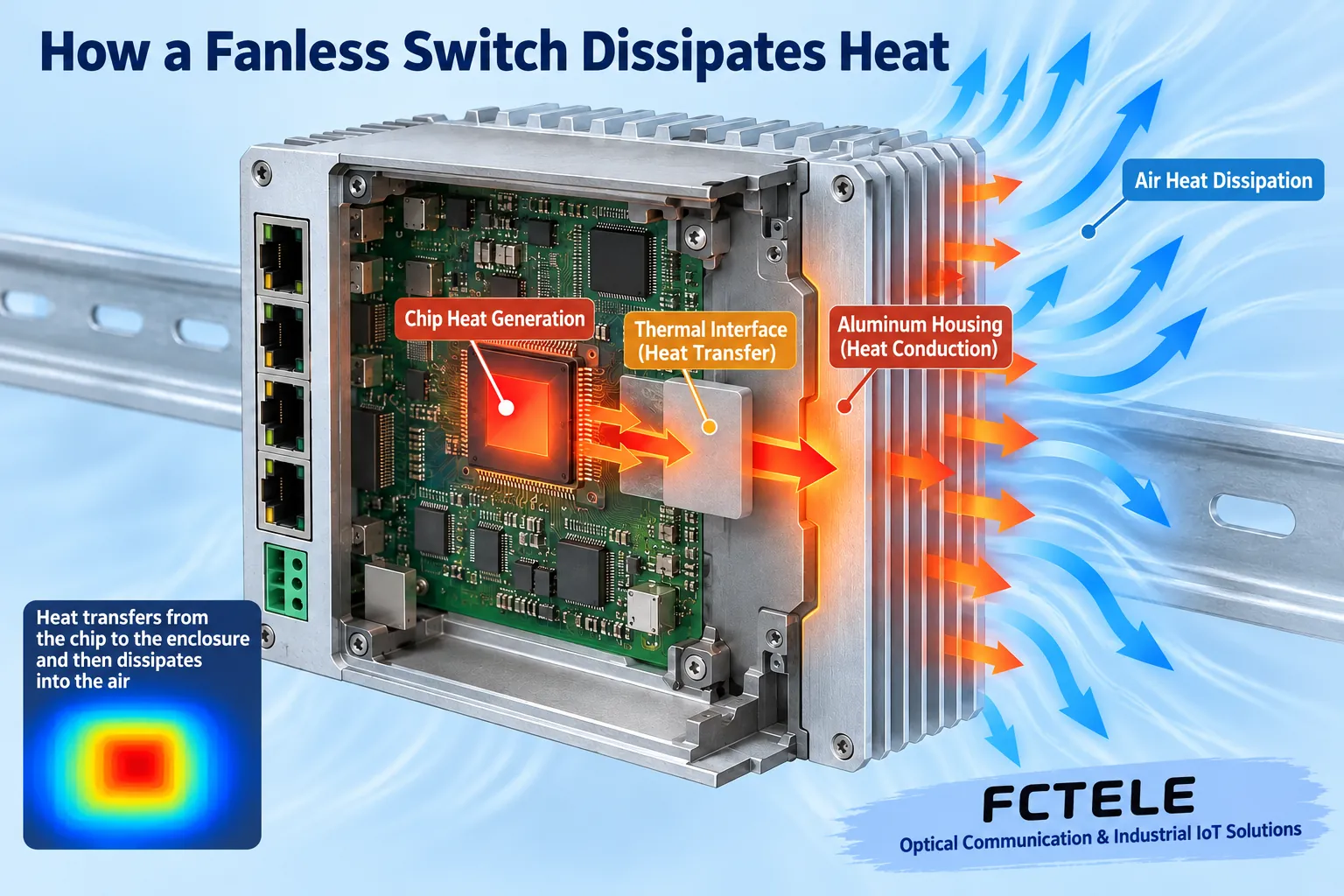
The ingress transceiver of an industrial switch recovers data from a cable or optical module. The switching chip looks up the egress. Packets pass through queues and are then sent to the next link. Chips, transceivers, and power conversion circuits consume electrical energy when working, and part of that energy becomes heat. A fanless device does not mean it produces no heat. Instead, it usually transfers heat to the surrounding environment through the circuit board, thermal interface, and metal housing.
The ambient temperature inside a cabinet and the chip junction temperature are not the same value. Cables piled around the housing, insufficient installation spacing, added heat sources inside the cabinet, or load changes can all alter cooling conditions. Even if a product lists a wide temperature range, it must still be used together with the specified mounting orientation, load, and power supply conditions. You cannot assume it will maintain the same reliability when placed next to any heat source.
Life is affected by actual stress, not determined by the word “warranty”
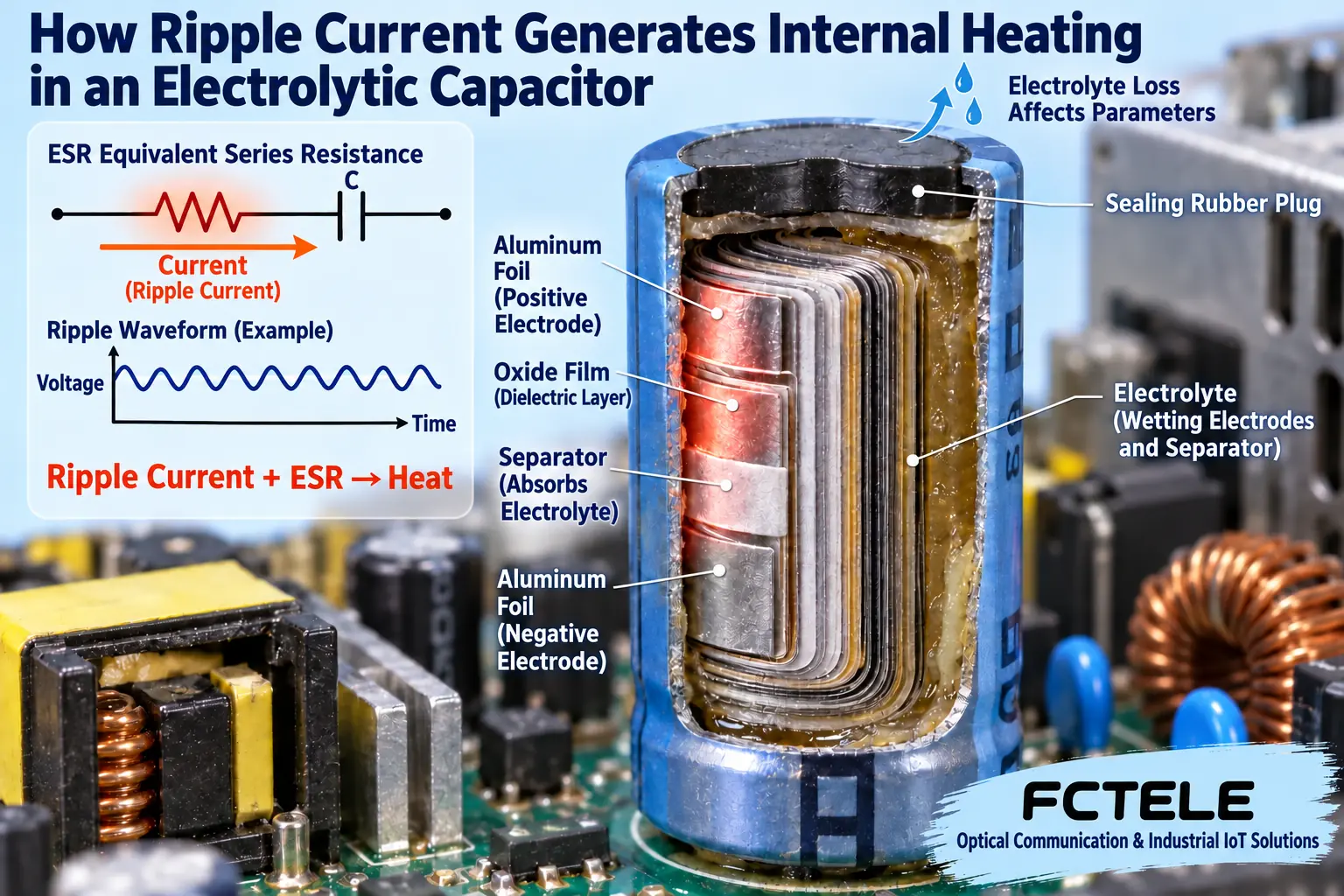
Take the wet aluminum electrolytic capacitor in a power supply as an example. It stores charge through its internal dielectric and electrolyte. When ripple current passes through the equivalent series resistance, it generates its own temperature rise. Changes such as electrolyte loss can in turn affect capacitance and impedance. Component structure, operating temperature, voltage, and ripple conditions are all related to long-term performance. This example shows that aging has a physical mechanism. It does not mean that every industrial switch uses the same capacitor or that this capacitor must be the first to fail.
Voltage outside the allowed range, poor contact, condensation, corrosion, and mechanical stress can also form different fault paths. You cannot use a life estimation formula for one type of component to directly calculate how many more years an entire switch can be used. You also cannot interpret a single burn-in test or short-term high-temperature test as proof that no problem will occur throughout the entire future warranty period. A test should have samples, conditions, and criteria, and its conclusion is valid only within the corresponding scope.
MTBF is not a countdown for one machine
MTBF is usually used to describe the statistically average time between failures or a reliability estimate. It must be understood together with the calculation method, environment, load, and assumptions. It is not the time at which a particular device will necessarily fail, and it cannot be directly converted into a warranty period. Even if two specification tables both list MTBF, different calculation models and conditions may mean they cannot be directly compared.
For engineering operations and maintenance, more useful questions are: under this project’s load, temperature, vibration, and power supply conditions, does the device pass acceptance? Can faults be discovered in time? Can the backup path and spare units restore service as planned? Reliability design and after-sales response need to be considered together. Procurement should not be decided by one very large hour number alone.
What do dual power supplies, ring networks, and ingress protection each protect?
Dual power supplies can provide redundancy for power supply faults, but if both inputs come from the same upstream power source, there is still a common failure point. Ring protection addresses applicable link or node faults. It does not mean that all device faults can recover automatically. An IP rating reflects the protection capability of a specific enclosure. It is not comprehensive proof of explosion protection, lightning protection, or long-term outdoor life.
The Feichang Technology four-copper-port, two-optical-port managed product lists dual DC versions and functions such as STP/RSTP, which provide means for power supply and Layer 2 path maintenance respectively. The specific choice should correspond to on-site fault risks, distinguishing power supply versions, protocol configurations, and topologies. You cannot omit grounding, installation, and service recovery testing just because these options exist. Unknown recovery times, environmental certifications, and long-term life cannot be written as guaranteed values on your own.
Keep fault evidence that helps after-sales reproduce the issue
At delivery, save the model, serial number, firmware, configuration, first-use record, and purchase proof. Record the power supply specification, cabinet location, and key services. In normal operation, pay attention to port errors, reboots, power supply alarms, abnormal temperatures, and service recovery. When a fault occurs, first record the time, symptoms, and environmental changes, and keep the logs. Do not immediately repeatedly restore factory settings or change multiple configuration items.
During a maintenance window, you can use confirmed-good cables, power supplies, or a spare unit with the same configuration for a controlled comparison. This helps avoid reporting a network configuration fault as hardware damage. When power supplies, live testing, or opening the enclosure are involved, follow safety procedures and contact professionals. Unauthorized disassembly, repair, or modification may affect fault diagnosis. Whether it affects the warranty scope should be confirmed with after-sales, rather than making a legal conclusion in this article on your own.
Finally, write the service term, technical acceptance, and operations plan clearly and separately: service terms address what to do after a problem occurs. Acceptance records prove under what conditions the service was met at that time. Maintenance and backup plans reduce risk during operation. The three complement one another. Only then can they help a project continue running better than the sentence “five years, so it is more reliable.”
References and notes
Basis for product and service information Feichang Technology four-copper-port, two-optical-port managed product page and service system ; confirm actual terms with after-sales. Capacitor mechanism reference: TDK electrolytic capacitor explanation . MTBF concept reference: Beckhoff reliability explanation . Its model data is not transferred to Feichang Technology equipment. The figures are general principle diagrams, not actual photos, measurements, or life promises.
Translated from the Chinese technical article. Source first published: 2021-01-07. Source last revised: 2026-10-13T11:23:08+08:00. Read the Chinese source
