


An industrial serial fiber modem normally carries RS232, RS422 or RS485 over fiber. A broadband optical terminal normally means a PON ONU or ONT. Both have optics and convert signals, but connect different systems and services under different requirements. Similar names cannot make a serial modem replace broadband access or give an instrument Gigabit download speed.
Identify the peer system before the modem name
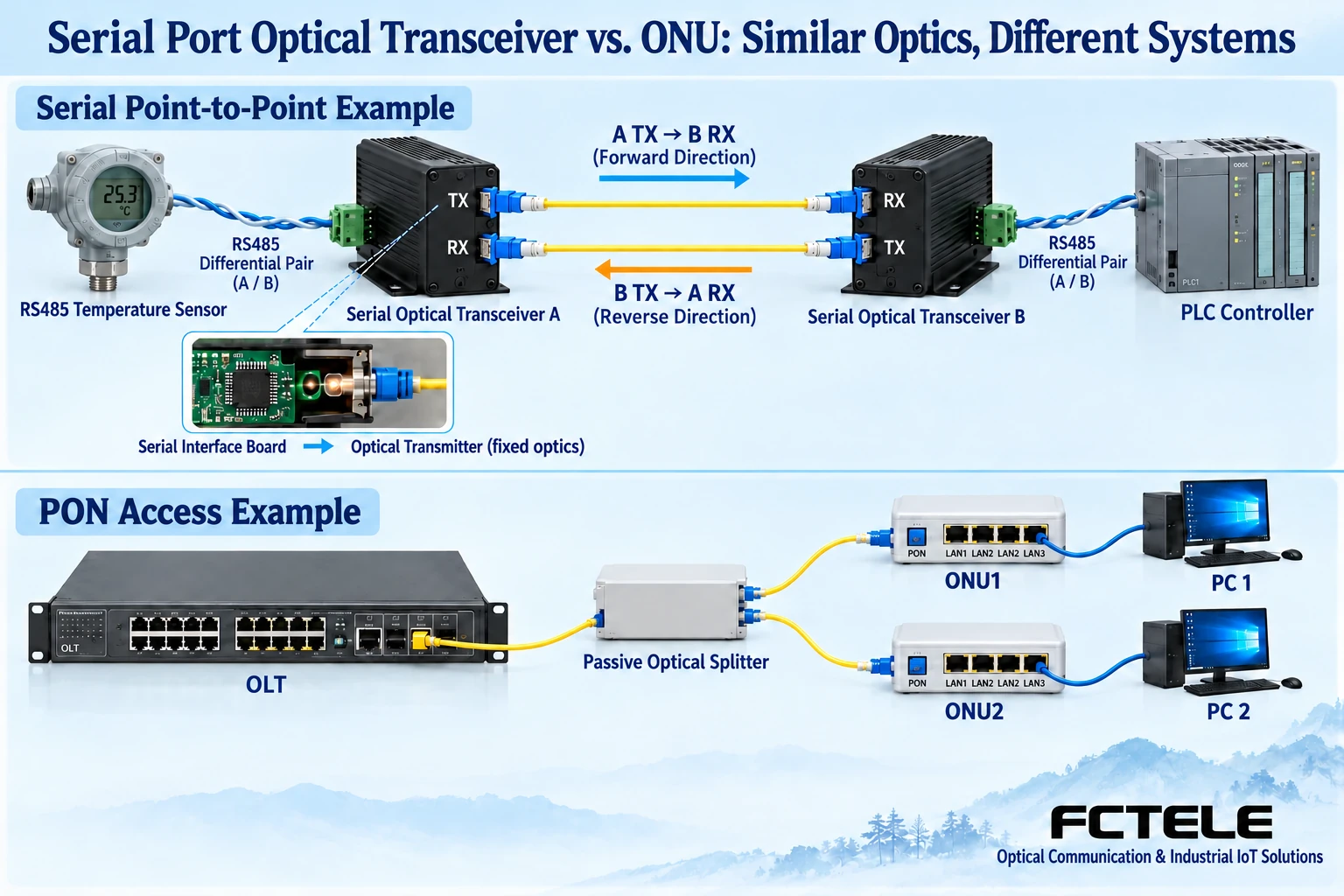
For an RS485 instrument returning measurements to a distant control room, the task is serial distance, interference and interface matching. A compatible converter pair replaces the intermediate medium with fiber while endpoints retain their protocol. Correct readings need complete request/reply verification, not a browser speed test.
For carrier broadband, the terminal must communicate with the access system using the appropriate PON technology before delivering service to Ethernet equipment or a router. A serial-only fiber device cannot replace it. Even with similar shapes/connectors, judge model, service interfaces and uplink technology rather than fiber insertion alone.
A serial fiber modem extends a serial signal path
The local converter receives serial electrical signals, transports information optically and restores matching electrical signals remotely. RS232/422/485 differ and need separate checks. Multiple named interfaces need not be independent channels or automatic protocol conversion. Check channel counts and mapping by model.
Think of changing the carrier, not the instrument brain. Address, message, error checks and meaning remain endpoint responsibilities. Transparency does not remove application configuration, baud, direction-control or character constraints. Fiber capacity cannot make the original serial transmitter send faster automatically.
An ONU belongs to an access system
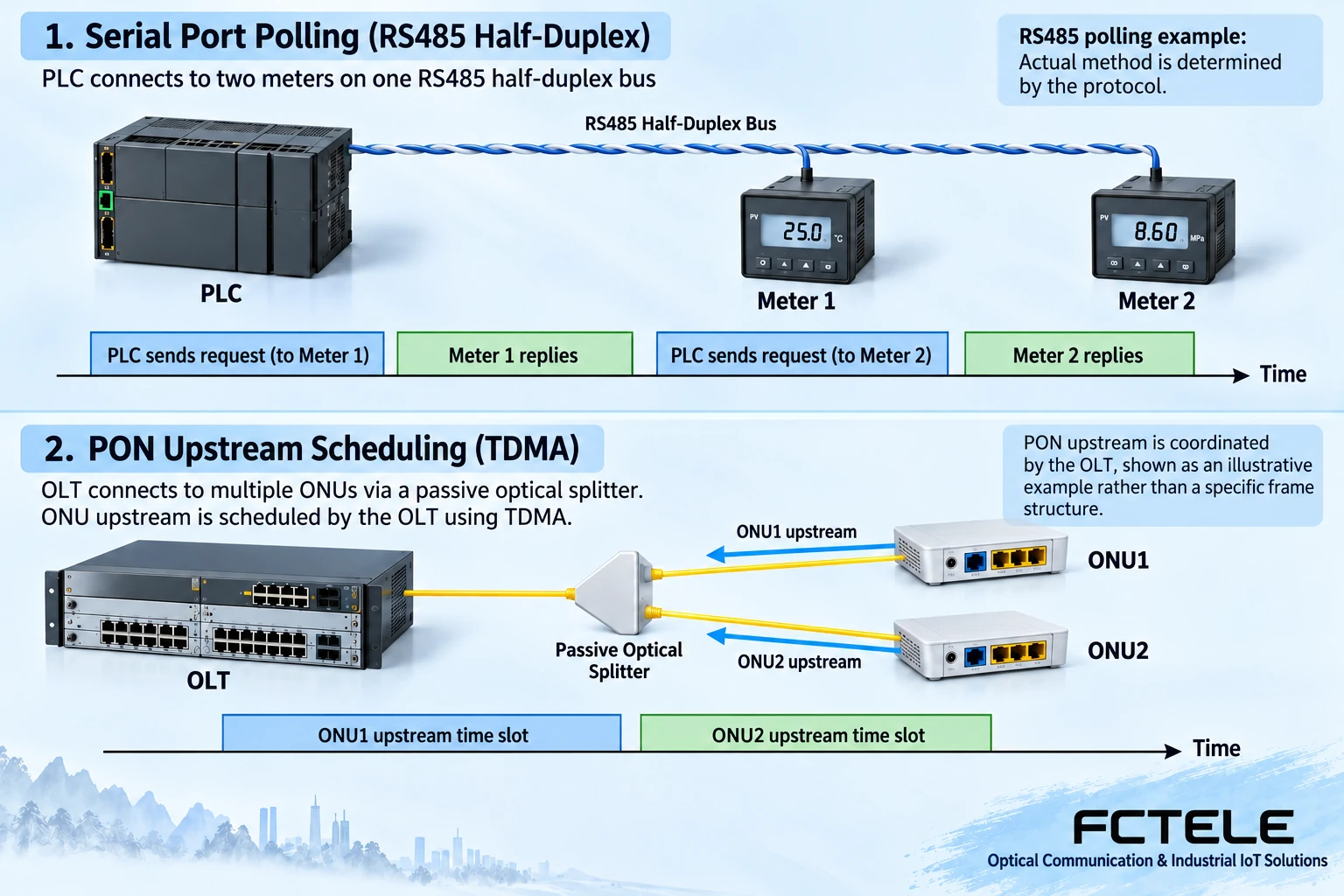
For GPON, ITU-T G.984.1 describes an OLT centrally, ONU/ONT at users and a passive optical distribution network between. Splitters distribute optical paths to several terminals. They are neither active Ethernet switches nor serial protocol gateways.
An ONU needs matching PON technology and deployment conditions; arbitrary optical devices cannot interconnect. Optoelectronic conversion does not prove RS485 reception. Industrial access devices may add serial or other interfaces, but that is a specific model feature, not universal ONU or serial-modem behavior.
Single-fiber bidirectional does not mean PON
Serial converters can use one or two fibers. Duplex usually uses separate directional cores with TX-to-RX. BiDi shares one through paired optical channels. One physical fiber cannot establish PON protocol or carrier-network compatibility. Optical pairing and system protocols are separate.
Adding a passive splitter cannot turn an ordinary point-to-point serial modem into a multiuser system. Multipoint, hub and self-healing-ring equipment must support that organization, conflict handling, mapping and recovery. Cable shape alone cannot create topology functions. Define responsibility for the electrical bus and optical network when several instruments share a site.
Measure serial performance with serial criteria
Check permitted rate, character format, message length, processing and query cycle. Two-wire half-duplex needs turns, allowing a slave response after the request. Raising baud without instrument/converter support may harm reliability instead of improving collection.
Broadband performance depends on access equipment, user ports, service configuration and traffic. A PON optical line rate is not an always-available per-user download rate and cannot describe ordinary serial devices. Unsupported historical percentage improvements in download or latency are not selection evidence.
Use FCTEL categories to avoid the wrong product
FCTEL separates RS232/422/485 fiber modems from industrial PON, helping identify the technology before specifications. FCP-D2 distinguishes RS422/485 and three-wire RS232 channels and describes channel crossing under specified conditions. It illustrates serial mapping, not a universal broadband ONU.
State which serial interface, endpoints and channel count must be extended, or which PON system, OLT and user interfaces must be accessed. Ask for exact model, order version and compatibility. For serial-to-IP applications, separately check servers/gateways. Serial fiber modems do not automatically provide TCP, UDP and remote IP management.
Troubleshoot along the correct service path
For serial failure, preserve settings/logs and check power, electrical wiring, optics and replies separately. Establish a one-device short-fiber baseline before the installed route, changing one variable at a time. A normal optical LED provides partial evidence; current readings, address and checksums still need application validation.
For PON faults, inspect terminal state, access relationships and provisioning under that system rather than swapping serial terminals. Both need optical safety, cleanliness and suitable environments, but shared maintenance cannot erase technical differences. Fiber is not automatic encryption, and remote control needs separate authorization, feedback and safeguards. Identify roles to select, connect and accept correctly.
References:FCTEL FCP-D2 details and product categories;ITU-T G.984.1. Figures show generic mechanisms, not specific products or field measurements.
Translated from the Chinese technical article. Source first published: 2024-04-23. Source last revised: 2026-10-13T15:49:49+08:00. Read the Chinese source
