


Conclusion first: The four technologies are at different stages of evolution and different bearer layers, so you cannot simply judge by new versus old which one absolutely replaces which. Network design should start from service type, granularity, distance, protection and existing equipment.
How to read the diagrams: This article centers on “SDH vs MSTP vs PTN vs OTN: Bearer Layers and Application Scenarios Compared” and uses SDH, MSTP, PTN and OTN respectively: first determine which layer the service is at, and how SDH encapsulates, maps or terminates it, to organize the diagrams. When reading, first confirm SDH along the signal or state direction, then use MSTP to check the boundary, and finally trace abnormal phenomena back to the specific interface, medium or protocol layer.
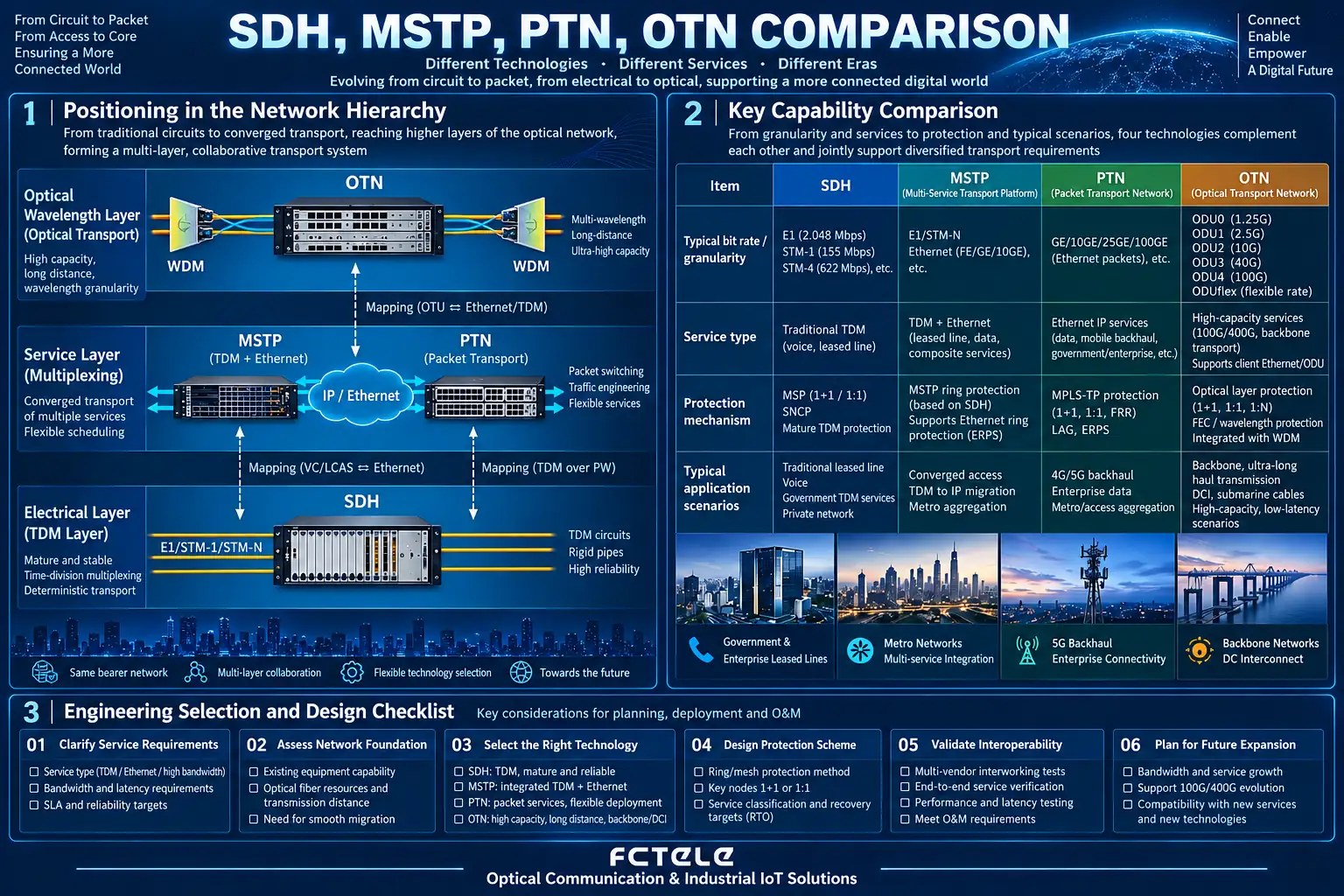
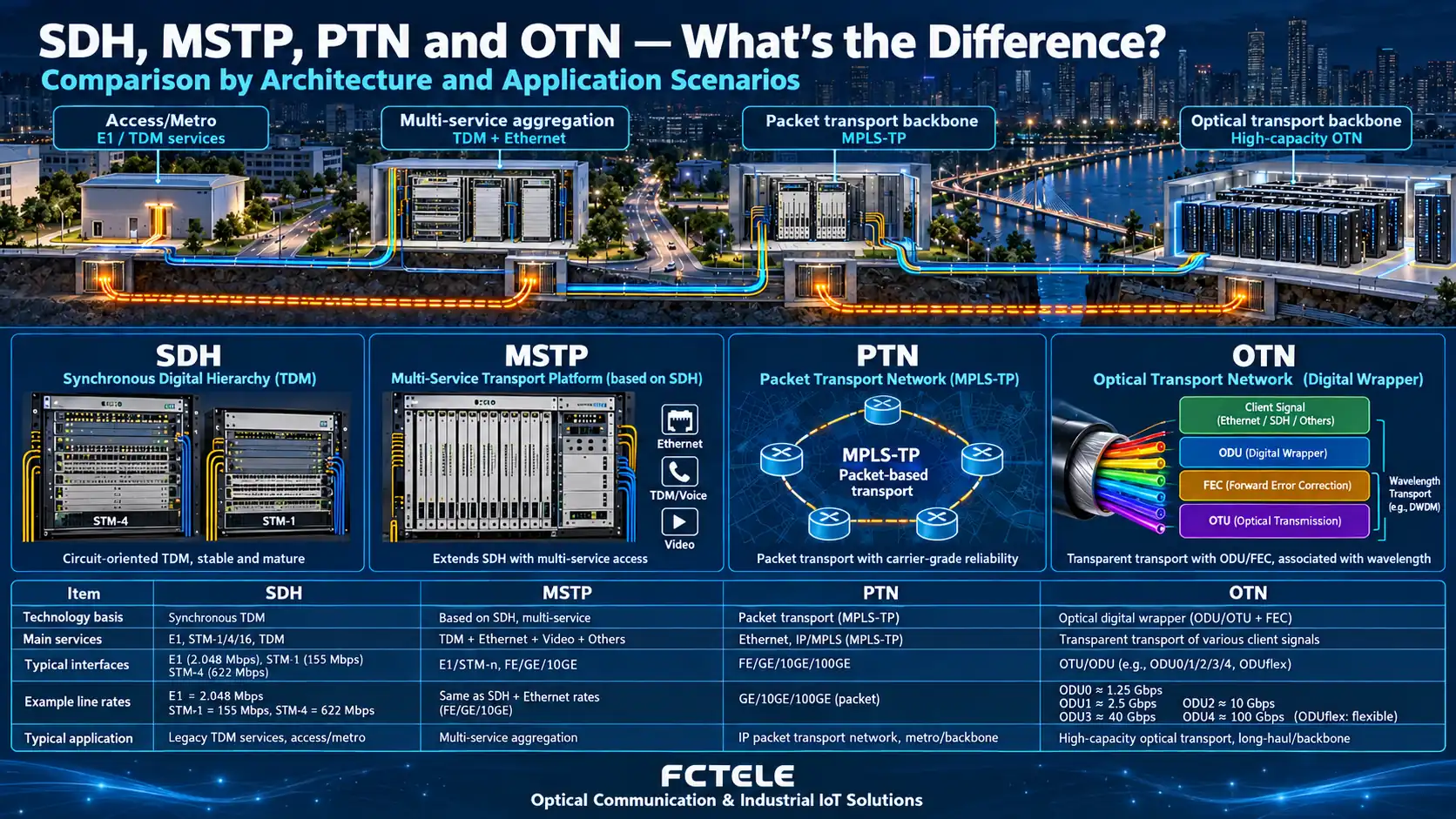
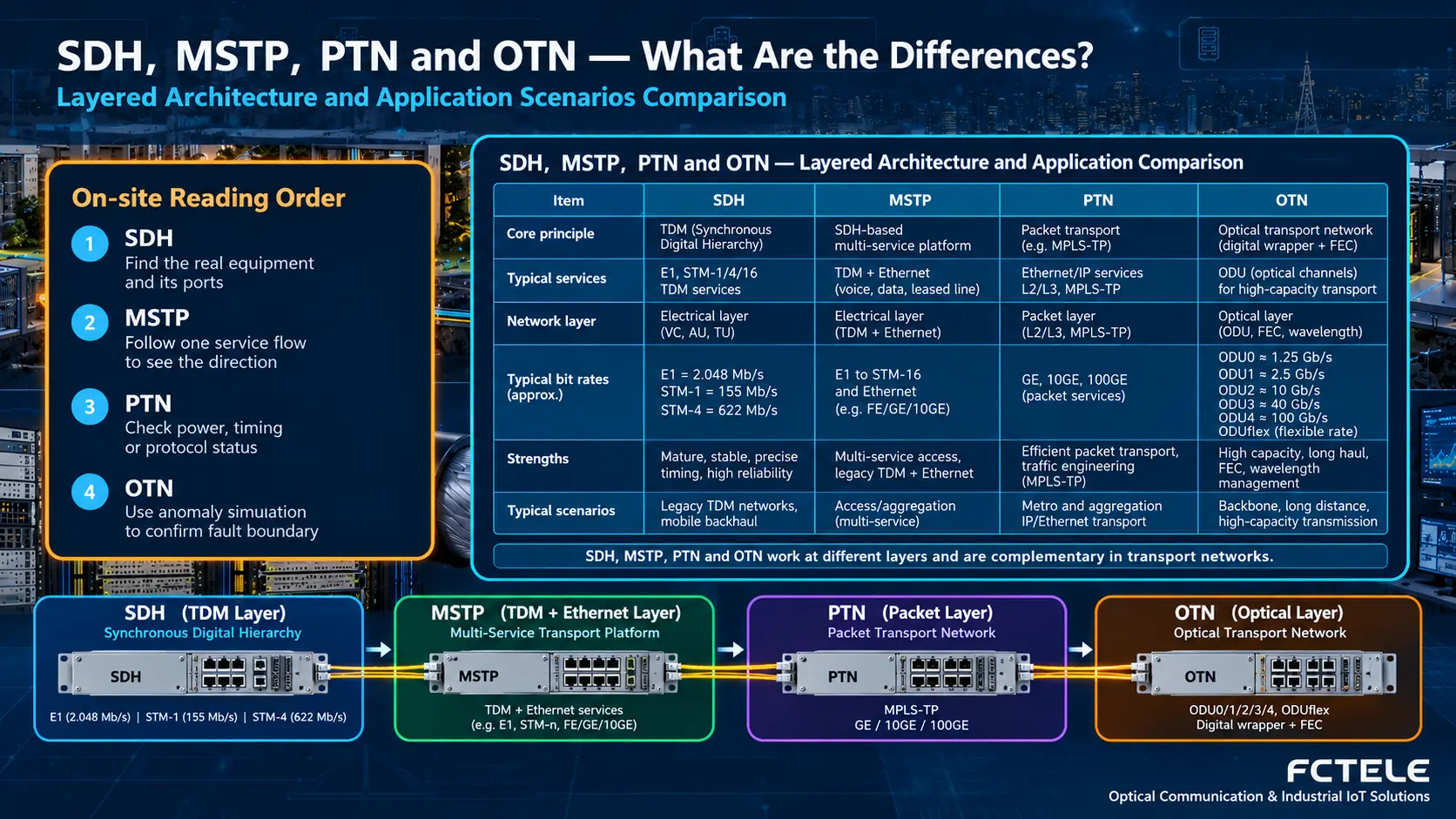
1. SDH, MSTP, PTN and OTN: first determine which layer the service is at
SDH carries mapped synchronous client circuits. SDH-based MSTP adds supported multi-service adaptations, while PTN is oriented to packet transport. OTN includes digital client containers, overhead and supported multiplexing as well as optical carriage; it is not defined solely as wavelength scheduling. The functions and protection of an installed platform must be checked against its actual interfaces and implementation.
Protocol functions work as expected only when the role, instance, control messages and protected object are consistent. Compare SDH, MSTP, PTN and OTN by circuit layer, packet layer and wavelength layer in terms of service granularity, protection mechanisms and typical applications. This article centers on “SDH, MSTP, PTN, OTN”. During implementation, mark the role of each interface and path in the drawings, record the differences between normal and fault states, and confirm the solution boundary with measured results.
2. SDH, MSTP, PTN and OTN: how SDH encapsulates, maps or terminates
Sort out existing TDM, Ethernet and high-bandwidth services, confirm SLA, latency, protection and capacity expansion goals, then decide on a single technology or layered coordination. Migration also needs to consider network management, clocking, interworking and cutover of existing services.
Acceptance suggestion: Execute in the order of “specification check—single-link test—fault simulation—recovery confirmation—record archiving”, changing only one variable at a time to avoid mixing configuration, medium and equipment problems together.
3. SDH, MSTP, PTN and OTN: why cross-layer configuration is prone to errors
Time-division multiplexing assigns defined payload positions in recurring transport structures; it is not a universal division of one second into 8000 individual service slots. SDH uses a 125 microsecond frame period, with frame organization and mapping defined for the applicable interface. Specify the client signal, container, clock relationship and provisioned capacity before comparing services.
SDH-based multi-service platforms adapt supported Ethernet and other clients into their implemented transport resources. There are no universal 70/20/10 percentage shares between SDH, Ethernet and ATM. Usable capacity depends on the actual mapping, overhead and allocated resources; compare measured service behavior under the intended load.
Synchronous transport capacity and client mapping must be stated using the selected standardized interface and actual equipment. Historical rollout limits do not establish a present universal maximum, and an informal passenger analogy cannot establish throughput. OTN digital mapping and wavelength-division carriage are distinct functions that may cooperate.
Wavelength-division multiplexing carries separate wavelength channels on a shared optical path. Channel plans and spacing follow the applicable grid and equipment; a single wavelength-spacing cutoff does not define every CWDM or DWDM implementation. Check channel interoperability, optical budget and client transport separately.
4. SDH, MSTP, PTN and OTN: cross-verify with packets, counters and alarms
Protocol functions work as expected only when the role, instance, control messages and protected object are consistent. Compare SDH, MSTP, PTN and OTN by circuit layer, packet layer and wavelength layer in terms of service granularity, protection mechanisms and typical applications. This article centers on “SDH, MSTP, PTN, OTN”. During implementation, mark the role of each interface and path in the drawings, record the differences between normal and fault states, and confirm the solution boundary with measured results.
Translated from the Chinese technical article. Source first published: 2019-07-22. Source last revised: 2026-10-13T23:45:12+08:00. Read the Chinese source
