


Traditional serial access control can connect to a network through a serial device server. Continued use of existing software and correct door operation during outages depend on the controller, software and communication design, not simply an added Ethernet port. Define whether the goal is collecting swipe records, distributing permissions or issuing real-time unlock commands. These have different risks and acceptance methods.
Identify the roles in an access-control system
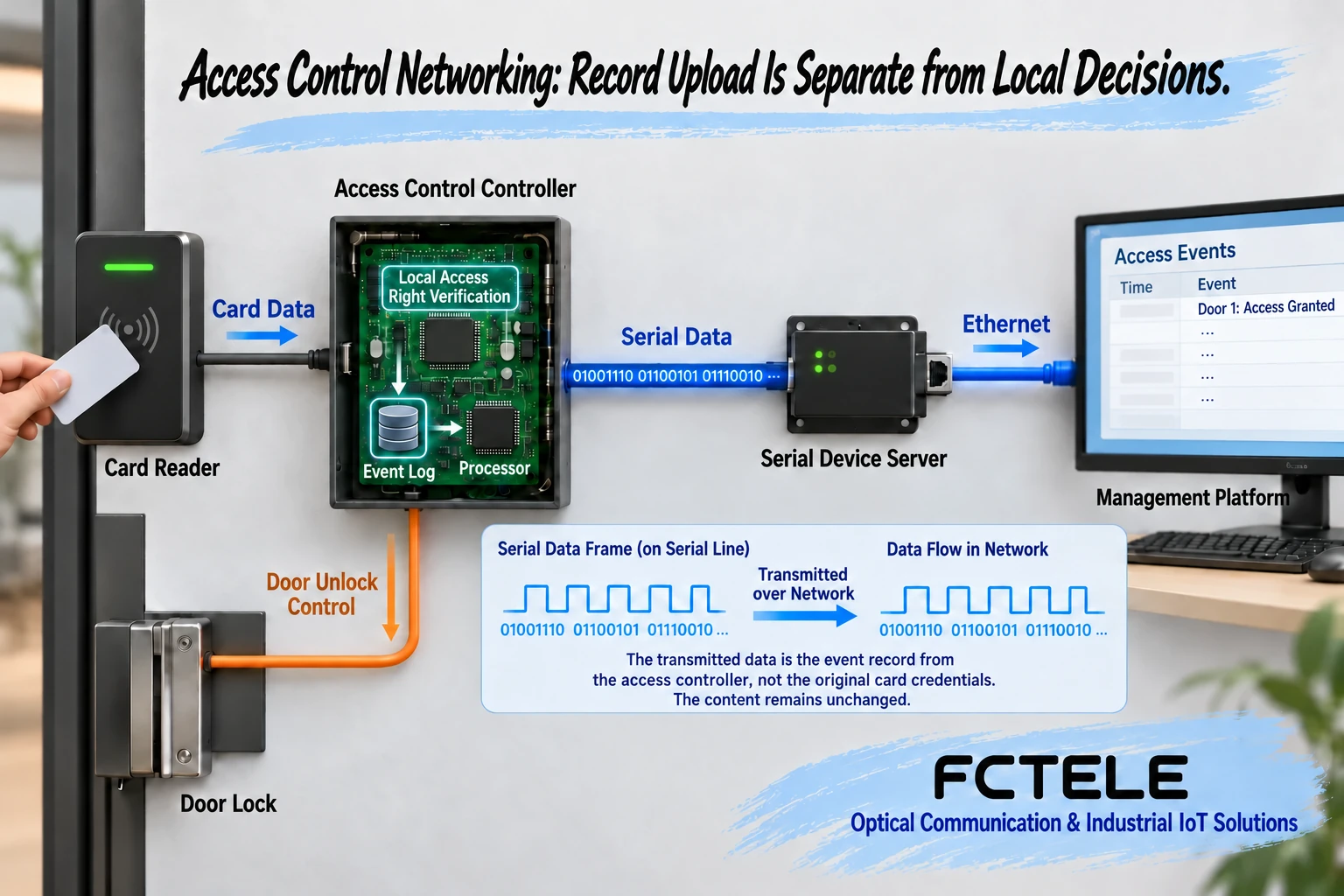
The reader reads credentials, the controller decides permission, the lock performs opening/closing and management software handles people, permissions and records. Products may integrate roles, but responsibilities still need confirmation. The serial server carries communication; networking does not give it authority to judge credentials or bypass the controller safety logic.
Compatibility with traditional systems is a retrofit objective to verify, not a guarantee for all models. Reader interfaces, controller uplink serial ports and lock-power terminals differ. Consult the controller communication manual for its permitted management interface. Two-wire-looking terminals must not all be connected to an RS485 server.
How a swipe record reaches the computer
Suppose the controller stores a record of a credential passing a door at a time. It formats bytes under its protocol and sends them serially. The server transports the bytes through a network connection; software identifies address, event and time. Networking is the carrier, while controller protocol and software define event meaning.
Byte forwarding does not automatically translate any manufacturer protocol into the platform format. With virtual serial ports, legacy software uses a COM interface whose driver sends operations remotely. Direct network operation requires supported connections and messages in the software. Verify both with actual software, especially time setting, bulk permission updates and event acknowledgment, not one command alone.
Correct wiring starts compatibility verification
RS232, RS422 and RS485 use different electrical signaling. Match the ordered server interface to the controller; connector appearance cannot replace pinouts. Design RS485 trunks, stubs, termination and bias for the site, checking polarity, reference connections and isolation. Preserve working legacy wiring and configuration so the retrofit retains an acceptance baseline.
Baud rate, data bits, parity and stop bits determine character reception. Incorrect settings can corrupt bytes before TCP transport, which cannot repair the original service. Shared-bus controllers also need unique addresses, a defined polling entry and confirmation of unsolicited reporting rules. Common meter-polling assumptions do not apply automatically to every access protocol.
Why old software may still need changes
Direct local software may rely on particular drivers, control lines or very short waits. A server/network adds transport, buffering and session recovery. Opening a virtual COM port proves only the entry point; compatibility includes bulk permission transfers, event retrieval, disconnections and driver restarts.
TCP is an ordered byte stream and does not bind each software read to one access-control message. Applications must reconstruct protocol boundaries. Packetization waiting affects when bytes are sent; it is not a universal replacement for message parsing. Missing bytes or combined events require comparison of complete data and parser logs, not an immediate cable diagnosis.
What should happen at the door during an outage?
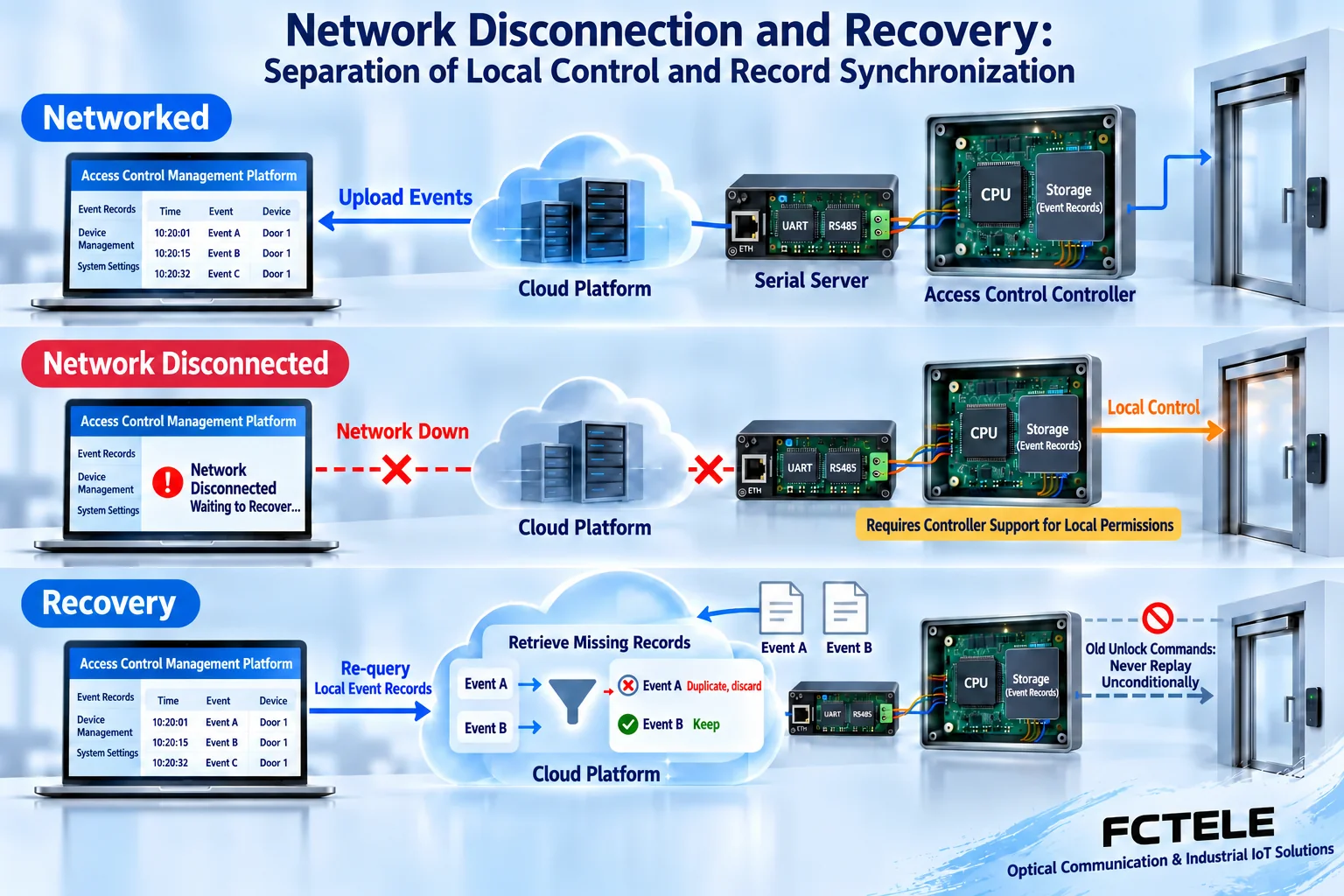
The key question is not automatic reconnect alone. Determine whether the local controller retains permissions, handles validity periods, stores events and synchronizes after recovery. These are controller/platform capabilities. Do not assume the serial server stores all records. Define the system offline policy and exercise it.
If a controller supports local permission decisions, it may continue normal passage under local rules during network failure while the platform shows disconnection rather than invented personnel status. After recovery, software retrieves unacknowledged records and deduplicates by event identifiers available in the protocol. If these capabilities are absent, state limits and necessary upgrades rather than hiding them with promotional claims.
Unlock commands and record reads need different retry rules
A timed-out record read may be retried with duplicate handling under the protocol. A timed-out unlock command may already have executed while its reply was lost. Repeating it can cause an unnecessary action. Confirm outcomes through transaction identifiers, execution state or a safe workflow. Timeout-and-resend is not a universal control strategy.
Fire integration, evacuation and safety interlocks must use appropriate onsite systems under project requirements rather than relying solely on an ordinary remote transparent link. Lock power, emergency release and communication have separate responsibilities. This article explains communication retrofits, not access, fire or building-safety design, and provides no unauthorized unlocking method.
What to verify when choosing FCTEL equipment
FCTEL serial-server categories offer different serial counts and network arrangements. The FCT-081206 page lists multiple serial interfaces, network management and operating modes as a selection reference for central management. Confirm interface version, firmware and companion software. Gateway or multisession features of one model do not apply to every product.
Prioritize protocol compatibility, driver stability, recovery and access control over Ethernet speed alone. Do not directly expose management or serial services publicly. Restrict source access, change default credentials and use assessed isolation/remote access where needed. Without documented encryption, do not claim the server encrypts the legacy protocol.
Pilot one door through a complete business cycle
Back up the original configuration and choose one controller in a controlled period. Verify permitted and denied passage, time setting, permission changes and record reconciliation. Test network loss, platform restart and local power failure, identifying which outcomes depend on controller or software. Before expanding, check shared-bus and bulk-task load.
Retain models, firmware, protocol, pinout, character settings, software version and rollback steps. Acceptance means correct service, visible failures and controlled recovery, not merely a connected computer. This preserves legacy value while documenting the effects of the added network path.
References:TCP specification RFC 9293;FCTEL serial device server categories;FCT-081206 product details. Figures show generic mechanisms, not a particular access controller or measured installation.
Translated from the Chinese technical article. Source first published: 2019-11-26. Source last revised: 2026-10-13T16:02:51+08:00. Read the Chinese source
