


Fiber can carry a long surveillance link, but first identify the camera output. A traditional analog-video fiber unit receives an electrical video signal, adapts it for optical transport and restores video remotely. An IP camera already outputs network data and usually needs an Ethernet media converter or optical switch. Both use fiber, yet their inputs, processing and recording equipment differ.
Identify the interface: BNC does not mean one universal video format
Traditional cameras often output composite video, or CVBS, through coaxial cable and BNC connectors. Brightness, color and synchronization share a continuously varying voltage; this is not IP data on Ethernet. Digital in a video fiber product’s name may mean internal digitization of an analog input, not direct acceptance of an IP camera.
SDI also commonly uses BNC, but is already serial digital video with different rates, formats and receiver circuitry. AHD, TVI and CVI high-definition coaxial systems are not interchangeable merely because connectors match. List camera model, actual output system and recording-input system. Matching shapes without documented format support cannot establish compatibility.
How a traditional digital video fiber unit works
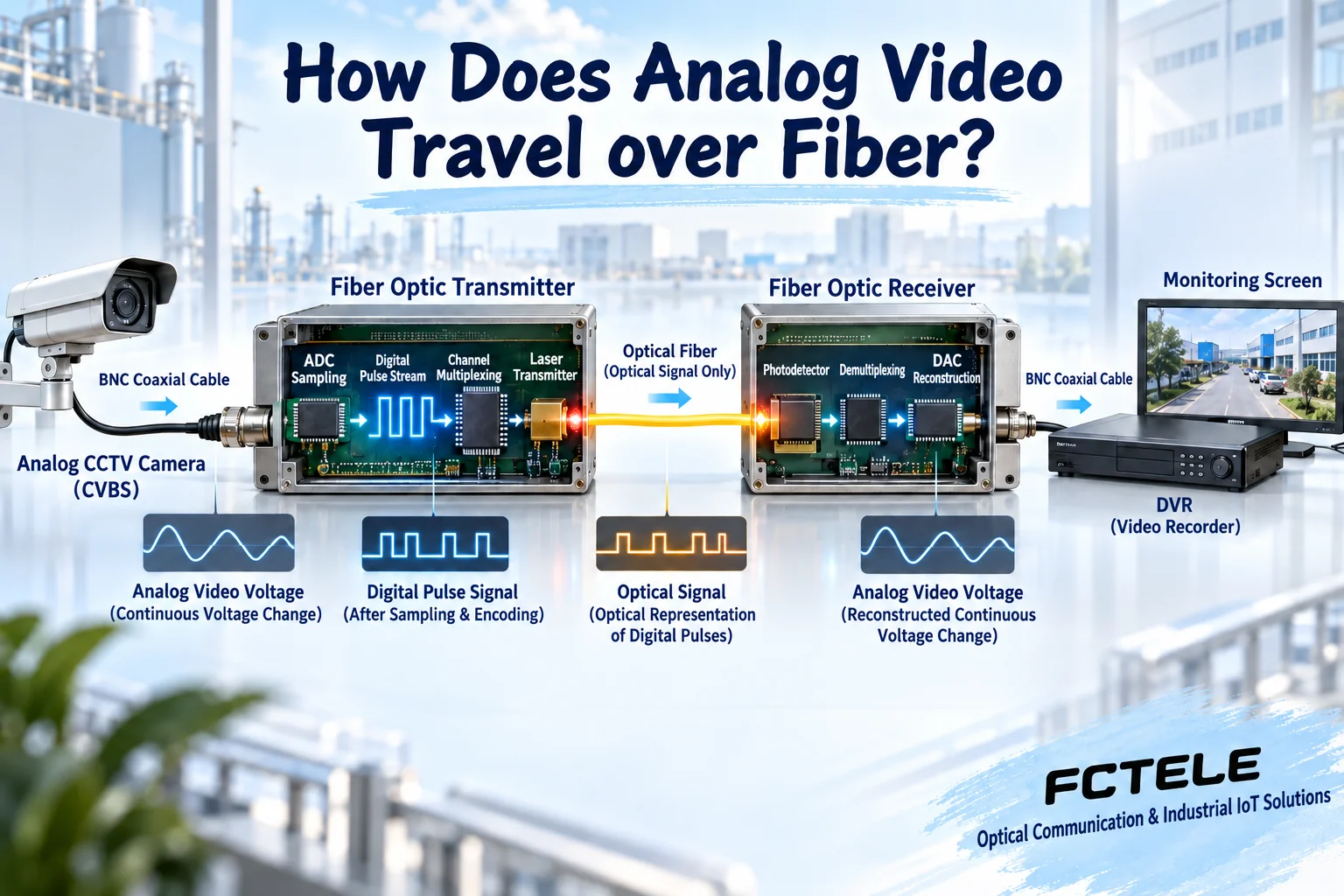
For CVBS, front-end circuitry receives and conditions the video voltage. An analog-to-digital converter, ADC, measures it at intervals and represents each value digitally. Sampling frequency determines how rapidly changing information can be followed, and quantization precision determines amplitude detail. Digitization cannot create missing picture detail; it may digitize input noise too.
The device organizes those numbers. Multichannel models also multiplex video channels into a shared optical link. Multiplexing arranges channels according to a defined scheme; it does not imply any passive splitter can distribute decodable video. A driver produces light carrying encoded information. Fiber transports a changing optical signal, rather than a whole picture moving through its core.
At reception, a photodetector converts light changes into an electrical signal. Decision and necessary timing recovery precede channel separation. A digital-to-analog converter, DAC, restores video voltage for the corresponding BNC output and compatible recorder. Multiplexing and channel configurations must match at both ends; do not mix arbitrary transmitters and receivers from different series.
What it does and does not do in surveillance
Video fiber equipment can retain existing analog cameras and compatible recorders while replacing long gatehouse, factory or roadside return trunks with fiber. It primarily changes medium and reach. Lenses, illumination and original resolution still determine visible detail. A rear-end converter cannot reconstruct a license plate the camera never captured clearly.
Digitized fiber transport reduces some limitations of long analog coaxial paths, and glass does not couple electromagnetic interference in the same way as copper. However, power, video inputs and control wires can still suffer interference, while insufficient optical budget or contamination can lose synchronization. Fiber does not guarantee zero errors, zero delay or uninterrupted pictures.
Some multiservice models add serial, audio, telephone or contact channels. Main video generally travels from field to center, while PTZ control can travel back. Confirm counts, direction, serial electrical standards and alarm forms in the manual. An Ethernet socket does not prove BNC video is automatically converted into an IP stream.
Why IP-platform migration needs a video encoder
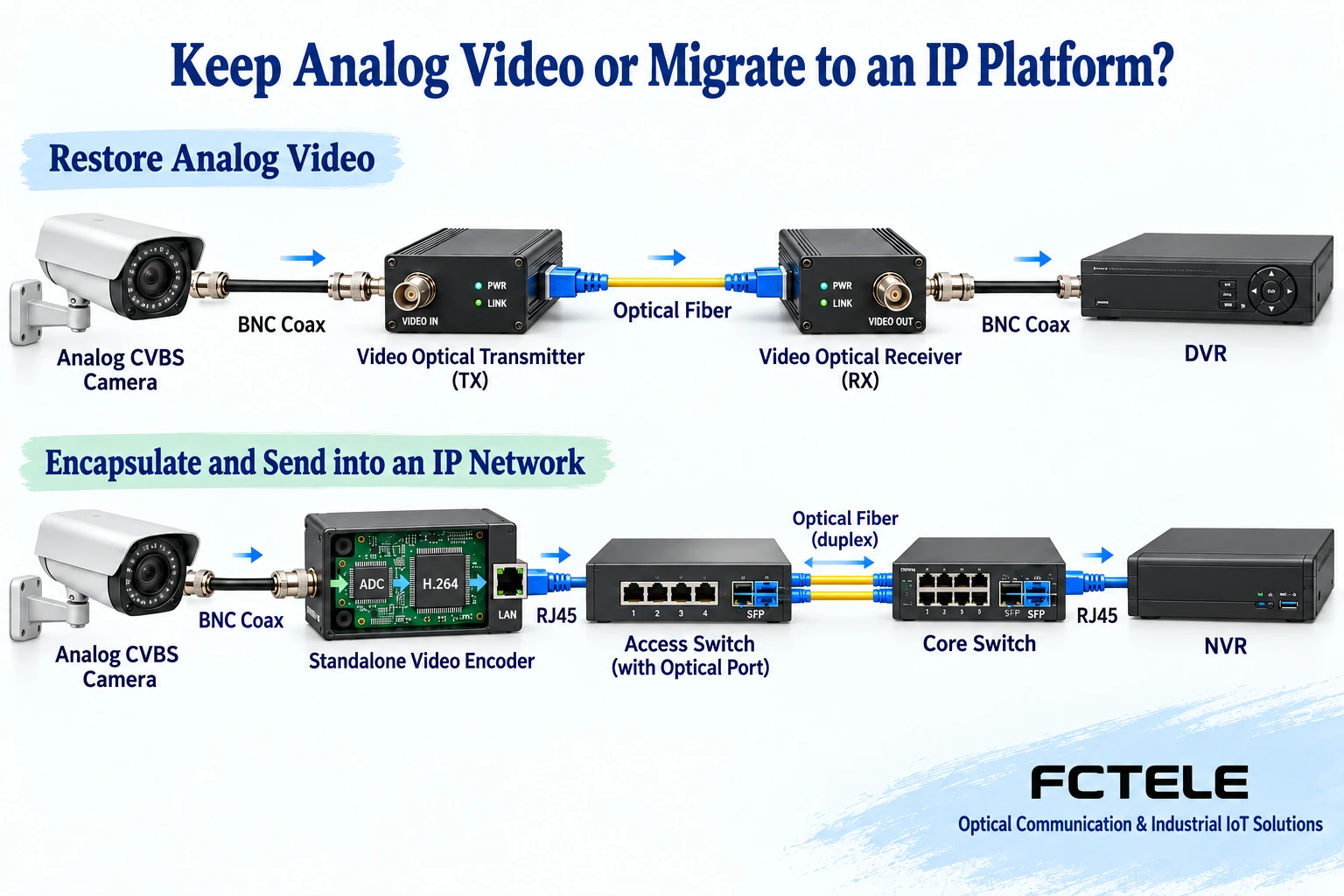
An analog camera joining an IP platform needs an encoder or recorder with corresponding functions. Besides digitization, it must compress and packetize video and establish a compatible streaming connection. That differs from internal coding used simply to carry video over a traditional optical link. H.264 and H.265 are common compression formats, not universal built-in features of digital video fiber equipment.
If old cameras and recorders remain suitable, matching video fiber endpoints can be retained. If analog cameras must join a common IP platform, evaluate encoders followed by switching and optical networking. With new IP cameras, compression usually occurs inside the camera, while an Ethernet media converter changes the medium. Compare compatibility, maintenance and downtime instead of ranking old and new technologies by name alone.
Selection needs more than a kilometer rating
Check video format and simultaneous channels first, then fiber type, single/duplex configuration, connectors and remote equipment. Rated distance assumes particular optics and link conditions. Include fiber attenuation, connectors, splices and maintenance margin in the budget. Received power must meet sensitivity without exceeding overload; a short span with powerful long-reach optics needs checking too.
FCTEL’s dedicated fiber transmission category includes FCP-V4F4pO8K8D8, whose page lists four video channels, BNC, PAL/NTSC/SECAM and additional services. These documented combinations are useful where legacy analog video and other interfaces must be retained together. They do not establish arbitrary 4K coaxial or SDI compatibility. Confirm service combinations, ordering versions and wiring against an agreed specification.
For SDI cameras, consult the high-definition video category and corresponding models, such as FCVH-V1b 3G HD-SDI details, which explicitly describe SDI support. That is evidence for a different input mechanism, not a CVBS capability. Check complete format, rate and end-to-end support for 4K or 8K rather than reasoning from fiber’s potential bandwidth.
Install, diagnose and hand over by segment
Commission the pair on a suitable short fiber first, checking format, numbering and control, then use the installed route. Treat coaxial cable, shielding and termination impedance according to the equipment. Verify power voltage, polarity and protection against drawings. Never look into a working optical port or fiber, and do not expose ordinary indoor equipment to rain.
For black video, check local camera output and recorder input before transmitter video status, receiver optical state, channel mapping and format. Link-up does not prove all video channels work. Record cleaning, power, supply and alarms. Do not continually raise gain to hide a source fault. Confirm AGC, OSD and particular alarm features by model.
Acceptance includes all channels, recording playback and controls, plus authorized power/link-loss alarms and recovery. Also distinguish fiber communication from perimeter sensing, which requires dedicated sensing cable, detection equipment and algorithms. Ordinary video transmission does not acquire intrusion detection merely by using fiber. For gatehouse planning, see Entrance surveillance return-link planning; for IP systems, see IP surveillance fiber design.
Reference note: verify interfaces and configurations against the FCTEL categories and products above. For IP migration concepts, consult Axis video encoder white paper. Figures illustrate generic mechanisms, not a particular product’s internals, site photographs or performance tests. Outdated market predictions are omitted; promotional judgments are not technical specifications.
Translated from the Chinese technical article. Source first published: 2019-12-09. Source last revised: 2026-10-13T14:28:14+08:00. Read the Chinese source
