


A telephone optical transceiver cannot be compared by price based only on “8 channels, how many kilometers.” First determine the interfaces at both ends, the actual voice channels, the fiber, and the power supply, then ask the supplier to quote a complete set of costs for the same configuration. Equipment, cabling, installation, acceptance, and subsequent maintenance together make up the project cost; historical prices in old articles cannot be used as current quotes.
First explain which type of telephone is to be extended
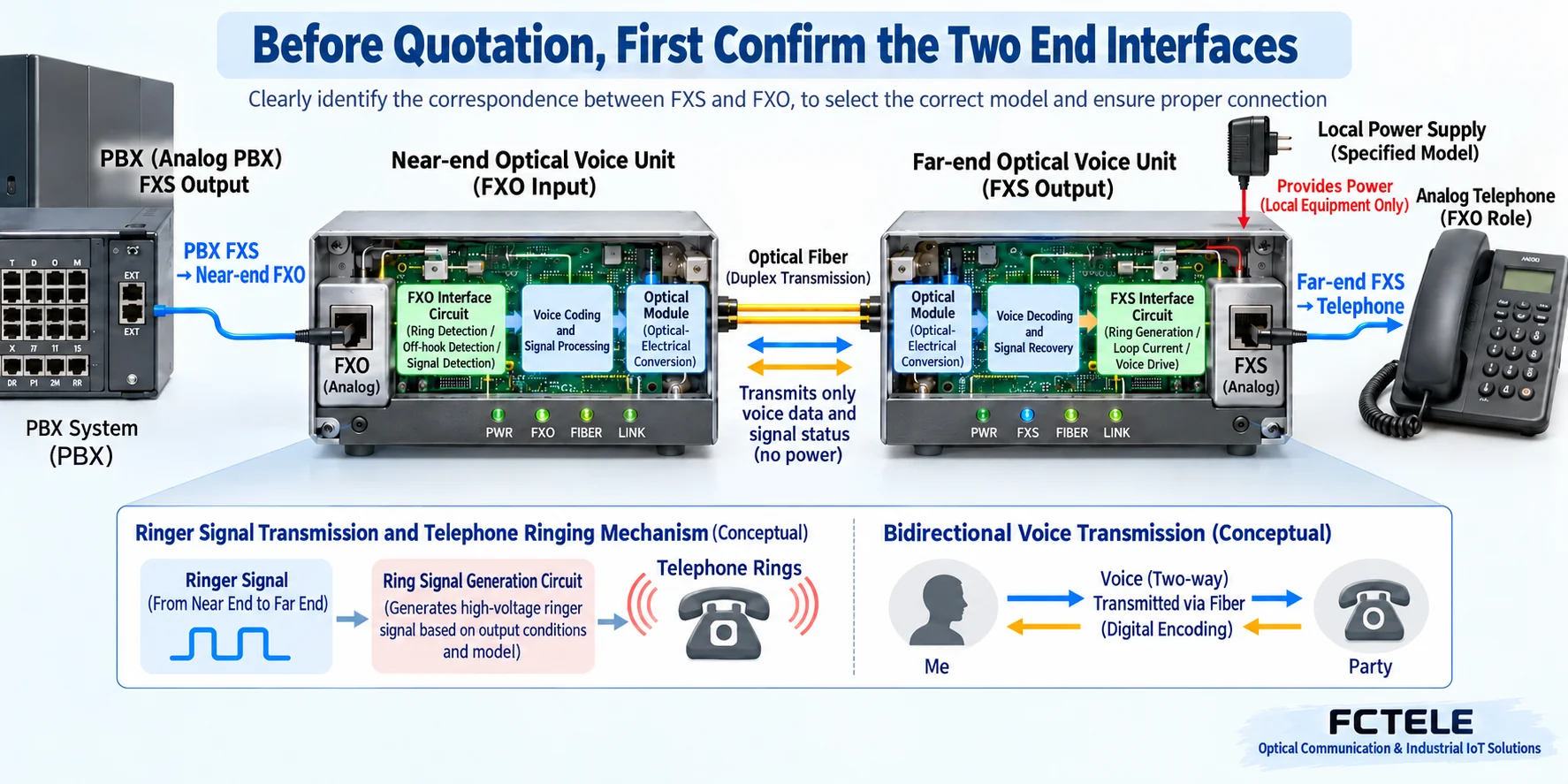
Assume an analog extension in the equipment room needs to be extended to another building. The near-end optical transceiver connects to the analog extension port of the PBX, and the far end connects to an ordinary analog telephone. Both ends transmit voice and call status over a matched optical path. The PBX extension port is usually an FXS role that provides line conditions, so the near end should use the corresponding FXO; the far-end FXS provides conditions such as power feeding and ringing to the telephone. The fiber transmits data and status; it does not directly send the telephone line power from the equipment room to the far end.
First verify whether it is an analog telephone, a digital proprietary extension, or an IP telephone. The same RJ11 socket does not prove electrical and signaling compatibility. Magneto telephones, E&M audio, E1 trunks, and SIP systems also cannot be applied to the same solution just because of the word “telephone.” If the interface is chosen incorrectly, even cheap equipment cannot be used; before quoting, writing down the actual equipment models at both ends is more effective than asking for the unit price first.
Why quotes still differ for the same number of channels
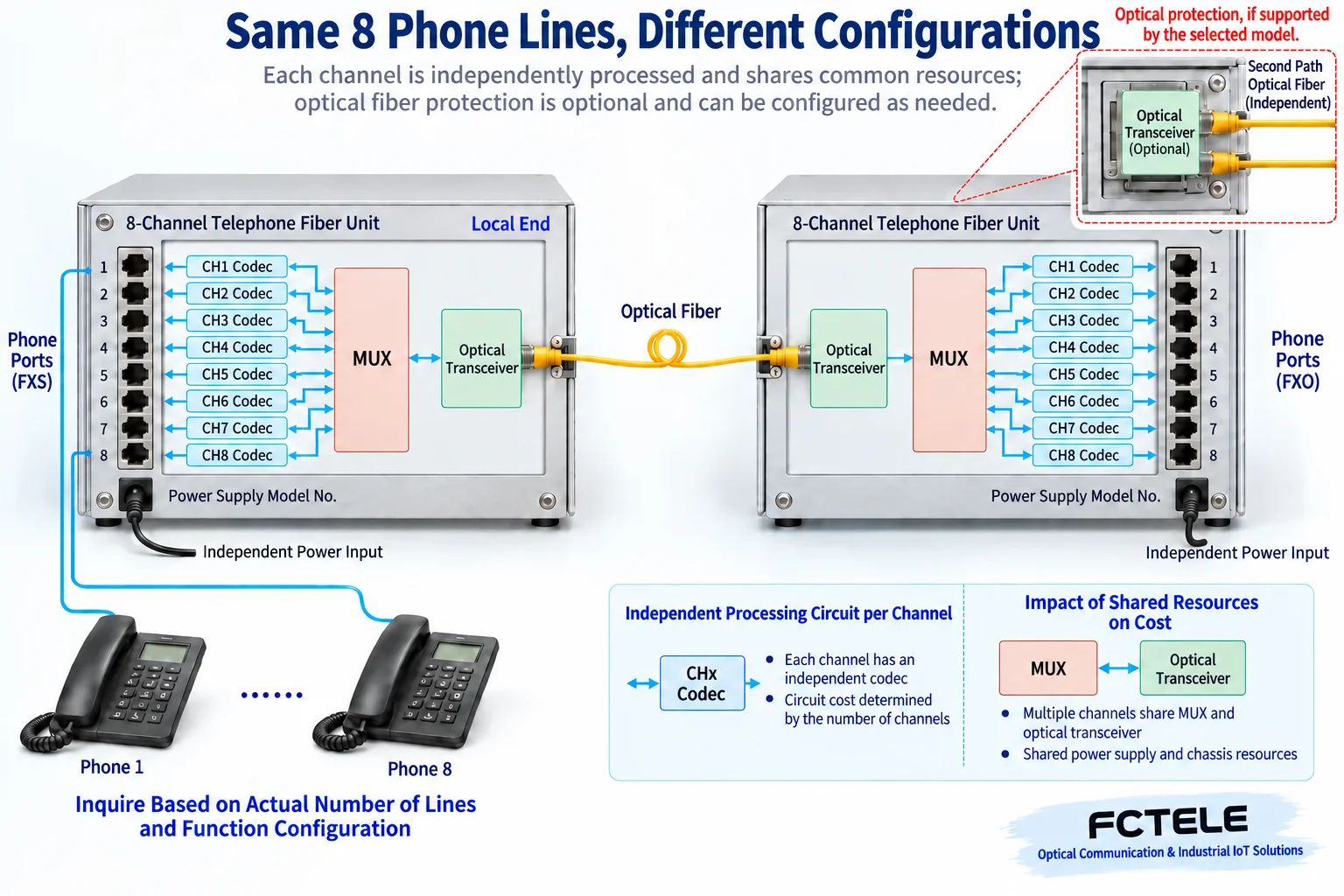
The number of telephone channels is the number of channels that can be connected at the same time, and the interface role and service capability of each channel must also be confirmed. When caller ID, fax, different dialing systems, or special on-hook release signaling are required, the supplier should explain the support conditions and test them with the actual PBX and telephone. A successful two-way call cannot be understood as meaning that all additional functions are compatible.
Inside the device, voice is collected, line status is detected, and each channel is organized according to the implementation, then transmitted through a common optical transceiver section. Adding telephone channels requires corresponding ports and circuit resources; the common optical path and chassis may be shared, but the price does not therefore follow a fixed “how much per channel” formula. A small number of spare ports helps expansion, while excessive reservation increases procurement, cabinet, and maintenance burdens, so it should be decided according to the real plan.
Pure telephone equipment and equipment with services such as E1, Ethernet, and serial ports are also different objects of comparison. Additional interfaces are valuable only when they are truly needed, clearly configured, and meet bandwidth and compatibility requirements. An Ethernet port’s nominal rate is not the number of telephone channels, nor can it be inferred that all services of the entire device can unconditionally run at full load at the same time.
Even at the same distance, fiber and pairing must still be checked
Write down the existing fiber type, available core count, connectors, actual length, and measured loss. Dual-fiber usually means the transmit and receive at both ends are cross-connected, while single-fiber bidirectional requires matching paired wavelengths and the device’s transmission system. Two devices having the same wavelength and connectors does not guarantee that a proprietary optical protocol can interoperate; this is especially necessary when replacing one end of old equipment, and the original model and version information are needed.
Nominal transmission distance cannot replace the optical power budget. The link also includes splices, connectors, bends, and future maintenance margin, and received power that is too low or too high may both be unsuitable. A very short distance does not necessarily mean buying the maximum distance grade. The quote should clearly list fixed optical ports or supported pluggable modules, whether modules are provided with the device, and whether both ends are already configured as a pair, so that after payment you do not discover that one end or a necessary accessory is missing.
How protection, power, and installation affect cost
Duty or emergency telephones are more sensitive to interruption. First state the allowed interruption time and recovery requirements, then confirm whether backup equipment, a second optical path, redundant power, or alarm management is needed. These are specific capabilities; two optical ports do not automatically mean protection is present. If the spare fiber core runs in the same easily damaged cable as the main one, it may not cover a common failure.
The equipment room and the far end each have power, installation, and environmental conditions. Clarify AC or DC, whether the power supply is built in, whether an adapter is included, and whether the installation form is rack, wall mount, or another type. An outdoor enclosure must also address protection, temperature, heat dissipation, grounding, and power quality; a metal shell cannot replace these conditions. The environmental specifications of one model cannot be applied to the entire series.
What to write in an inquiry to make price comparison easier
Give the same inquiry document to candidate suppliers: telephone systems and interfaces at both ends, current and reserved channel counts, concurrent calls, caller ID or fax requirements, fiber test results, installation power, and service acceptance conditions. Require item-by-item answers of “included as standard, optional, or not supported,” and list uncertain items separately rather than ranking total prices for different configurations.
The quote scope should state whether it is per unit or per pair, whether tax and shipping are included, optical modules and power supplies, installation parts, patch cords, patch panels, commissioning, and acceptance support. Then verify delivery time, warranty, spare parts availability, and the boundaries of subsequent technical service. Specific amounts and quote validity are subject to the supplier’s written reply; this article does not provide unverified current market prices.
For example, if 6 analog extensions are actually needed and 2 more are planned, the supplier can be asked to quote a complete 8-channel solution, then compare the additional cost, space, and maintenance requirements of a larger-capacity alternative. This number only explains how to organize requirements; it is not a recommendation of a fixed model, nor a promise that the per-channel price of larger capacity will definitely be lower.
Include acceptance and maintenance in the real cost
Cheap but incompatible equipment increases rework; complete specifications without on-site testing also cannot guarantee service. First test with the actual PBX and telephone on a short link with appropriate optical power, then connect to the on-site fiber and verify per channel: on-hook/off-hook, incoming ringing, dialing, two-way voice, and call release. Required caller ID, fax, and multi-channel concurrency should be tested separately, and a port-to-extension number mapping table should be saved.
Acceptance also includes received optical power at both ends, alarms, and service status after recovery. Controlled fiber disconnection and power failure tests should be scheduled in a maintenance window; a light turning on after restart is not a substitute for evidence of fault recovery. Keeping configuration, cable numbering, spare parts lists, and test records allows maintenance personnel to quickly distinguish faults in the upstream PBX, telephone line, port, and common optical path.
When upgrading an existing system, do not omit replacement costs
If one end of an old system fails, first record the models at both ends, port roles, optical parameters, pairing rules, and existing telephone functions. Buying only one new device with a similar appearance may fail to connect due to incompatible transmission protocol or signaling. Ask the supplier to confirm whether single-end replacement is possible; if it cannot be confirmed, then compare the workload of paired replacement and re-acceptance, and do not let the equipment unit price hide downtime and rework costs.
At the same time, check whether the old fiber, patch panel, and power supply can be reused. Reusable parts should be written into the construction scope, and parts that need updating should have quantities and responsible persons. The migration plan includes service windows, temporary contact methods, configuration backups, and rollback steps. These measures are not the same for every project, but clarifying the boundaries before procurement can reduce temporary additional costs and responsibility disputes after arrival.
How Feichang Technology models are used for configuration comparison
You can check the actual channel count and installation form from Feichang Technology pure telephone optical transceiver series. The official website FCP-O16/FCP-S16 desktop 1–16 channel telephone optical transceiver lists FXO/FXS interface relationships and management functions, suitable for confirming interface, channel, and management requirements item by item. When ordering, the actual configuration, included accessories, and compatibility with the existing PBX must still be confirmed; public product descriptions are not a formal quote for this project.
The final choice should be based on a complete solution that can be delivered and verified under the same requirements. Historical amounts in old articles about pricing and “good quality must be more expensive” are not enough to guide procurement; judging by service match, complete costs, and service evidence makes it easier to see what the cost actually buys.
Basis: the above Feichang Technology product information, and Cisco analog telephone port and call status description(used only for general interface principles). The two figures are mechanism illustrations, not specific product photos, measurements, or price commitments.
Translated from the Chinese technical article. Source first published: 2019-07-18. Source last revised: 2026-10-13T14:07:46+08:00. Read the Chinese source
