● The device can monitor the alarm status of the remote end.
● E1 interface complies with the G.703 recommendation and adopts all-digital clock recovery and smooth phase-locked loop technology.
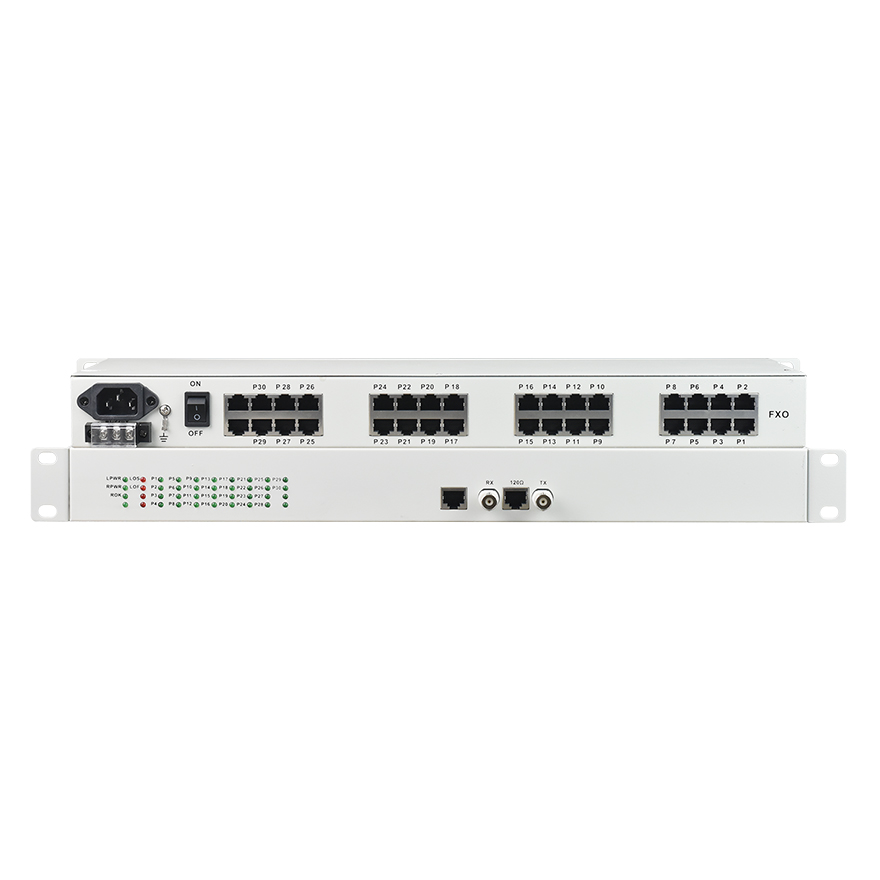
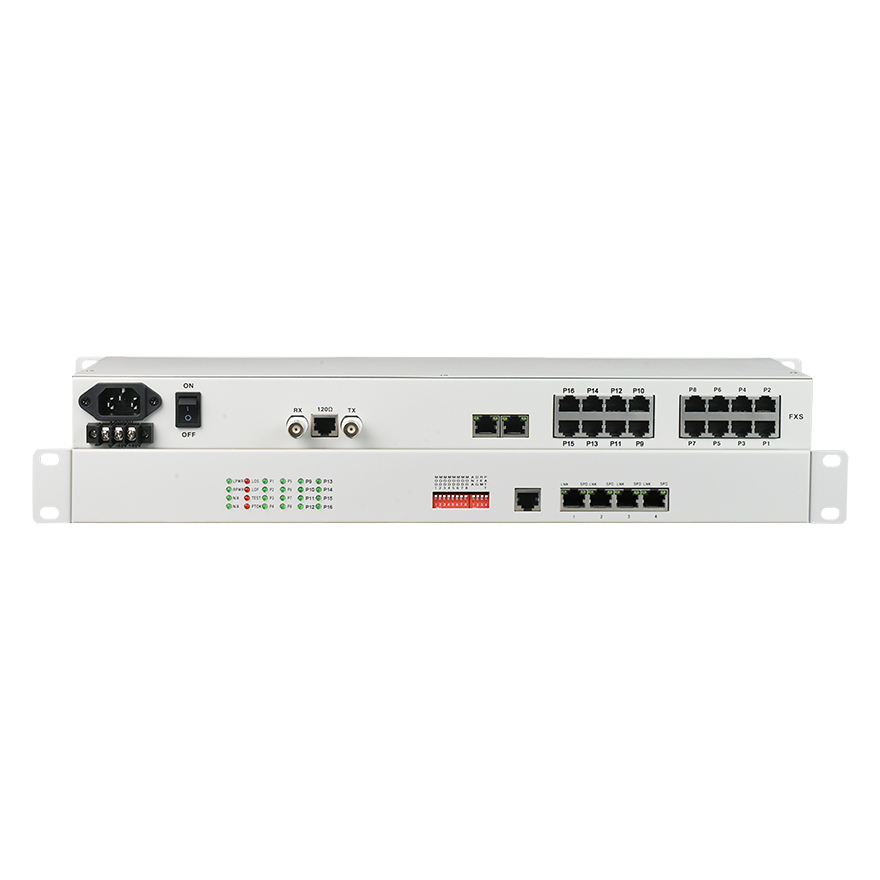
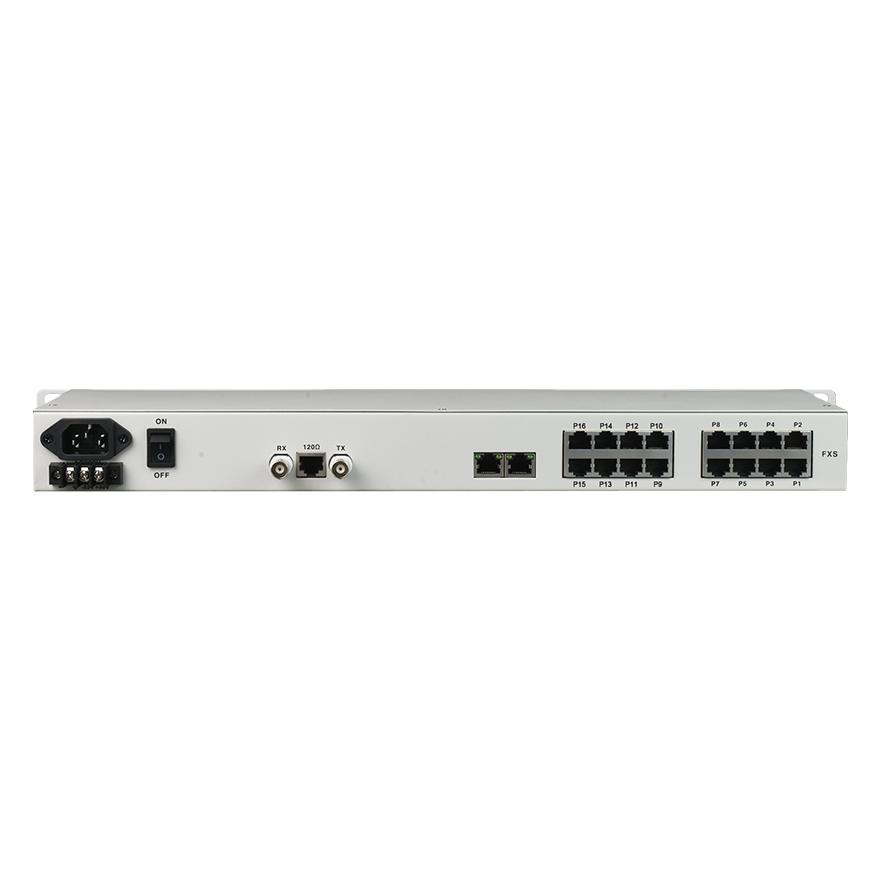
● Voice port supports FXO/FXS/2&4-wire EM/2&4-wire audio/magnetic telephone interfaces. The FXO port is connected to the PBX, and the FXS port is connected to the user’s telephone.
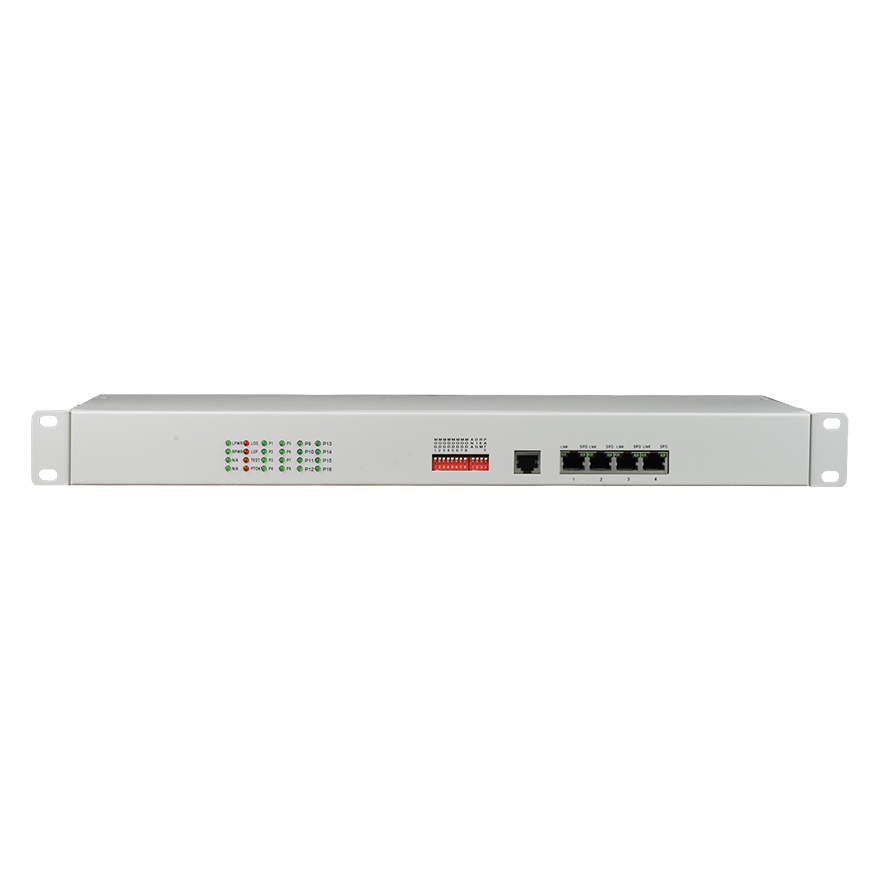
● It provides four expansion interfaces that can expand 1-4 asynchronous data such as RS232/RS485/RS422/TTL, or 1-8 dry contact signals.
● Ethernet interface rate is 10/100M, full/half duplex fully adaptive, and supports VLAN partitioning.
● Each Ethernet ports support Auto-MDIX (cross/straight cable adaptation).
● It supports caller ID display, reverse polarity charging, and fax function.
● It supports mutual dialing function between different sites.
● The device can detect whether the remote device is powered off or the E1 is not connected when the E1 signal is lost.
● It provides two clock modes: E1 master clock and E1 line clock.
● It provides three loopback functions: ANA (local loopback), DIG (Ethernet interface loopback to the remote end), and REM (remote Ethernet interface loopback to the local end).
● It has a pseudo-random code testing function (PATT), which is convenient for line commissioning and can be used as a single E1-bit error tester.
● E1 can support N*64k (N=1-32) rates, that is, the rate can be adjusted from 64K to 2048K.
● Multiple power supply options are available: AC220V, DC-48V/DC24V, etc.; support dual power backup modes such as AC+DC, AC+AC, and DC+DC.
● The telephone interface is equipped with lightning protection, which can withstand short-circuit current wave 10/700μs and open-circuit peak output voltage 6KV, in accordance with the GB/T17626.5 (IEC61000-4-5) standard.



 Inquire Now