


The value of serial server networking is not turning old instruments into faster instruments, but letting field serial devices keep working while being accessed, collected, and maintained centrally over a network. Whether costs can be saved depends on whether the original devices, host computer software, and network are compatible; whether it can run stably requires verifying serial speed, protocol, permissions, and reconnection after disconnection. Below, the previously vague “seven advantages” are broken down and explained.
1. First look at how data travels, then you know where the advantages come from
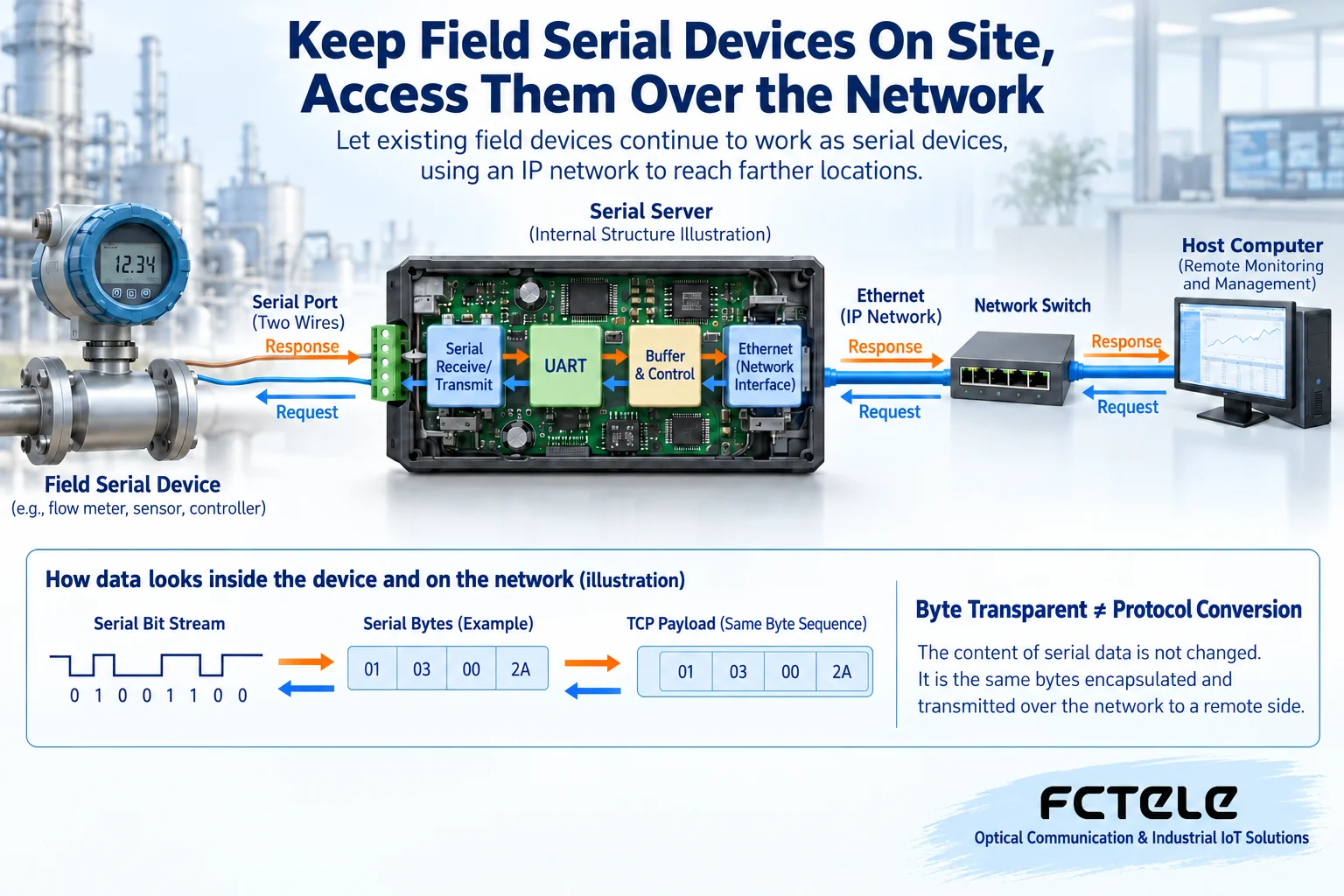
In the past, one computer connected to an instrument nearby with a serial cable, and distance, number of interfaces, and wiring conditions limited deployment. After switching to a serial server, the path from the instrument to the server is still a local serial line designed according to electrical requirements; the server then sends the received bytes into Ethernet, and a remote collection program reads them over the network. The longer-distance part is handled by the network, not by extending an RS232 cable indefinitely.
Internally, the serial transceiver circuit first handles the electrical signal, then the UART (Universal Asynchronous Receiver/Transmitter) restores the bytes; the buffer temporarily stores the bytes, and the network interface is responsible for sending. In the reverse direction, data received from the network is sent to the terminal through the serial port. Transparent transmission usually preserves the application byte content, but it does not automatically understand device commands, nor does it automatically convert one application protocol into another. RS485 is an electrical interface, and Modbus is a message rule; they cannot be treated as the same thing.
2. Keeping old devices offers a chance to reduce retrofit costs
Many instruments still measure well enough; they simply do not have a network interface. After adding adapter devices, the instruments and some field wiring can be retained, reducing the one-time workload of replacing devices, re-commissioning, and downtime. This is the actual meaning of “making full use of existing devices” in the old text; it does not mean that any device can connect to the network as soon as it is plugged in.
It is necessary to check the RS232, RS422, or RS485 interface, terminals, baud rate, parity, and control protocol. Even if the same terminal blocks are used, the electrical standards may differ. When old software only recognizes COM ports, a compatible virtual serial port driver can be evaluated to map a local COM number to a network port; when the software itself supports network connections, a virtual serial port may not be needed. Driver versions, operating systems, software licenses, and message handling should still be tested, and “no need to change existing software” cannot be treated as a universal promise.
When calculating cost, in addition to the server price, switches, power supply, cables, network planning, software adaptation, maintenance, and downtime risk should also be included. A simple project with a few devices connected nearby to one computer is not necessarily worth introducing a full network. The advantages should be compared with the existing solution, not judged only by whether the device has gained a network port.
3. Dispersed sites can be collected centrally, but capacity cannot be expanded indefinitely
Servers in different workshops can each connect to local instruments, then converge through the network to one collection service. Each session should be associated with a specific device, serial port, and business function, and the collection program uses this to parse results, record time, and determine communication status. A network switch only forwards network data; it does not automatically know which reading belongs to which instrument.
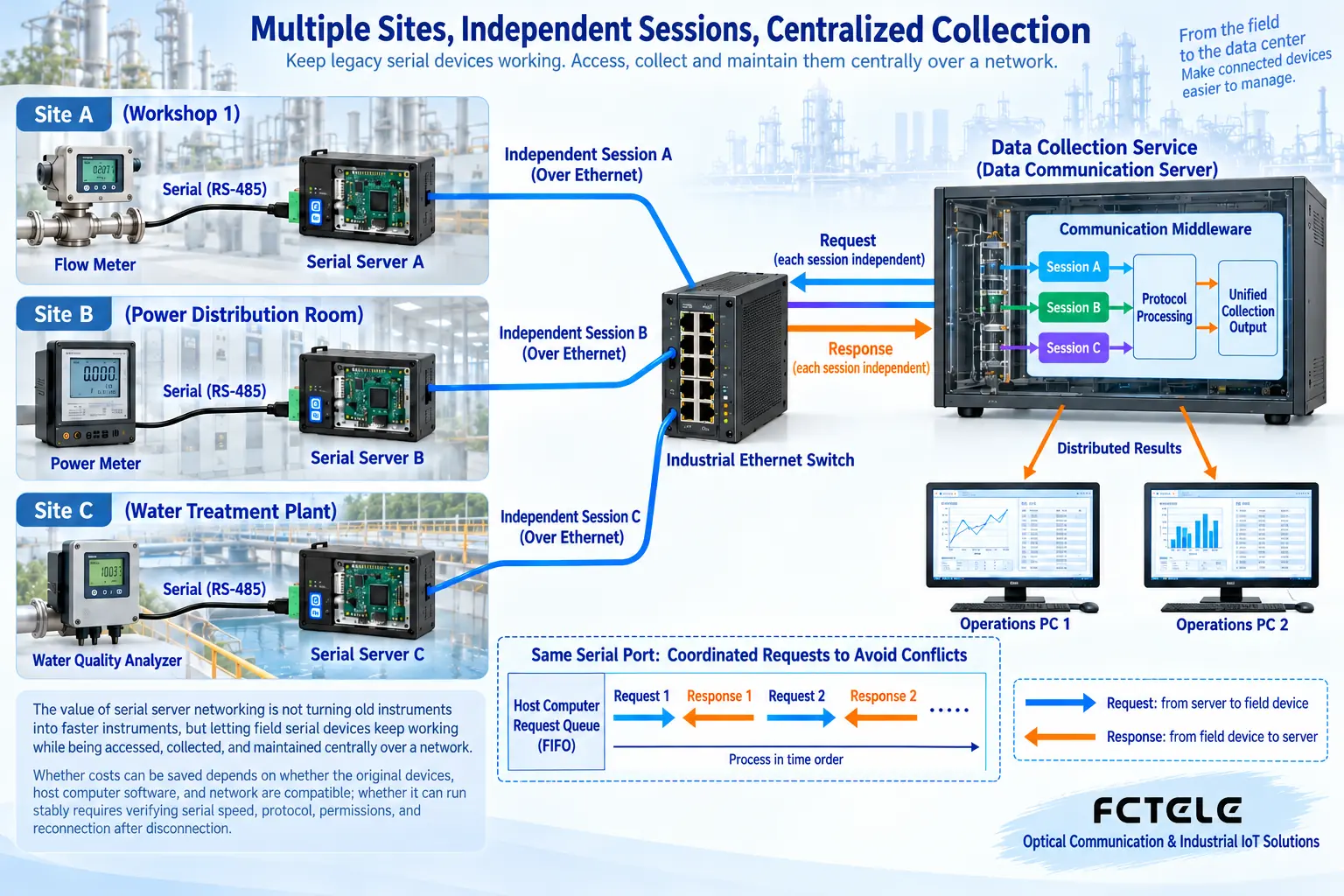
The network can converge multiple sources, but each serial port’s speed, buffer, number of sessions, and terminal processing capacity all have limits. A two-wire RS485 bus often needs to complete requests and responses in sequence; adding more viewing computers does not mean they can send commands to the same instrument at the same time. A safer approach is for one collection service to coordinate polling, then distribute the results to multiple viewing terminals, avoiding request contention, confused replies, and duplicate control.
Expansion also requires calculating the polling cycle: more devices, longer replies, and more retries all increase the time needed for one complete collection round. A port “successfully connected” only proves that a network session was established; it does not prove that all data has reached the serial terminal. Reading integrity and maximum response time should be verified under expected load, rather than estimating overall system performance only from the network port rate.
4. Remote access reduces site visits, but it is not the same as directly opening the public network
Authorized maintenance personnel can view status, check configuration, and analyze logs, which may reduce trips to the site for simple communication problems. However, power, wiring, grounding, damaged terminals, and mechanical faults may still require on-site inspection. Without terminal diagnostic capability, the server also cannot determine internal instrument faults out of thin air.
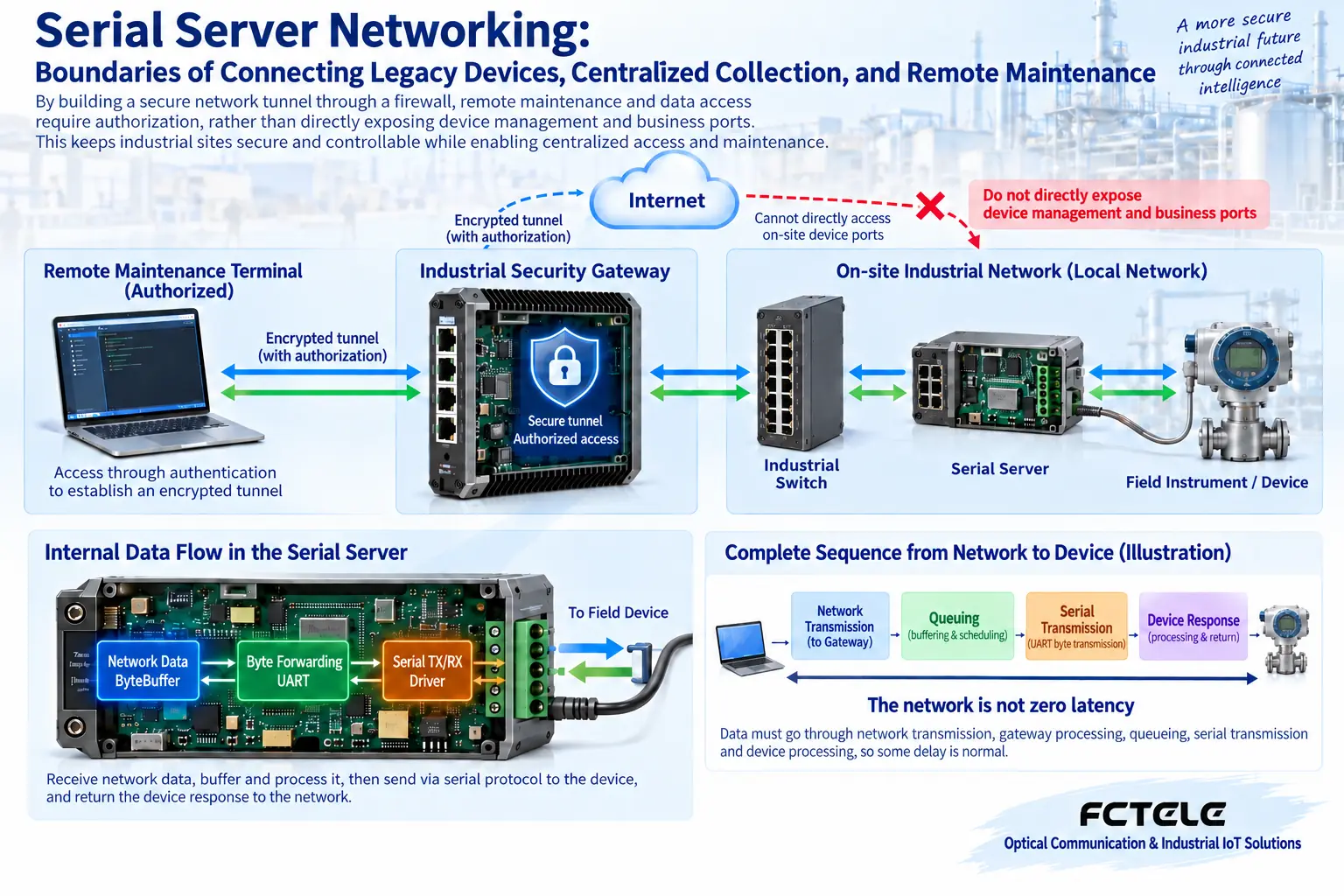
Cross-region access should be planned by network and security personnel as a controlled VPN or another approved access method, limiting accounts, sources, and ports and retaining operation records. Do not directly expose device management web pages and serial control ports to the public network, and do not disable all firewalls just for debugging. Remote access capability and access permission are two different things: being able to connect does not mean being allowed to modify production parameters.
Likewise, remote upgrades are only valid when the terminal supports the corresponding upgrade protocol, the tool allows it to run over the network, and the link is reliable. Before upgrading, check the version, back up the configuration, arrange a downtime window, and prepare a failure recovery method. Some upgrades depend on special handshakes or strict timing, and virtual serial port transparent transmission may not be compatible. “Accessible over the network” cannot be written as “all terminals can be upgraded faster.”
5. Keeping the field network structure does not mean automatic isolation or real-time performance
Each area keeps its local serial line, which can reduce the need to pull long-distance serial cables again. On the network side, VLANs, routing, and access policies can be divided by project to separate collection traffic from other business traffic. But the serial server itself does not necessarily provide complete security isolation; different IP subnets, virtual serial ports, or one extra network port cannot by themselves prove that access is effectively restricted.
Network round trips, buffer queuing, serial transmission, terminal processing, and packetization waits together affect response time. TCP provides an ordered byte stream, does not guarantee zero business latency, and certainly cannot replace terminal execution result confirmation. How to handle a network outage, whether reconnection will repeat execution, and how long readings remain valid should be clearly specified by the application. Emergency stops and safety interlocks cannot be assigned to an ordinary serial networking link without evaluation.
6. A centralized meter reading example: verify on a small scale before expanding
Assume three areas each have instruments, and the interfaces and reading protocols have already been confirmed. Each area uses a suitable server to connect to the local serial line, and the collection service establishes independent sessions with the three servers. First connect only one instrument in one area, confirm the reading with the manufacturer-specified read-only request, then gradually add other devices. This is a teaching assumption, not an implemented customer case.
For each instrument, record the area, server address, physical port, and terminal station number, avoiding confusion between network and serial identities by using the same concept of “address.” The collection service schedules requests according to terminal capability, and after a timeout distinguishes failure, invalid value, and last valid value, without passing off old data as a real-time reading. Viewing terminals only obtain results from the collection service, and control or modification operations have separate permissions.
Acceptance after going live should cover continuous reading, expected peak load, reconnection, power cycling, multi-node operation, and abnormal replies. First confirm normal data, then simulate a network outage in an authorized test environment to check whether recovery occurs and whether duplicate or missed readings appear. Keep wiring diagrams, configuration, firmware versions, and rollback steps; production sites must not have cables unplugged for testing without authorization.
7. How to apply the advantages to specific models
First list the number of interfaces, protocol, and software access method, then check power supply, isolation, environment, and maintenance requirements. The Feichang FCT-1500 series product details list different serial configurations, virtual serial ports, and RTU/TCP conversion modes: old COM software can be evaluated for driver adaptation, and when protocols are inconsistent, the conversion mode should be checked rather than expecting transparent transmission to convert automatically. Actual capabilities are subject to the ordered model, firmware, and manual, and should not be generalized to mean all products support them.
In summary, the advantages come from retaining devices, network convergence, and controlled remote access; reliability comes from compatibility verification, coordinated scheduling, permissions, and recovery design. For specific wiring and parameter steps, see Industrial Serial Server Usage Tutorial; if an abnormality has already occurred, see Serial Server Troubleshooting. This article focuses on why to network, whether it is worth it, and what the boundaries are.
References:Feichang Serial Server Categories, FCT-1500 Product Details, Modbus Serial Line Implementation Guide. Organized the valid topics of 1761, 2296, 2148, and 2065, and removed duplicate promotional content and unconditional promises. The illustrations are general mechanism diagrams, not actual product photos or measured results.
Translated from the Chinese technical article. Source first published: 2021-04-16. Source last revised: 2026-10-13T19:15:07+08:00. Read the Chinese source
