


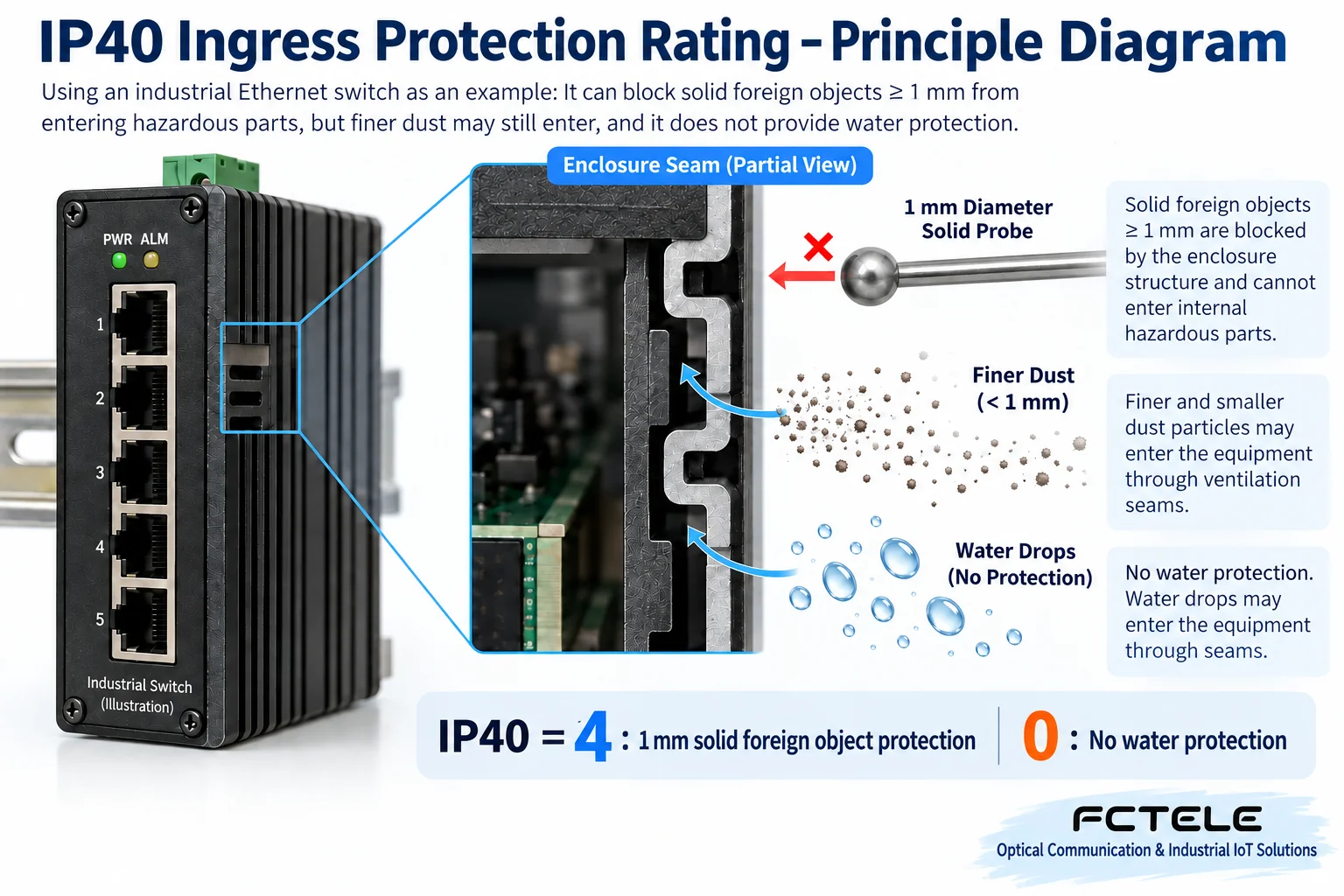
IP40 is not waterproof, and it is not fully dust-tight either. The protection rating of an industrial switch describes the enclosure’s ability to block solid foreign objects and water under specified test conditions. It does not represent temperature, interference immunity, or network security levels. When selecting a model, first look at where the device will actually be placed, then look at the protection measures of the complete installation. You cannot just compare which number is larger.
1. What problem does each of the two digits solve?
Here, IP refers to the enclosure protection marking. It has nothing to do with an IP address in a network. Following the classification approach of IEC 60529, the first digit concerns protection against access to hazardous parts and the entry of solid foreign objects. The second digit concerns protection against harmful effects caused by water entering. If a particular item is not marked according to the corresponding level, it may be shown as X. X is not zero, and you should not assume on your own that it passed the test.
When reading IP40, you cannot treat forty as a single overall score. The first digit 4 corresponds to the relevant solid foreign object protection condition. A common summary is protection against solid foreign objects of 1 mm and above. The second digit 0 means there is no corresponding water protection level. It does not mean fine dust will absolutely never enter, and it certainly does not allow the device to be placed where rain or washdown water directly contacts it. Whether there are other usage restrictions still depends on reading the model’s manual.
First digit: solid foreign objects and dust protection (0–6)
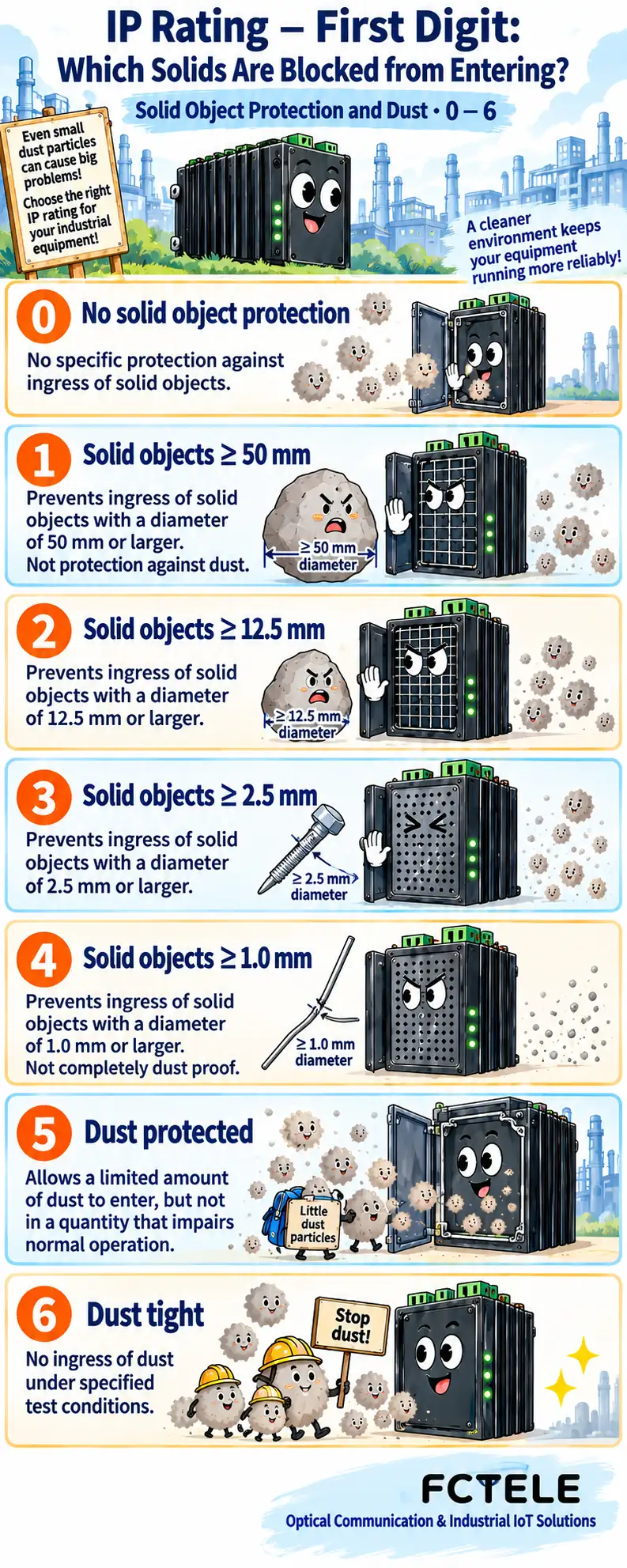
Expand the text descriptions for each level
0 No solid foreign object protection:No corresponding protection against the entry of solid foreign objects.
1 ≥50 mm solid foreign objects:Blocks solid foreign objects with a diameter of 50 mm and above; this is not fine dust protection.
2 ≥12.5 mm solid foreign objects:Blocks solid foreign objects with a diameter of 12.5 mm and above.
3 ≥2.5 mm solid foreign objects:Blocks solid foreign objects with a diameter of 2.5 mm and above.
4 ≥1.0 mm solid foreign objects:Blocks solid foreign objects with a diameter of 1.0 mm and above; this does not equal complete dust protection.
5 Dust protected:Limited dust entry is allowed, but it must not reach a level that affects normal operation or safety.
6 Dust-tight:Under specified test conditions, dust entry is not allowed.
Second digit: water test (0–9)
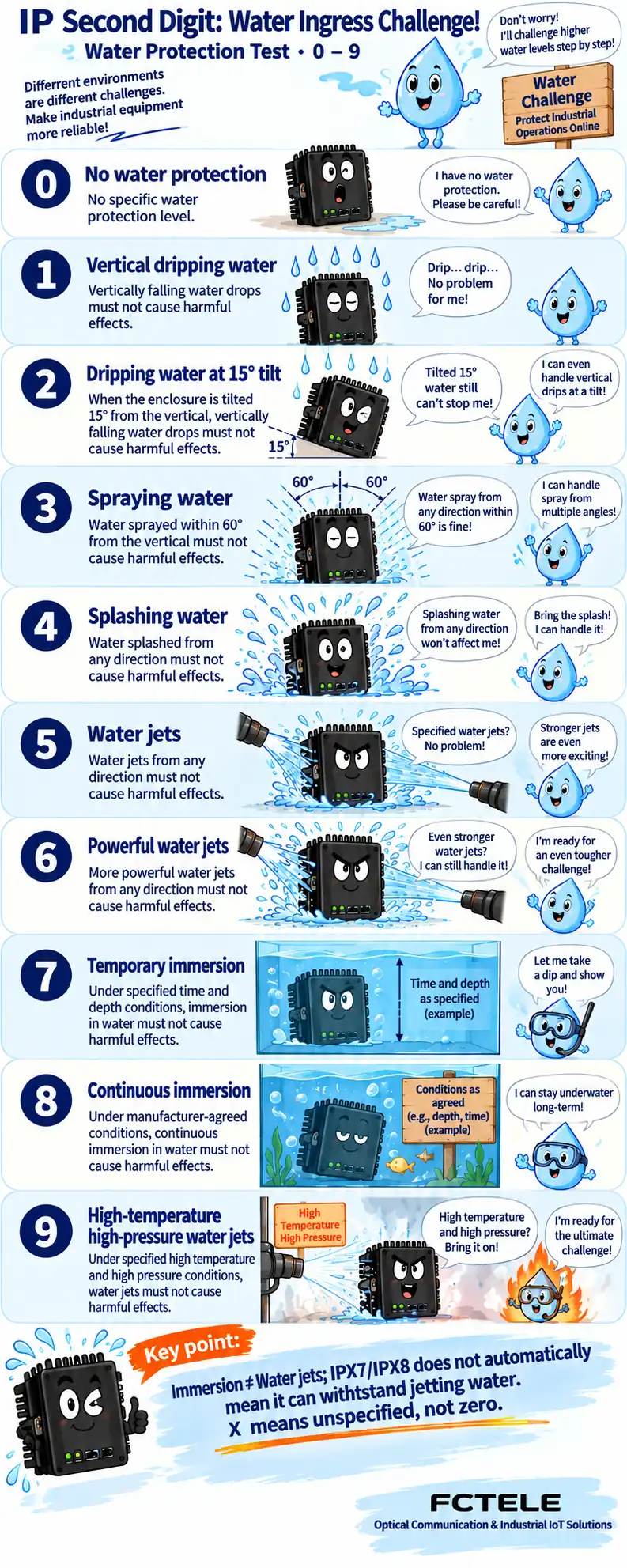
Expand the text explanation for each level
0 No water protection:No corresponding water protection level.
1 Vertical dripping water:Vertically falling water drops must not cause harmful effects.
2 Dripping water when tilted 15°:When the enclosure is tilted to 15° in the specified direction, vertically dripping water must not cause harmful effects.
3 Spray water:Water sprayed within a range of 60° from the vertical must not cause harmful effects.
4 Splashing water:Water splashing from all directions must not cause harmful effects.
5 Water jet:A specified water jet from all directions must not cause harmful effects.
6 Strong water jet:A specified strong water jet from all directions must not cause harmful effects.
7 Short-time immersion:Under conditions such as the time and water depth specified in the standard, water ingress must not reach a level that causes harmful effects.
8 Continuous immersion:Immersion testing is carried out under conditions agreed between the manufacturer and the user; this does not mean unlimited water depth or unlimited time.
9 High-temperature high-pressure water jet:Under the specified high-temperature, high-pressure water jet test conditions, harmful effects must not occur.
How should IP40 be read?The first digit 4 indicates the corresponding protection against solid foreign objects of 1.0 mm and above. The second digit 0 indicates no corresponding water protection. IP5X is not completely dust-tight; only IP6X is a dust-tight level. X means that item is not marked, and it should not be treated as 0. Immersion levels IPX7/IPX8 cannot automatically replace water jet levels; the model report, combined marking, and installation requirements should be taken as the basis. The above is a plain-language overview of IEC 60529 and does not replace the complete test provisions.
2. How does the enclosure form a protection boundary?
Protection does not come from the enclosure color or the name of the material. It comes from the complete structure: the seams of cover plates, seals, ventilation holes, connectors, screw holes, and cable entries together determine the paths of entry. A metal enclosure can have open ventilation holes, and a plastic enclosure can also be designed with a sealed structure. Therefore, you cannot assume that an aluminum enclosure must be IP40 or that a steel enclosure must be IP30. Even with the same material, different designs may achieve different levels.
Protection testing targets specified samples and installation states. Removing a connector’s protective cap, using a mismatched cable seal, or failing to press the sealing ring tightly during installation may all change the original boundary. A device marked with a rating does not mean it still maintains that rating after arbitrary wiring. During procurement, you should ask clearly whether the test object is the complete unit, a particular connector, or an empty enclosure, as well as the required installation direction and matching accessories.
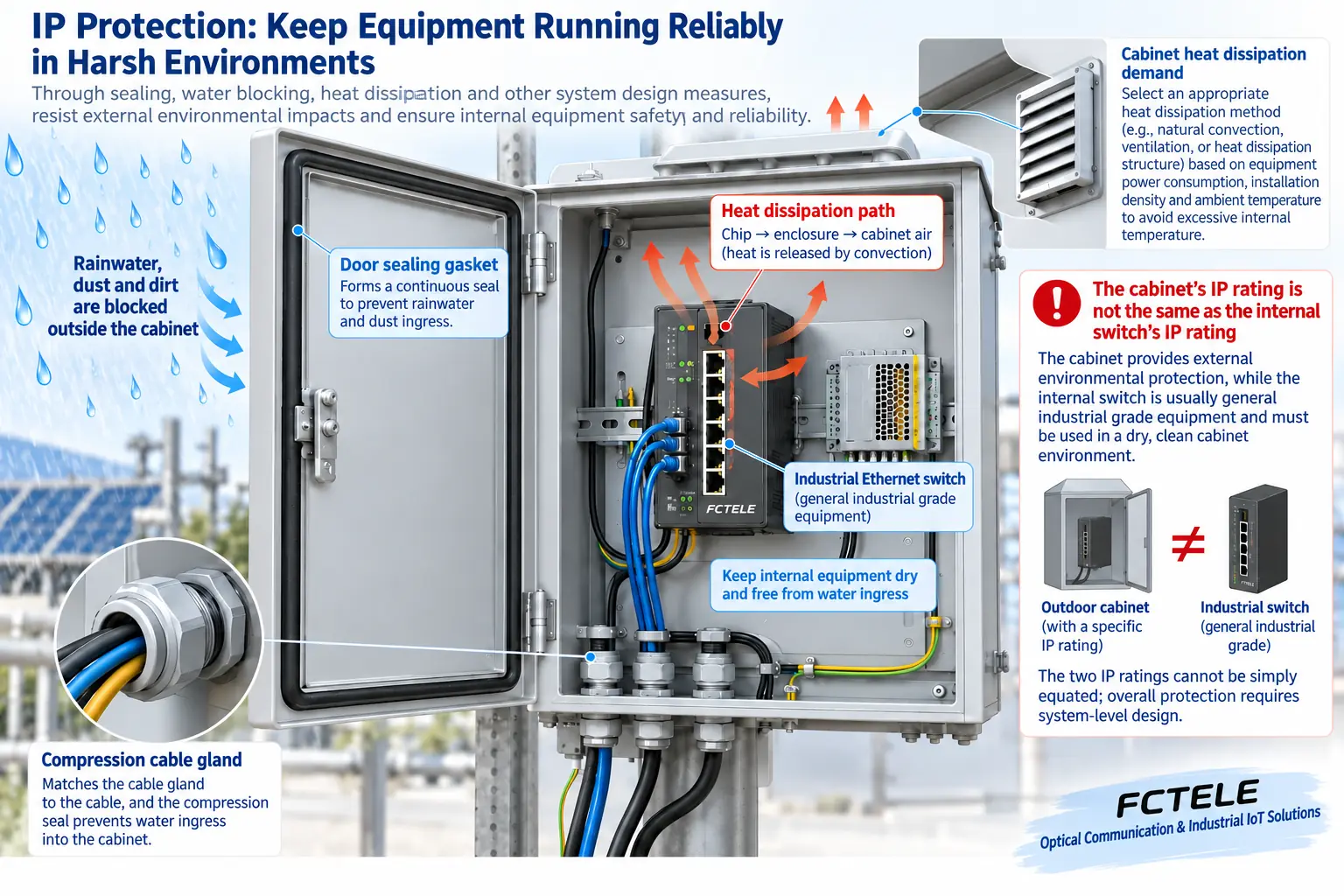
If a protective cabinet is used to protect an ordinary switch, external rainwater is blocked by the cabinet door seams and cable entries, but the rating of the switch itself does not change because of this. This combination also needs to consider cabinet heat dissipation, condensation, and sealing restoration after maintenance. Washing with the cabinet door open, or running cables through the cabinet top without sealing, may bypass the protection boundary.
3. A water protection number is not a pass for any scenario
Different water protection levels use different forms of water testing. Spraying, jetting, and immersion are not the same problem. You cannot simply infer from a “larger number” that it can withstand all cleaning conditions. In particular, the meaning of an immersion level differs from that of a water jet level: a higher immersion marking does not automatically cover all water jet tests, and the device may need the corresponding combined marking or an additional report.
For IPX8, the test conditions should be checked against the specific information agreed between the manufacturer and the user. It must not be understood on your own as unlimited depth or unlimited duration. The standard also includes conditions such as IPX9, so “the highest water protection is only 8” is not accurate. On site there are also variables such as water temperature, cleaning agents, pressure, and direction of action. Food processing washdown, outdoor heavy rain, and short-time immersion should not share a single “waterproof” conclusion.
Do not use direct water spraying on production equipment as an acceptance method. Without suitable test conditions, personnel, and records, doing so is both dangerous and cannot prove compliance with the standard. When water protection capability is needed, request the report for the corresponding level and complete model, clarify whether connectors and accessories are within the test scope, and then install according to the manual. For applications that still have questions, confirm with the manufacturer first rather than relying on trial and error.
4. Work backward from on-site exposure conditions to choose
Indoors in a control cabinet, first check whether the inside of the cabinet is dry, whether there is fine dust, whether the cabinet door is opened frequently, and whether the cable entries are properly handled. For outdoor locations, rain, standing water, and sunlight should be evaluated. It is usually more suitable to use an enclosure with a clear protection rating or corresponding equipment, rather than installing an ordinary DIN-rail switch exposed outside. In dusty environments, also look at dust particle size and deposition, and do not treat “industrial grade” as a dust protection certificate.
Take a hypothetical scenario: a campus camera network needs to install a switch in an outdoor box. Selection cannot only ask about the switch’s IP number. It should also check the enclosure rating, cable sealing glands, temperature rise inside the box, power supply heat dissipation, and condensation risk in humid weather. If the box is sealed well enough but traps heat inside, the network may still become unstable because the allowable temperature is exceeded. Protection and heat dissipation often need to be weighed together.
A certain managed switch detail page on the Feichang Technology website indicates IP40, fanless design, and DIN-rail or wall mounting. This information is suitable for checking cabinet installation conditions, but it cannot be used to claim that the device is rainproof when exposed or suitable for washdown areas. That detail page has inconsistent descriptions of port quantity. Specific ports, environmental range, and accessories should be confirmed with the current delivered model documentation; features from a single page cannot be generalized to the entire series.
5. Which capabilities still need to be checked separately?
The IP marking does not indicate salt spray resistance, corrosion resistance, or UV resistance, nor does it indicate vibration resistance, electromagnetic interference resistance, or explosion protection. A high-IP enclosure may still corrode in an unsuitable chemical environment. Use in hazardous areas also requires meeting the requirements of that area; dust and water protection cannot replace explosion-proof certification. Network access permissions, vulnerability management, and communication availability are also not guaranteed by the IP rating.
Acceptance can start with documents and installation status: the model matches the report; connectors and seals are complete; openings and cable entry methods meet requirements; sealing surfaces are free of foreign matter; cables have strain relief; the cabinet ventilation or heat exchange plan has a basis; and the original sealing can be restored after maintenance. Keeping these records together with on-site photos is more useful than writing only an IP number in a table.
Therefore, the IP explanation in 2201 is merged into this article, retaining the practical direction of “choose the level according to the on-site environment” and correcting the statements that material determines the level and that a water protection number is all-powerful. Enclosure heat dissipation, temperature and humidity, and network security are each expanded in separate articles, avoiding the interpretation of one protection marking as all industrial capabilities.
Sources:IEC 60529 standard information; Rittal enclosure protection rating information; Feichang Technology managed switch details. The illustrations are general principle diagrams, not evidence of level certification.
Translated from the Chinese technical article. Source first published: 2020-11-20. Source last revised: 2026-10-13T17:34:48+08:00. Read the Chinese source
