


Both types carry data between compatible Ethernet copper and optical interfaces. The main difference is the ability to read status, change supported parameters and deliver fault information to maintenance personnel. Unmanaged devices may suit a few nearby, easily accessed links. Distributed sites needing central alarms merit managed devices, but management does not mean a link can never fail.
1. Separate service forwarding from management
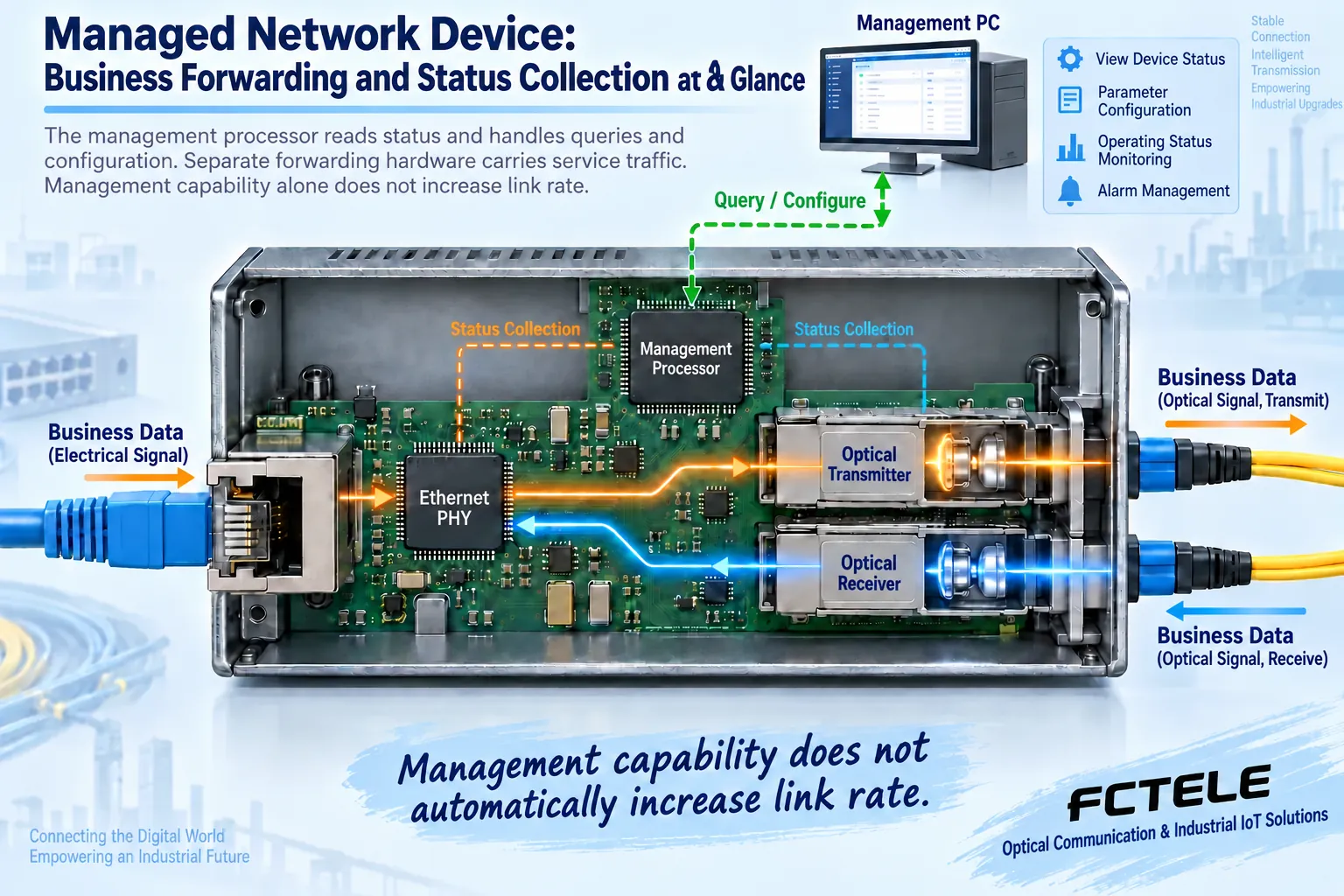
Terminal Ethernet data enters the copper circuit, is processed electrically and becomes light at the transmitter. At the other end, the optical receiver recovers the signal for copper output. Round trips require matching transmit/receive conditions at both ends. Management adds status collection and control beside this path; it does not replace conversion or automatically increase speed.
Unmanaged products normally offer limited observation and setup through LEDs, DIP switches or fixed settings. Check the manual for actual switch, link-fault propagation and flow-control support. A device without a management address may not respond to network probes; an inaccessible web page does not prove failure. Managed products may offer an address, web interface, command line or SNMP, but there is no universal package of all these interfaces.
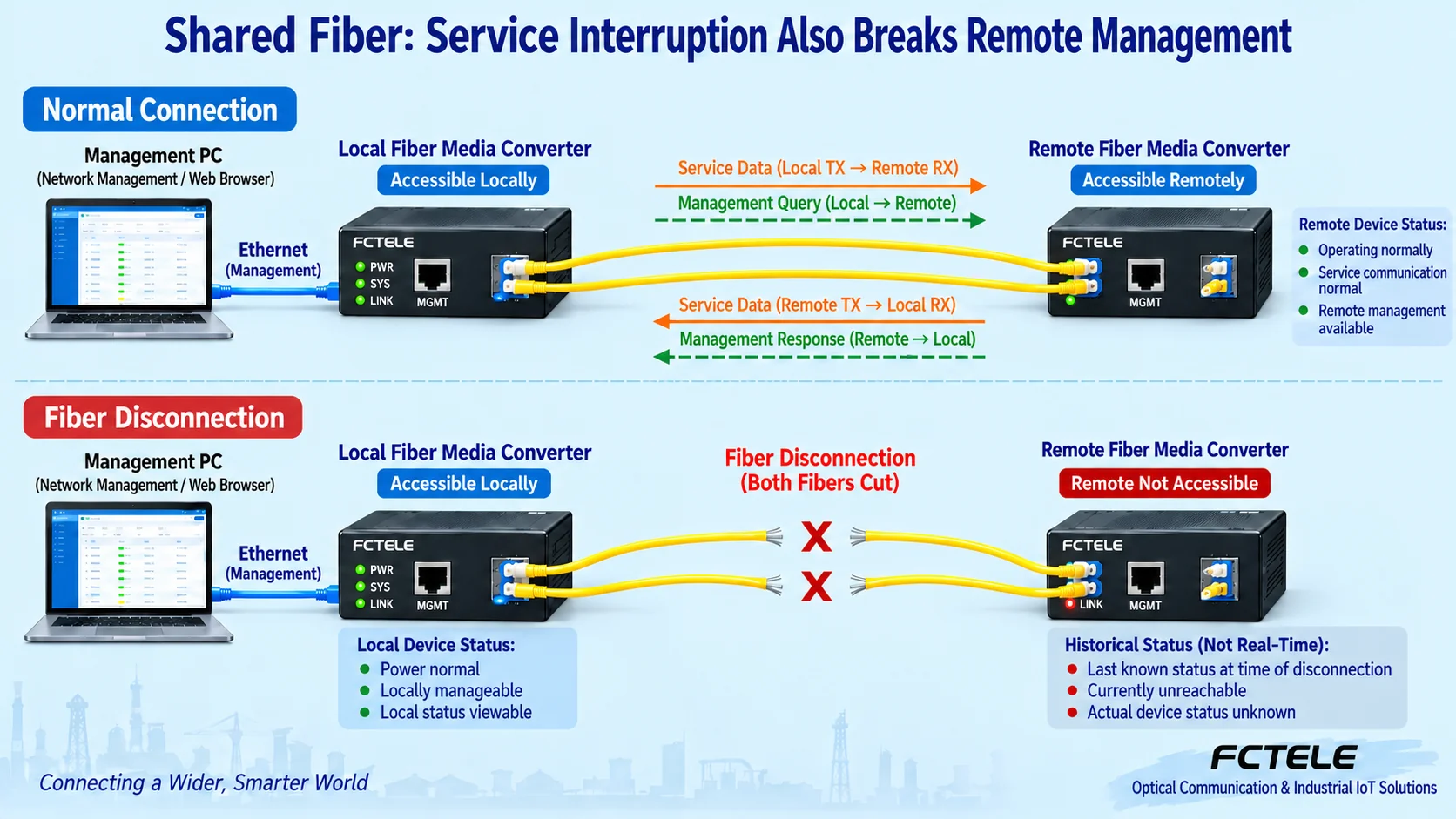
Think of the service path as moving data and the management path as reading status and applying settings along the way. This does not imply separate roads: management messages may share the same fiber, so remote responses disappear when it breaks. Ask which ports carry management rather than counting advertised access methods.
2. What management can actually reveal
Basic information includes link establishment, negotiated speed and operating status. Models with appropriate counters can show receive errors, discards and traffic changes. These are clues, not an automatic root cause. Flapping may involve power, cabling or compatibility; traffic near output capacity suggests congestion. One normal indicator cannot verify an entire application.
Optical power and temperature require compatible diagnostics in both optics and equipment. Fixed optics may not provide them, and a pluggable module does not guarantee every field appears on the web page. Even a power reading alone cannot distinguish fiber loss, dirty connectors, transmitter faults and receiver faults. Combine operating ranges, endpoint status and measurement conditions.
Management interfaces have different uses. Web pages suit manual inspection and setup; SNMP supports platform polling and notifications; a local control interface can support initial setup and recovery. One successful login does not verify every method. A protocol name also does not prove a third-party platform understands vendor-specific fields; check object definitions and actual integration.
3. Local/remote and in-band/out-of-band describe different things
Local and remote identify the managed object location: a central chassis card or an endpoint across fiber. In-band and out-of-band identify the message path: shared service facilities or a separately arranged management connection. Web and SNMP are not inherently in-band, and a control-interface name alone cannot establish a complete remote out-of-band network.
For example, a central computer may contact a converter address and the converter then request status from a compatible remote endpoint over fiber. This usually depends on that fiber. After a break, local status may remain available while fresh remote replies stop. Remote unreachable is a result requiring optical and power investigation. Timestamp saved status so it is not mistaken for a current reading.
Dedicated messages, Ethernet OAM or other mechanisms depend on model design. A remote processor is not the only possible management implementation, and optical-power monitoring alone is not complete remote management. List readable status, writable settings, supported endpoint combinations and diagnostics remaining during failure.
4. Choose by maintenance tasks
Consider one link between nearby buildings where personnel can reach either end and no centralized history is required. An unmanaged product may suffice if ports, fiber, speed and environment match. For many remote cabinets needing fault identification, port-change records and fewer visits, management offers clearer value. These are hypothetical examples, not customer cases.
Management does not remove the need for site labels. Names, addresses, chassis slots and ports on the platform must identify actual locations. More complex maintenance needs permissions, backups and change records. Remote port shutdown or reset affects service; use authorized windows and plan onsite recovery if access is lost.
The FCTEL remotely managed single-port Gigabit converter with external power lists local/remote management, OAM frames and link-fault propagation. Use it as a concrete reference for management boundaries, while confirming version, peer, platform and enablement. These features do not apply to every FCTEL converter and cannot replace a separately designed backup link.
5. Accept service and management separately
First verify bidirectional traffic in isolation or an approved test environment, checking speed, optical matching and the actual application. Then verify address reachability, accurate fields and alarms mapped to real equipment. With permission, simulate an interruption and record local and remote changes and post-recovery update timing. Agree permitted times per project.
Check changed default credentials, restricted management access and read-only users unable to modify service parameters. Do not expose management directly to the public Internet or infer security certification from management support. Handover records should explain capabilities, limits and evidence/recovery procedures during disconnection. Match maintainability to actual requirements rather than maximizing feature count.
Translated from the Chinese technical article. Source first published: 2020-08-26. Source last revised: 2026-10-13T16:02:51+08:00. Read the Chinese source
