


A program-controlled exchange handles telephone call connection.
A program-controlled telephone exchange uses stored programs to handle users’ call requests and decides how to establish, maintain, and release calls. An enterprise’s internal telephone switching system is often called a PBX, and it can connect extensions and external trunks according to the interfaces it supports. The switching here is not the same thing as an Ethernet switch forwarding frames by MAC address, and the ports or configurations of the two kinds of equipment cannot be directly interchanged.
Program-controlled describes the control method, while digital describes the corresponding voice processing or switching method; the two cannot be completely treated as synonyms. Different generations and models use different architectures, and their service functions also differ. To understand the equipment, first ask how the user places a call, how the system finds the called party, and through what channel the sound reaches the other end, rather than only looking at how many jacks are on the chassis.
What stages a call goes through
When an ordinary analog extension goes off-hook, the state of the subscriber line changes, and the switching equipment detects the corresponding event and handles it according to rules. After the user dials a number, the system collects and analyzes the number and decides the next step based on the extension table, permissions, and route selection. When the called party can be connected, the system arranges ringing and the corresponding call prompt; after the other party answers, it establishes the call path according to the mechanism.
After hang-up, the system identifies the release condition, ends the call, and reclaims resources. Busy, no answer, no available trunk, and line faults may produce different results, and one cannot conclude that the equipment is broken just because one kind of prompt tone is heard. The numbering plan, allowed calling scope, and interface signaling all participate in the process, and incorrect software settings may also make it impossible to connect calls even when the cables and voice circuits are normal.
Why signaling and voice should be understood separately
Signaling describes control information such as off-hook, dialing, ringing, answer, and release; voice carries the conversation content of both parties. Some interfaces organize them in associated lines or structures, while other interfaces use different control methods. Being able to hear sound does not mean all signaling is correct, and being able to send ringing does not prove that two-way voice has been connected.
The call processor controls connection according to rules, and the voice switching structure moves the corresponding samples or media according to the established relationship. The diagram separates purple control from blue voice to help understand responsibilities; it is not the internal wiring of a certain model. Do not infer from the presence of a CPU that every voice sample must be processed one by one by the same processor, and do not treat the management port as a voice service port.
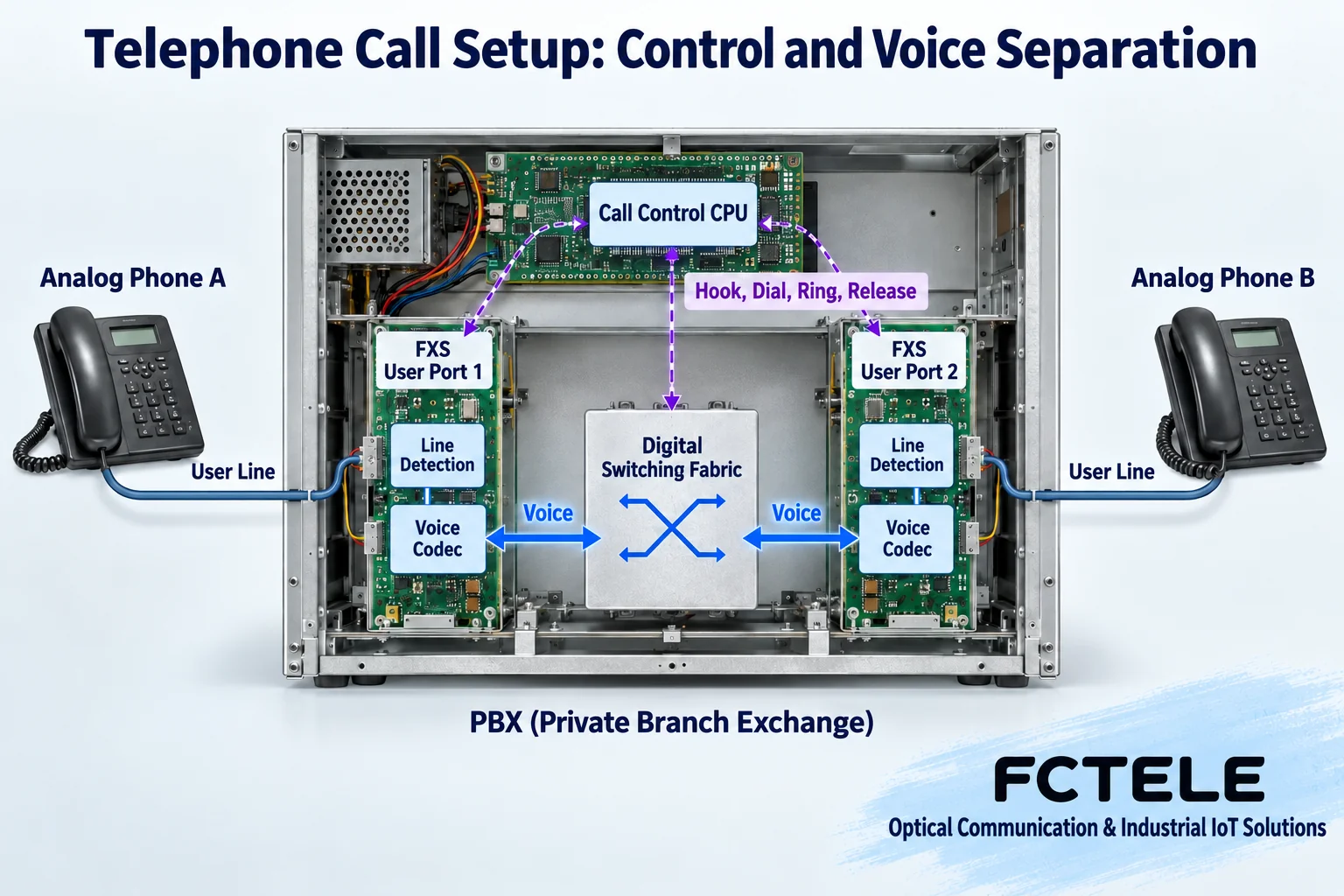
How analog voice enters digital switching
When a digital switching system connects to an analog telephone, the corresponding interface circuit handles the line and audio, and then obtains digital voice through sampling and encoding. The other end restores the audio according to the supported method. PCM is pulse code modulation, which describes using digits to represent sampled values; it is not responsible for deciding which extension is dialed, nor is it the complete functional name of telephone switching equipment.
Traditional G.711 voice can be understood as having a coding rate of 64,000 bits per second using 8,000 samples per second and eight bits per sample, with signaling and bearer overhead counted separately. This is a general coding example and does not mean that all telephone equipment can only use one coding. Time-slot switching or other switching structures also need to organize the corresponding speech channels to the correct output, and sampling and call control cannot replace each other.
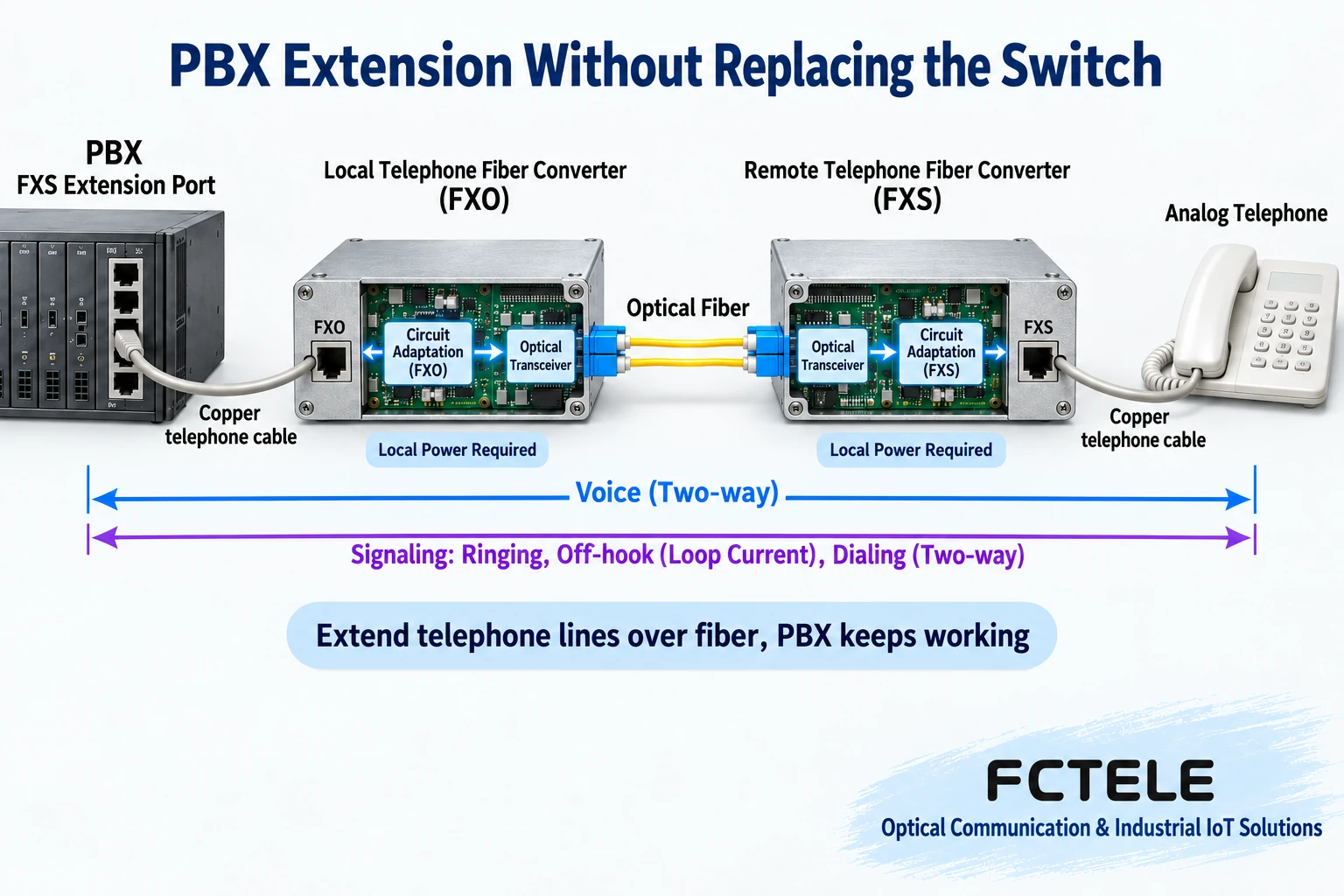
Extension ports and trunk ports have different roles
An analog extension usually connects to an FXS interface that provides subscriber line conditions, while FXO serves as one end for connecting to such a line. A digital trunk such as E1 also involves electrical, framing, clock, and signaling choices, and compatibility cannot be judged only by identical connectors. Options also called trunks in manufacturer materials may support different protocols, capacities, and interconnection conditions.
Analog subscriber access, digital trunk, and IP telephone access should be listed as separate requirements. Some equipment can provide voice gateway functions, but this requires clear interface and protocol support, and the two words program-controlled cannot be equated with built-in SIP, all codings, or network routing. When interconnecting with external systems, the interface definitions and supporting configurations of both sides should be obtained, and one should not find the correct port by trial-plugging unknown telephone lines.
The value and limits of program control
Organizing numbers, permissions, and some services through programs and data is usually easier to adjust and observe status than fixed wiring logic. But adding functions may still require corresponding hardware, authorization, or version; the conclusion in old articles that any new service can be realized by changing software alone cannot be carried over. Call forwarding, caller ID, and fax must also be verified according to the actual system and the support of the other end.
Port quantity, allowed concurrency, and trunk capacity are different indicators. Suppose there are multiple extensions internally, but the external trunk allows only limited concurrency; more people dialing outside lines at the same time may still encounter insufficient resources. Equipment size, power consumption, and maintenance cost are determined by the specific configuration, and being electronic does not guarantee that all projects are cheaper or more reliable.
Using Feichang Technology equipment to extend a remote extension
When a PBX’s analog extension needs to be extended across buildings, paired telephone optical multiplexers can be evaluated: the PBX’s FXS subscriber port connects to the local FXO, the optical path connects to the remote FXS, and then connects to the analog telephone. The optical multiplexer extends the supported line service, while the PBX still handles number analysis and call connection. Optical fiber does not deliver the central equipment’s power to the remote end, and the extension equipment also needs to meet its own power supply conditions.
The FCP-O16/FCP-S16 details in Feichang Technology’s pure telephone category list one to sixteen channels of FXO/FXS telephone and the corresponding installation and network management instructions, which can be used to check this kind of extension requirement. The number of channels, roles at both ends, optical ports, and power versions need to be confirmed according to ordering information, and one cannot infer from this model that E1 trunk, IP registration, or additional functions of all switching systems will definitely pass through.
Accept connection and extension separately
First use a known-good near-end telephone to verify the PBX extension, then test a short optical link according to the supporting requirements, and finally connect the formal line. Confirm incoming calls, outgoing calls, ringing, two-way voice, and hang-up release channel by channel; when caller ID or fax is needed, verify separately with actual terminals. An optical port light being on does not mean that extension numbers, call permissions, and telephone signaling are all correct.
Suppose the near-end extension is normal but the remote end does not work; you can locate the fault segment by segment along the local interface, paired equipment, optical path, remote subscriber line, and telephone; if multiple extensions are abnormal at the same time, also check common power, control, and trunk resources. Change only one condition at a time, keep records of normal and faulty states, and do not randomly pull cables for testing in an important operating communication system.
Delivery materials should let the next person maintain it
Keep the correspondence between numbers and ports, interface roles, versions, configuration backups, and test records. Clarify which extensions are directly connected, which go through optical extension, and which external calls depend on digital or IP trunks. Backup power, links, and recovery requirements for important services should also be accepted separately; having dual power supplies does not mean that any fault will not interrupt service.
Before expansion, recheck interfaces, concurrency, switching resources, and transmission capability. The final judgment should be able to explain who controls the call, where the voice goes, and how the remote line is extended, and should map each capability to actual materials and tests. Understanding a program-controlled telephone exchange in this way prevents treating a telephone optical multiplexer, PCM coding, or an industrial Ethernet switch as the same kind of equipment.
Material note: The schematic diagrams have been checked for technical content and are used to explain general mechanisms; they are not product photos or measured records. Specific interfaces, modes, and capabilities are subject to the selected model, version, and on-site verification.
Verification materials: ITU-T Q.512 Digital subscriber access interfaces for digital exchanges
Cisco voice gateway and telephone trunk interface descriptions
ITU-T G.711 Pulse code modulation of voice frequencies
Feichang Technology FCP-O16/FCP-S16 desktop telephone optical multiplexer
Feichang Technology pure telephone optical multiplexer category
Related technical topic: How to maintain a program-controlled telephone exchange: segmented troubleshooting of power, interfaces, calls, and configuration
Translated from the Chinese technical article. Source first published: 2019-11-13. Source last revised: 2026-10-13T03:57:28+08:00. Read the Chinese source
