


Define the task first, then choose the series
H3C switches should be selected as specific series and models according to deployment location, ports, and business needs. Campus access, data center interconnection, and factory site access face different loads and maintenance conditions, and the brand name cannot be treated as a uniform performance guarantee. Old articles that list models from many years ago, market share without a time range, and all product certifications cannot support current procurement decisions.
First write down which terminals the device must connect, where it uplinks from, which network functions are needed, and how large an impact is allowed when a fault occurs. Then check the vendor’s current product categories for applicable models. The series is used to narrow the search range, but the specific hardware, software version, and ordering combination still need to be checked. The same prefix or a similar appearance does not prove that ports, capacity, and environmental capabilities are the same.
How campus access, aggregation, and core divide the work
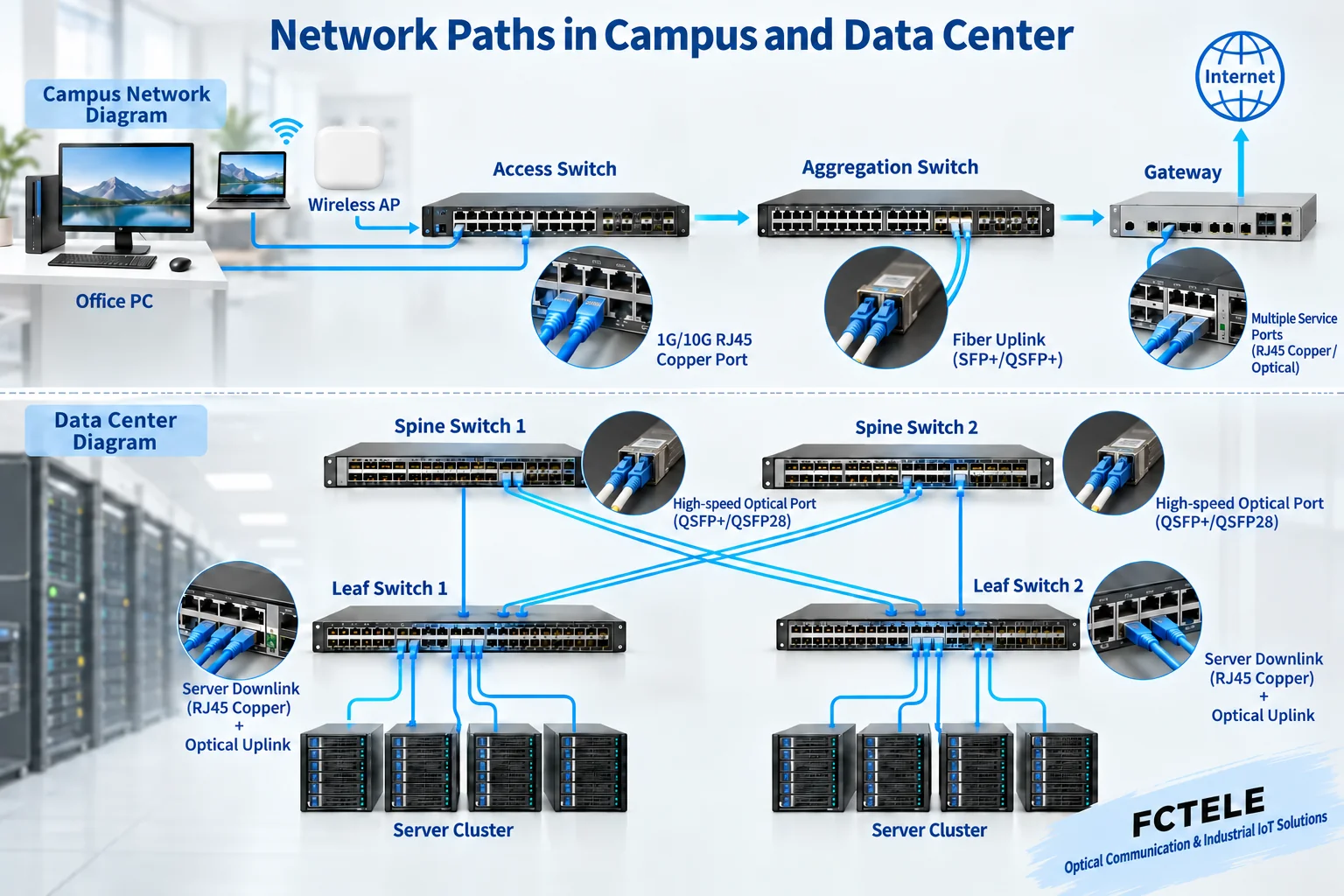
Access switches usually connect computers, wireless access points, or other terminals. Aggregation organizes traffic from multiple access areas. The core handles interconnection over a larger scope. Frames enter the switching chip from the ingress transceiver circuit and move to the egress according to MAC, VLAN, or supported Layer 3 rules. The role division reflects topology and load, not that each device can only do one fixed type of work.
In a school, classroom terminals may first connect to a floor switch and then feed into a building uplink. If all floors access central services at the same time, the traffic carried by the shared egress should be calculated, not just the number of access ports. Cross-subnet access also requires the corresponding gateway, routing, and access policies; network management functions cannot automatically replace Layer 3 service design.
Why data centers have different concerns
Servers generate a large amount of east-west traffic between each other. A leaf-spine topology uses leaf nodes that connect servers and upper spine nodes to organize paths, making it easier to evaluate multiple connections and fault impact; it is not the only solution for every data center. Service throughput, egress contention, congestion control, and port combinations need to be checked against the actual application and architecture.
When comparing products, distinguish between the nominal interface rate, switching capacity, and forwarding capability at a specified frame length. Do not treat maximum capacity directly as the speed each service can obtain. Redundant devices, link protocols, and server-side connections must also be planned together. A nice topology diagram does not mean fault convergence and application recovery acceptance have already been completed.
Modular examples in official materials
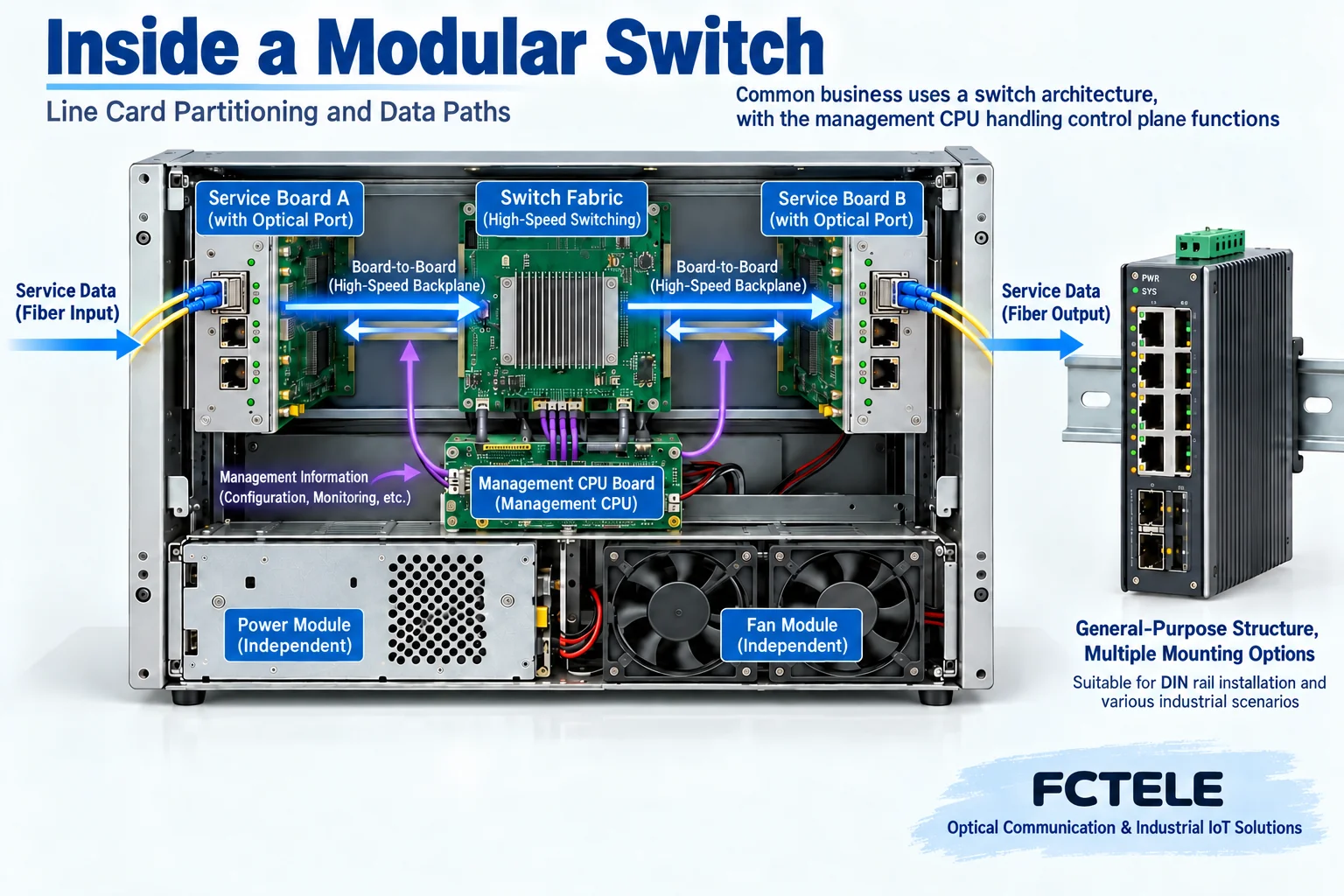
When checking, H3C official categories provide separate entries for campus and data center products. The S12500G-EF details list the chassis, management and routing processing board, switch fabric board, service boards, and power supplies as configuration elements. This can be used to understand that modular selection requires multiple components to work together; here only the public structure of this specific series is cited, and it is not generalized to mean that all brand devices use the same design.
In general mechanisms, service boards handle port access, the switching fabric organizes forwarding between boards, the management and processing part handles control, and power and cooling ensure operation. Adding a service board still requires checking chassis slots, software support, switching resources, and power conditions. A module being insertable does not mean the combination is supported, and modularity cannot be used to infer that any component can be replaced while powered.
Fixed-port devices also need to be checked as a combination
Fixed-port devices integrate the corresponding interfaces into one chassis. Deployment may be more direct, but expansion usually requires adding devices or adjusting uplinks. Optical and electrical port rates, installable modules, PoE power supply, and shared resources should be checked item by item. More ports are not necessarily more suitable, and idle ports do not mean switching resources can increase without limit.
Software support and licensing may also affect available functions. After writing a feature from the materials into the requirements, confirm that the selected model and software combination actually supports it, and test it with the corresponding configuration. Merely seeing a protocol in a series introduction cannot directly list it as a delivered capability of the whole device; upgrade paths and rollback conditions between different versions must also be clarified.
How to distinguish industrial sites from equipment room conditions
An indoor temperature-controlled equipment room differs from an outdoor cabinet, a vibration area, or a site with unstable power. Industrial applicability should have temperature, power, installation, and test data corresponding to the model, and should not be judged by a metal shell, rack, or brand name. Even when industrial equipment is used, it should meet the cabinet, protection, grounding, and heat dissipation conditions it requires.
The Feichang numbered 3243 mini managed industrial switch details provide four gigabit electrical ports, two gigabit optical ports, and optional PoE. This can serve as a specific example for checking requirements for optical uplinks and local on-site access. It has a different task from a large modular core, and the appearance of a small industrial device cannot be used to infer the capabilities of a large device, nor should the PoE option be written as a default function of the entire series.
Check interfaces and protocols first for cross-vendor connections
When connecting H3C devices with equipment from other vendors, first confirm port rates, optical module support, single-fiber or dual-fiber, and transmit-receive pairing, then check VLAN tags, routing, and access rules. Even if public standards are the same, implementation and configuration conditions still need to be confirmed. Private ring networks or stacking cannot be inferred to interoperate merely because the names are similar. An optical port light being on is only the basic link condition; it does not mean the service return path has been established.
For example, when campus aggregation connects to a production area, record separately the path from the industrial terminal to aggregation and from aggregation to the server. Testing should cover actual requests and responses, allowed load, and approved fault scenarios. If one direction works but two-way communication fails, check the return route and policies; do not immediately attribute all problems to vendor incompatibility.
How procurement conclusions can leave evidence
Write requirements as verifiable items: port and uplink combinations, network functions, environment, management entry points, spare parts, and maintenance support. A quotation must correspond to the complete model, software, and options, and cannot just say one unit of a certain series. Ask the supplier to point out items requiring additional modules, licenses, or verification, so that uplinks, power, or functions are not found after purchase to be outside the quoted version.
Acceptance records should retain the document version, configuration, test load, and results, and distinguish chassis, link, and application fault recovery. Historical models can still be used to maintain existing systems, but new procurement should check current supply and service conditions. The final selection basis is project conditions and actual evidence. This article does not provide unverified brand rankings or universal certification promises for all models.
Documentation note: The schematic diagrams have been checked for technical content and are used to explain general mechanisms. They are not actual product photos or measured records. Specific interfaces, modes, and capabilities are subject to the selected model, version, and on-site verification.
Verification materials: H3C official switch product categories
H3C S12500G-EF modular configuration description
Feichang mini four-electrical two-optical managed industrial switch
Feichang industrial switch categories
Related technical topics: How to configure a switch command line: operation modes, running settings, and save verification How to troubleshoot no image on a network video decoder: power, stream, decoding, and display output How E1 carries video and audio: encoding bitrate, framing, clocking, and peer matching
Translated from the Chinese technical article. Source first published: 2020-03-02. Source last revised: 2026-10-13T03:22:35+08:00. Read the Chinese source
