


SERIAL / HARDWARE FLOW CONTROL
When should a receiver ask its sender to pause?
Before receive space is exhausted. Compatible RTS/CTS flow control feeds readiness back to the transmitter, which obeys its documented stopping rules. Characters already under way or delayed through intermediaries still need storage. Verify the whole control path, worst-case response and application outcome; a three-wire interface cannot gain missing handshake signals through a software setting.
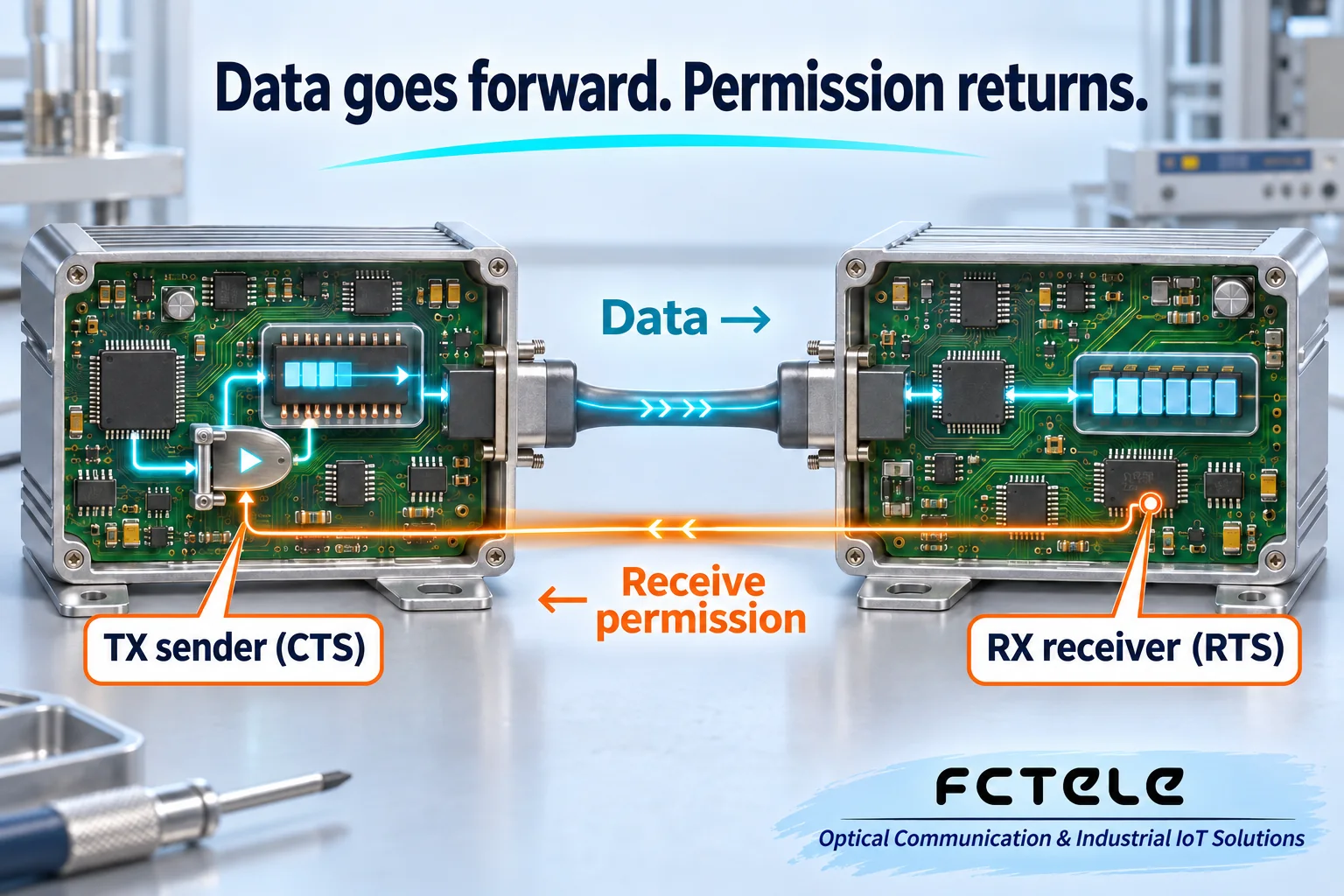
01 · Receiver sends permission
Data travels toward the receiver. In a compatible modern automatic mode, receive permission returns to the sender.
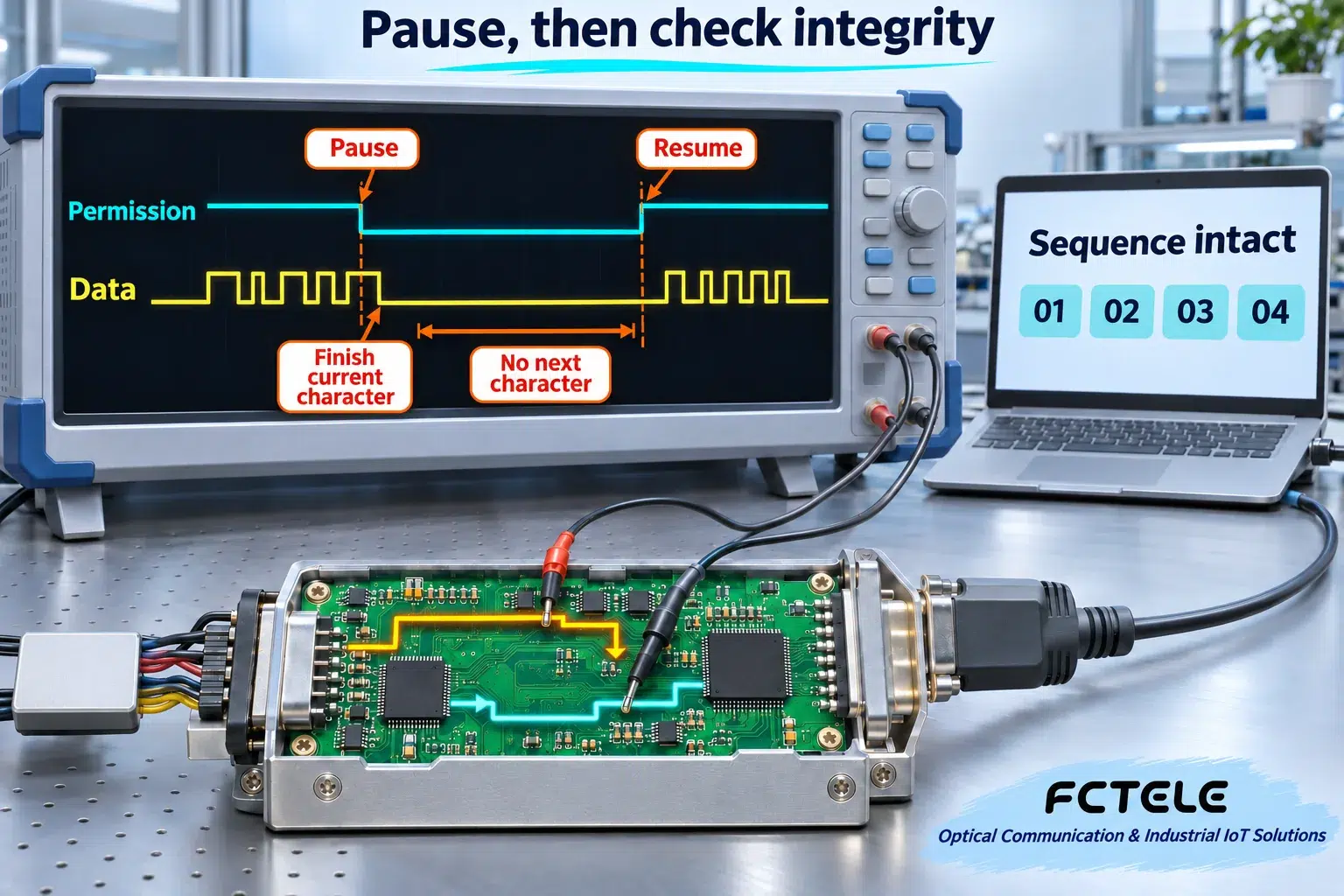
02 · Finish, then pause
A documented transmitter may finish its current character before stopping new starts. Withdrawal is not instant removal of in-flight data.
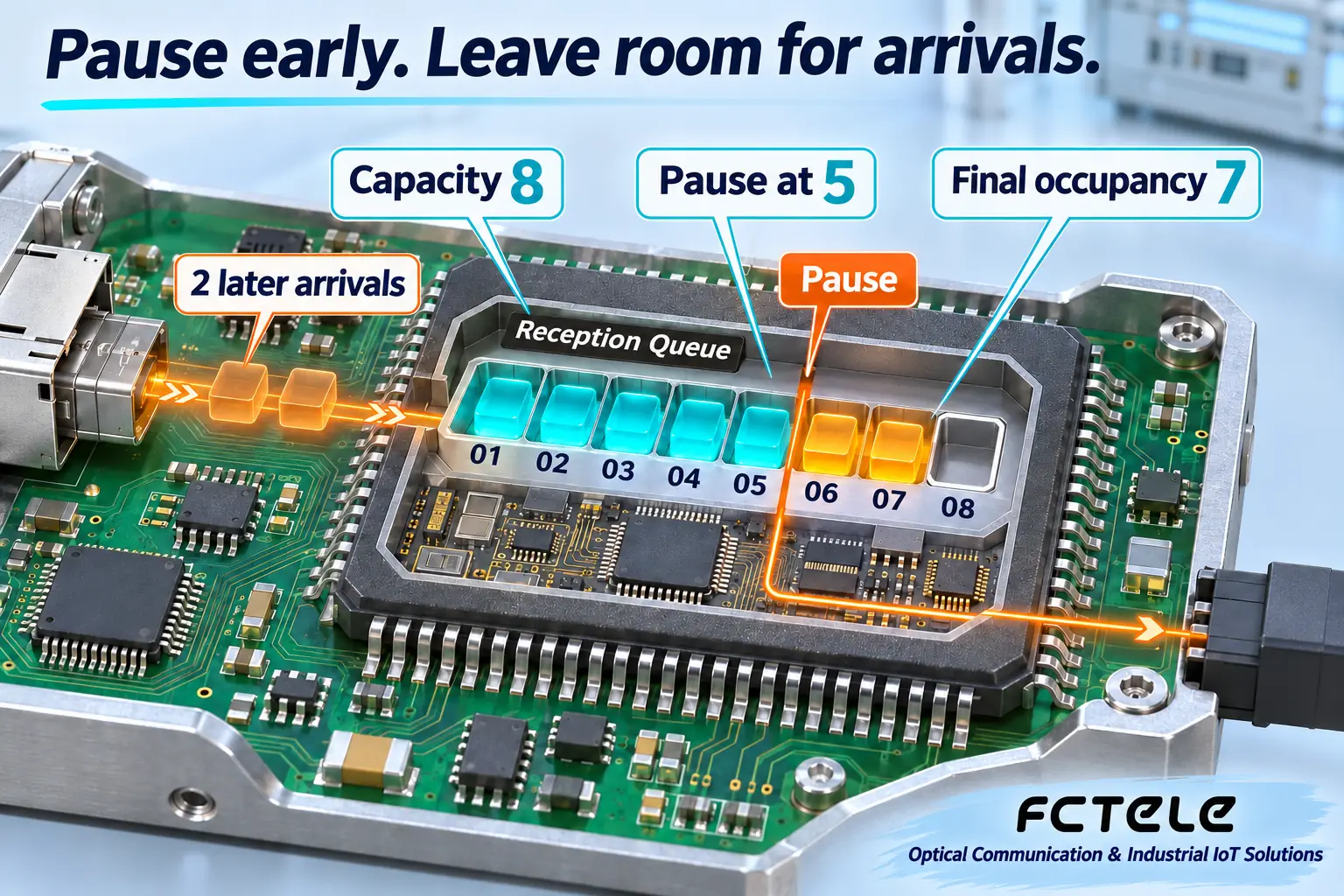
03 · Reserve headroom
Teaching example only: pause at five occupied positions; two assumed later arrivals leave final occupancy seven of eight.
Trace both directions
Confirm receiver RTS reaches the peer CTS in the documented operating mode.
Count final arrivals
Observe withdrawal and the last complete character; test headroom under relevant load.
Verify recovery
Restore consumption and check sequence, content and order after permission returns.
Selection and verification checklist — expand
| Check | What to confirm | How to verify |
|---|---|---|
| Interface | Control conductors and polarity | Exact manuals and supported diagnostics |
| Pause | Stopping boundary and remaining space | Controlled bench observations |
| Resume | Complete ordered messages | Known sequence, length and checksum |
How can a serial receiver ask its peer to wait before receive space runs out? When both ends support a compatible modern RTS/CTS hardware-flow-control mode, the receiver feeds its readiness back to the sender. The sender uses that permission to decide whether to start another character. A pause request and the arrival of the last character are different events: a character may already be in progress, and a link or intermediary may still hold data. Flow control must therefore act before storage is exhausted. This article uses a hypothetical bench setup, not a Feichang model’s capacity, wiring definition or timing specification.
How receive space becomes transmit permission
A UART, or universal asynchronous receiver/transmitter, sends and receives characters bit by bit using an agreed format. A FIFO is a first-in, first-out storage queue. In one common modern automatic-flow-control arrangement, the receiving UART monitors queue occupancy and uses its RTS output to indicate whether reception should continue. That state reaches its peer’s CTS input, where transmit-control logic determines whether another waiting character may begin. Data travels toward the receiver; receive permission travels back toward the sender.
The traditional names, Request To Send and Clear To Send, originated with terminal-to-modem interfaces. Modern equipment may use RTS for receive flow control, retain traditional handshaking or assign another function. Check the documented direction and operating mode; an RTS label alone does not establish automatic receive-space signaling. The illustration shows just one data direction in a modern automatic mode. Bidirectional traffic needs the corresponding conditions independently in the other direction.
UART pins must also be distinguished from external RS232 voltage levels. A chip document may describe an active-low control input; a line transceiver changes the electrical representation, so that high/low relationship must not simply be copied onto an external connector. This article uses the functional terms permission granted and permission withdrawn. It specifies neither positive/negative voltages nor DB9 pin assignments for unfamiliar equipment. Both ends’ actual terminals, reference, polarity and wiring must be verified.
Why the pause request must precede a full queue
When receive occupancy reaches a pause threshold, the control output changes first. That change passes through line circuits and the connection before the peer’s transmitter can respond. For example, the automatic-CTS behavior described in TI’s TL16C752C manual finishes a character already in progress after permission is withdrawn, then does not begin the next character. This is a documented component example, not a promise that every serial product has the same stopping boundary.
Cutting a character off partway could leave incomplete data bits or a missing valid stop bit. Stopping at a character boundary helps preserve the character already under way. A character completing after the pause request therefore does not by itself show a flow-control failure. Observe when the sender recognizes the changed permission, whether subsequent characters start and when the final complete character arrives.
USB adapters, drivers, network serial servers and optical extenders add another question: where is the control state actually processed? Some hardware handles it locally at the UART, while other arrangements use software or a remote mapping. An application ceasing to write does not erase data already queued. Do not reduce the entire pause response to copper propagation time or infer handshake latency from an Ethernet port’s speed.
Eight teaching positions make headroom visible
Assume a teaching receive queue has eight positions and withdraws permission when five are occupied. During the assumed link’s response interval, two more complete characters arrive. Final occupancy becomes seven, leaving one position. This illustrates advance action. Two in-flight characters are an assumption about this example, not a universal UART behavior or a recommended five-byte threshold for any product.
For comparison, if the same eight-position queue waits until it is full before withdrawing permission, those two later characters have nowhere to be stored normally. Enlarging an application array may not change this hardware handoff at all. Choose headroom using the worst pause response, character format, any character already being received and intermediary buffering. Average software load is not enough.
At 115200 baud with 8N1, a character occupies one start bit, eight data bits and one stop bit: ten bit times, approximately 86.8 microseconds. This connects continuous character count with time. It is neither a measured flow-control delay nor permission for software to sleep for that interval. In verification, record the actual ordering of permission withdrawal and final-character completion, and examine the worst result across relevant loads.
Why resume and pause thresholds are often different
As receive software removes characters, occupancy falls and permission can eventually be restored. In the same teaching model, assume a pause threshold of five and a resume threshold of two. Falling to four still leaves transmission paused; reaching two allows it again. Separate state boundaries avoid repeatedly toggling permission when occupancy fluctuates around a single point.
The interval also provides room when transmission resumes, but it does not increase long-term processing capacity. If the downstream consumer remains slower than the upstream producer, pauses will recur and the sender’s own queue may eventually fill. Flow control coordinates finite storage. It does not increase throughput or confirm application-message completeness and transaction success.
Pause and resume conditions may be programmable, fixed or dependent on FIFO and automatic-mode enablement. An interrupt trigger threshold need not be the flow-control threshold. If the product offers only a hardware-flow-control switch, do not invent an adjustable watermark menu. Check the firmware documentation or obtain confirmation of the actual behavior.
How to verify that the sender obeyed
On an authorized bench outside production, establish a short link using ports explicitly supporting compatible flow control. Send known messages with sequence numbers, lengths and an application checksum. Use supported diagnostics and appropriate instruments to observe data and permission, slow receive consumption under controlled conditions until a pause occurs, then restore consumption. Do not short unidentified pins or apply external voltage to force a control state.
Observation points include the receiver’s permission output, the sender’s recognized permission, transmitted data and received sequence. First establish that withdrawal prevents new character starts. Then count the last arriving characters and check that receive headroom accommodates them. After resumption, verify content, order and sequence rather than merely a flashing TX indicator. If an internal boundary cannot be measured directly, state that limitation; application-log time is not pin timing.
Separate failures by evidence. If the receiver withdraws permission but the sender still reads permission granted, investigate the control path, mode and polarity. If the sender recognizes the change yet continues transmitting, check automatic-CTS enablement and the transmit implementation. If it stops according to specification but data still overruns, investigate headroom and other downstream queues. A sender that never resumes may be waiting for a genuine resume condition; blindly disabling flow control hides that distinction.
Three-wire interfaces cannot supply missing handshake signals
Feichang serial servers and interface converters serve different field connections. Verify the exact interface version in current product documentation. A converter described as three-wire RS232 cannot be assumed to provide RTS/CTS simply because it supports RS232. For legacy equipment needing handshaking, acceptance conditions should include control lines, driver mapping, automatic-control location, disconnected state and recovery behavior.
Two-wire RS485 direction enable determines who may drive a shared pair; it is different from receive-permission feedback. XON/XOFF software flow control sends control characters within the data path, requiring correct interpretation and consideration of conflicts with payload values. These methods are not interchangeable. Advance pausing and sufficient headroom work only when the entire connection supports the same agreement.
Sources and scope
TI TL16C752C — automatic RTS/CTS, sections 8.3.1.2–8.3.1.4 · Feichang serial-server product reference (Chinese)
The chip document establishes general mechanisms, not chip selection, capacity, thresholds or timing in any Feichang product. Only one data direction is shown; actual terminals and external polarity require both manuals.
Translated from the Chinese technical article: Read the original Chinese article.
Common questions
Do characters received after permission withdrawal prove flow-control failure?
Not necessarily. A character already in progress may finish under the documented device rules, and feedback or intermediaries take time to respond. Check whether new characters still start and reserve space for final arrivals.
Can any three-wire RS232 interface enable RTS/CTS?
No. Verify physical control signals, direction and driver support. A software option cannot add handshake conductors absent from a three-wire data interface.
Why use different pause and resume thresholds?
Separate occupancy boundaries reduce repeated switching around one point and provide room at resumption. They do not increase sustained throughput; the actual hardware and firmware determine the thresholds.
Further reading
UART receive FIFO overrun · UART parity checks and their limits
