


A LoRa industrial gateway usually hands data from wireless terminals to a system on the other side, but “gateway” does not mean every device can automatically recognize sensors, convert any protocol, or connect directly to a cloud platform. First distinguish wireless modulation, on-site networking, and network-side data format, then look at which part a specific product handles. This article uses Feichang Technology LoRa products to explain how signals enter the wireless link, how they are restored as data, and why selection needs to consider both interfaces and capacity.
1. LoRa, LoRaWAN, and industrial gateways are not the same concept
LoRa mainly describes a wireless modulation technology and determines how data is represented in a wireless signal. LoRaWAN is a protocol system that defines network communication rules on top of the related wireless technology, involving different roles such as terminals, gateways, and network services. Devices using LoRa wireless may use a vendor’s own point-to-point or aggregation protocol, and you cannot assume it is a standard LoRaWAN device just from the name.
Common LoRaWAN networks use a star-shaped aggregation architecture, where gateways forward terminal messages to network services for processing. What industrial products call a gateway may also organize switch status into Modbus TCP data, or perform another kind of wireless-to-wired handover. These two types of devices may differ in configuration, messages, and platform interfaces. When purchasing, ask how terminals connect, which side initiates reading, and how data is represented, rather than only confirming that there is an antenna and an RJ45 port.
2. How on-site status becomes a wireless message
Take a float switch as an example. The terminal’s input circuit first detects whether the contact is closed, and the processor then forms data containing the corresponding status according to the device protocol. When it needs to send, the wireless chip maps this data into the specified radio-frequency signal and radiates it through the antenna. The receiving device obtains the signal through the antenna, the wireless circuit completes reception and demodulation, and the corresponding processing program then determines whether the message and data are valid.
LoRa uses the idea of chirp spread spectrum. A chirp can be understood as a signal whose frequency changes over time, like a tone sweeping through a range of pitches in a regular way; this analogy only helps understand frequency change and does not mean the device is playing sound. The receiver uses the known signal structure to recover symbol information and then obtain the message content. It transmits encoded information, not the switch contact or analog current placed into the air as-is.
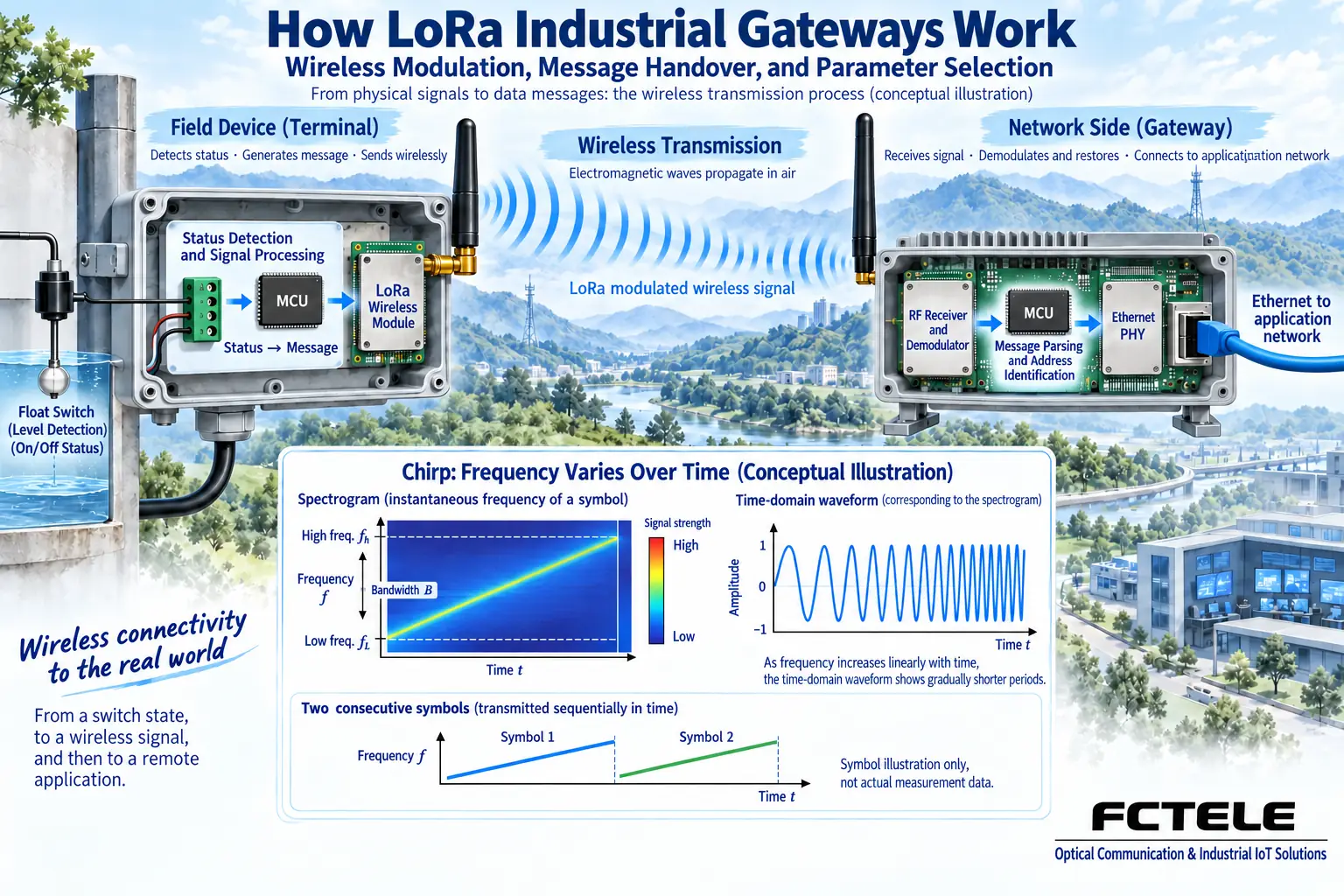
3. Successful wireless reception does not equal correct application operation
After a gateway receives a message, the application still needs to identify the source and application meaning. The physical layer may be able to demodulate, but if the message format is incompatible, the terminal may still be unable to connect; even if wireless parameters match, wrong addresses, operating modes, or data mapping may also cause read failures. Also distinguish wireless message verification from application-layer confirmation: the former cannot prove that a platform field corresponds to the correct device, and the latter cannot directly prove that an on-site action has been completed.
Transparent transmission usually means the device forwards data or status according to an agreement, and does not mean it understands all application protocols. A node that only receives switch status cannot read any analog value just because it uses LoRa; a terminal with a serial port does not mean it supports collection from all instruments. The interface layer, wireless protocol, gateway output format, and application fields should be listed separately, and problems should be checked layer by layer, avoiding calling every abnormality “weak signal.”
4. Why coverage distance and update capability should be considered together
Wireless reception performance is related to bandwidth, spread spectrum parameters, transmission conditions, antennas, and the propagation environment. In general LoRa systems, adjusting parameters often changes the trade-off between reception capability and airtime; a slower data configuration or a longer message may make one transmission occupy more time. Which parameters a specific device exposes and what ranges are available should be based on the delivered documentation, and you cannot write all chip capabilities as configurable in gateway firmware.
Airtime is the time a message takes to be sent on the wireless channel, including organizational overhead beyond the effective data. Adding nodes, increasing update frequency, or making many retries can all increase occupation of shared resources. Fast updates from a single node over a short distance do not prove that dozens of nodes can maintain the same performance in an obstructed environment; a wired port being 100 Mbps does not mean the wireless segment has 100 Mbps throughput.
On-site propagation is also affected by metal cabinets, walls, terrain, antenna height, and surrounding interference. Distances given on official websites usually have corresponding test conditions and cannot be directly treated as a guarantee for any site. When planning, first confirm the configuration and installation conditions used, then record message updates, errors, and retries at the target location. Signal strength is only part of the clue and needs to be judged together with actual update results.
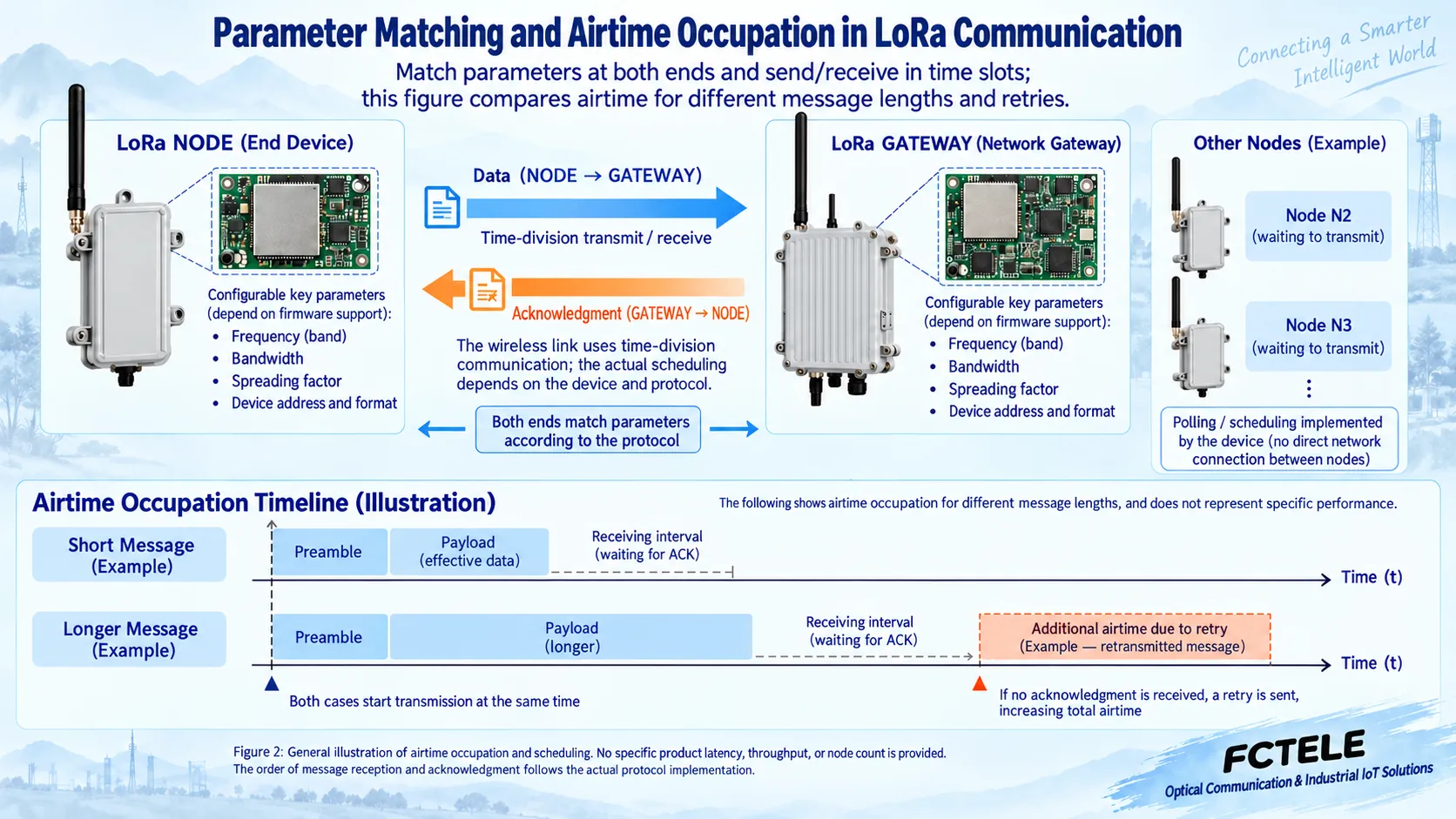
5. How three Feichang Technology products correspond to different needs
The public information for FCT-303L describes it as a LoRa switch-status multi-point aggregation network device that can hand over the corresponding status as Modbus TCP and provides management methods such as a network interface, WEB, and SNMP. It is suitable as a selection clue for aggregating switch status into a network system, but terminal matching, channel mapping, and application read/write relationships still need to be confirmed. A management web page and a data service serve different purposes, and being able to log in to a web page cannot replace point-by-point acceptance.
The documented purpose of FCT-K8L is 1–8 channel switch-status LoRa transparent transmission. The documentation includes paired transmission and corresponding networking modes, and lists output status settings for when wireless is not communicating. When choosing it, check communication failure together with output status, rather than only looking at the number of terminals. One model listing modes such as Mesh does not mean all LoRa gateways or LoRaWAN networks use mesh forwarding, and even less does it prove that devices from other vendors can join directly.
The documented purpose of FCT-042909-4-1 is 16-channel DI/DO/AI/AO switch-status and analog transmission, and the product documentation also has corresponding paired transmission and collection application descriptions. The analog type, range, port assignment, and aggregation method must be confirmed independently, and you should not infer from the product title that 16 channels can simultaneously use all signal types arbitrarily. Whether it is compatible with a certain gateway, whether serial handover or an additional collection program is needed, all require clear configuration documentation.
6. What to check separately for low power consumption and industrial grade
LoRa supports low-power applications, but that does not mean every industrial gateway can run for a long time on a small battery. If a node needs continuous collection, maintained output, continuous command reception, or to drive external sensors, its energy consumption may differ greatly from a device that reports at low frequency and sleeps. The gateway and external interfaces also need power. Power consumption and battery life must be calculated based on the specific operating mode and load, and you cannot give a multi-year endurance promise based only on the LoRa name.
Industrial grade is also not a universal guarantee covering all environments. These Feichang Technology product pages give corresponding enclosure, installation, power, and environmental information, which should be checked against the specific version. Installation inside a metal cabinet also requires considering antenna position; external electrical ports need confirmation of ratings, protection, and isolation boundaries. The local response time of an electrical contact cannot be directly treated as wireless end-to-end control latency, nor can it be used to conclude that it is suitable for a certain hard real-time control loop.
7. From short-link verification to complete system acceptance
First use a pair of devices confirmed to be compatible to establish a short link, check the interface, wireless configuration, address, and message format, change inputs point by point, and observe the corresponding output or network data. After passing, add other nodes, run according to the target messages and update requirements, and record update intervals, retries, disconnections, and recovery. Finally connect to the actual site and upper-level system, compare the meaning of data in each segment, and do not only look at one wireless indicator light.
For control projects, also test the state after disconnection, restart, and recovery under controllable maintenance conditions, distinguishing command reception, contact action, and actual on-site feedback. Wireless frequency, power, and usage conditions should be confirmed according to deployment region requirements, and the website phrase “free frequency band” should not be treated as a conclusion applicable to all locations. Save device versions, parameters, point tables, test conditions, and results, so that later device replacement has a reproducible basis.
The work of a LoRa gateway can be divided into three things: obtain the required wireless message, hand the data to the specified application processing, and then send it to the next system segment through a suitable interface. Distance, capacity, power consumption, and protocol each have boundaries. Only by checking these relationships clearly can you select equipment that truly corresponds to on-site needs, rather than misunderstanding “long-distance wireless” as reliable and immediate transmission for any application.
Sources: Semtech LoRa technology Q&A ; Semtech LoRa and LoRaWAN principle materials ; LoRa Alliance protocol description ; Feichang Technology FCT-303L ; FCT-K8L ; FCT-042909-4-1 . The principle diagrams are general mechanism illustrations, not physical objects, measured waveforms, or certification materials.
Deployment extension: How LoRa and 4G remote measurement and control are networked: point tables, interface handover, and control confirmation .
Common on-site questions
If a LoRa gateway has an RJ45 port and an antenna, can it join any LoRaWAN platform?
No. LoRa modulation and LoRaWAN network rules are different, and industrial devices may also use private paired transmission or aggregation protocols. You should confirm terminal matching, address and operating mode, gateway output format, and platform requirements. Being able to demodulate wirelessly does not mean the message or point table is compatible, and being able to access a management web page cannot replace application data acceptance.
If LoRa parameters are adjusted to make long-distance reception easier, will multi-node updates definitely be faster?
This cannot be guaranteed. Configurations such as bandwidth and spread spectrum may change the trade-off between reception capability and airtime, and messages, node count, and retries will jointly occupy resources. The parameters actually exposed should be confirmed by product version. Observe update intervals and abnormalities at the target location and with the final node count, rather than extending a single-node short-distance result to the entire site.
If a wireless command receives confirmation, does that prove the remote actuator has completed the action?
Not necessarily. Message reception, output contact change, and the actual action of the controlled device are different stages. You should clarify which layer the confirmation comes from, then check the real feedback. Output behavior during disconnection, restart, and recovery also needs to be verified by model; you cannot derive end-to-end hard real-time, safety control, or multi-year endurance promises from local contact response or the LoRa name.
Continue reading: How LoRa and 4G remote measurement and control are networked: point tables, interface handover, and control confirmation ; How do switch-status optical transceivers achieve stable long-distance transmission? Dual-fiber backup, status retention, and wiring selection ;
Translated from the Chinese technical article. Source first published: 2024-10-31. Source last revised: 2026-10-15T22:31:43.863560+08:00. Read the Chinese source
