


When distributed sites need to send operating status to a remote platform, LoRa can handle low-speed wireless field acquisition, and 4G can handle wide-area networking from the site to the platform. Between the two network segments, the status also needs to be organized into data that the platform can understand. Choosing the right device is only the first step: interfaces, wireless parameters, application protocols, update cycles, and exception handling all need to correspond. This article uses digital input aggregation as the main line to explain networking. Analog quantities and control functions should be checked separately according to the delivered model.
1. First separate field wireless from public network backhaul
LoRa is a wireless modulation technology suitable for sending a small amount of data from field terminals to receiving devices. 4G provides IP connections over a longer range through the operator’s mobile network. The two handle different links. A node being able to communicate with a LoRa gateway does not mean that 4G has already connected to the platform; a 4G router being able to access the internet does not mean that the remote switch status has been correctly read. Engineering records should separately save the configuration and test results of the field wireless segment and the wide-area networking segment.
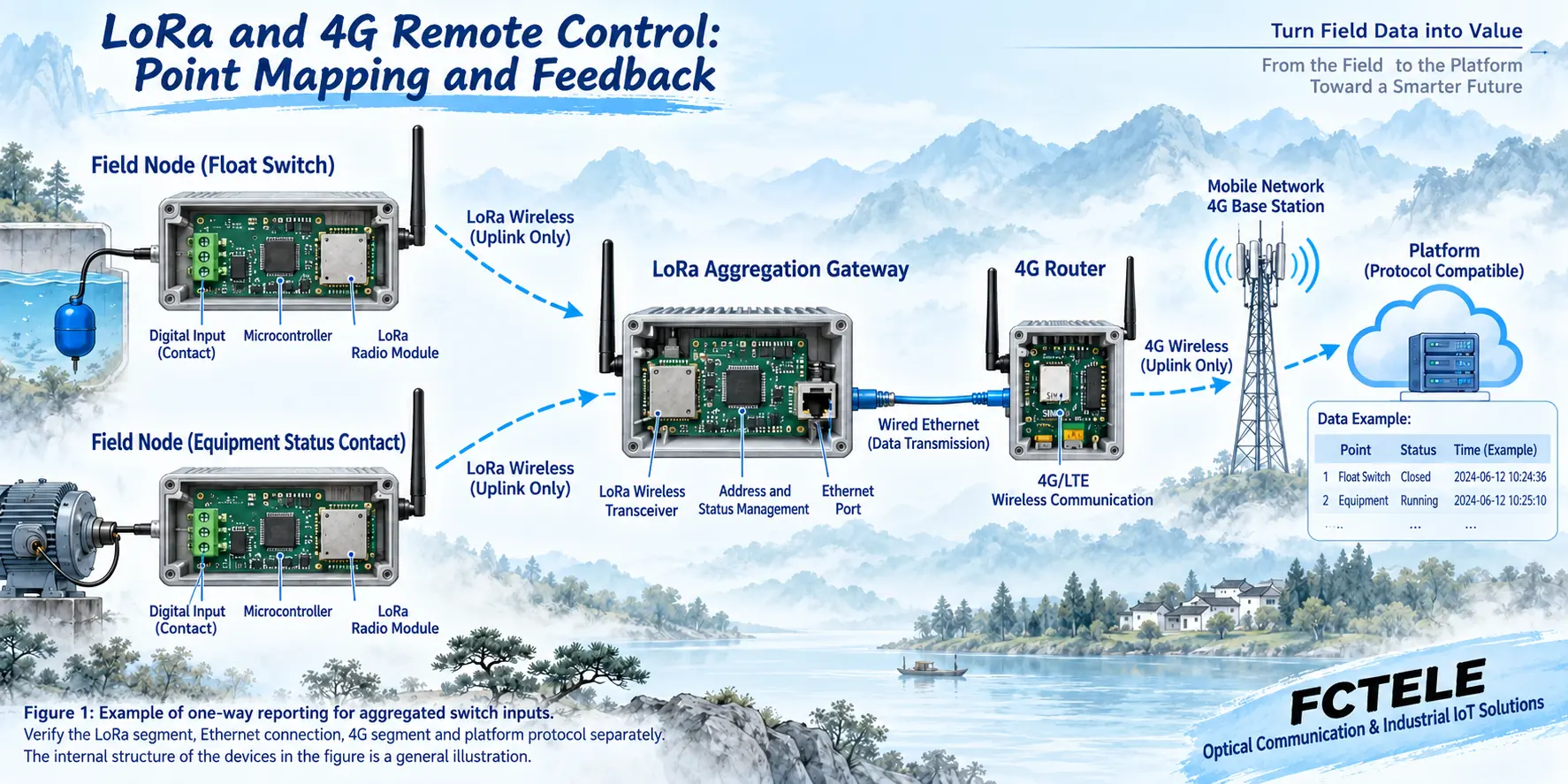
For example, to read a float switch and equipment running contact in a pump room, the node first detects the contact status, then organizes the status into a message and sends it via LoRa to the aggregation device. After receiving it, the gateway identifies the node and data and provides it to the network side in the way it supports; the 4G router is responsible for the external connection of this network. The platform or acquisition software also needs to read according to the agreed protocol, address, and fields before a display with application meaning is formed.
2. Start with the point table, not by counting wireless nodes first
A point table is a table that records the meaning of each signal. First write down the device name, point number, signal type, normal state, alarm state, sampling or reporting requirements, and how to handle loss of contact. Digital input DI reads discrete states, and digital output DO drives the corresponding output contacts; analog input AI reads continuously changing values, and analog output AO provides a continuous setpoint. Similar abbreviations do not mean that electrical connections and processing methods are the same.
A dry contact is a contact that does not actively provide voltage. The detection input of the node needs to be wired according to the manual; active level inputs, relay outputs, and pulse outputs also need to be checked separately. For analog quantities, you need to confirm the voltage or current type, range, power supply, and engineering unit conversion. Do not treat a gateway that only supports digital input aggregation as an arbitrary analog acquisition device, and do not connect low-power signal contacts directly to the motor main circuit.
The meaning of the state must also be fully defined. The same closed contact may represent normal operation, or it may represent a fault or the liquid level reaching the upper limit. The platform should distinguish between “state is zero” and “node has not updated,” and judge whether data is expired by using the data update time and communication status. Save the terminal diagram and point table before installation, and verify point by point on site to avoid a situation where the screen appears to change but the corresponding device is mismatched.
3. Determine the interface handover method with Feichang Technology products
The documented product purpose of Feichang Technology FCT-303L is LoRa digital input multi-point aggregation to the network. It supports converting the corresponding states into Modbus TCP data and provides 100 Mbps Ethernet, WEB, and SNMP management functions. Modbus TCP is an industrial application protocol that accesses agreed data through a TCP network. When connecting to a platform, you still need to check the data addresses, read/write objects, and node correspondence. A web page opening only means that part of the management path is available; it does not mean that the application point table is already correct.
Field terminals must be confirmed according to FCT-303L materials for compatible models, wireless versions, and operating modes. The official website FCT-K8L belongs to the 1–8 channel digital input LoRa transparent transmission category, while FCT-042909-4-1 belongs to the 16-channel DI/DO/AI/AO product category; their application objects and networking methods cannot be interchanged just because of the word LoRa. When analog aggregation is involved, clear compatibility and mapping materials should be obtained. Do not combine capabilities from multiple product pages into one device.
The Feichang Technology official website 4G router with 4 LAN ports, 1 WAN port, and 2 serial ports can serve as a selection clue for site wide-area connection. Its materials also list the corresponding serial communication and platform docking operating modes. The processing links for Ethernet, serial ports, and platform protocols must be confirmed according to the configuration. Do not infer that because the router lists MQTT, it can directly collect data from any network gateway. The required protocol conversion, active reporting, or data acquisition program should be clarified by the solution, and a separate acquisition host should be set up if necessary.
4. Why the reporting cycle affects wireless capacity
A wireless message occupies air time from transmission to reception. In addition to the payload data, there is also identification, verification, and other organizational overhead. An increase in the number of nodes, overly frequent reporting, longer messages, or more retries can all increase the burden on shared wireless resources. Do not treat the wired network port rate as the field throughput of LoRa, and do not directly combine the maximum number of nodes and the maximum number of updates per second.
First distinguish periodic data from event data according to application requirements, and then arrange polling or reporting according to the actual scheduling method of the product. For slowly changing states, there is no need to blindly increase the frequency just to make the interface “real-time”; for short pulses, you need to confirm the input capture, counting, or holding capability, otherwise the platform may have already missed the event when polling. Latency, packet loss, and capacity should be measured under the target number of nodes and actual message conditions, not promised as uniform values for unknown models.
5. Remote control requires actual feedback and field priority
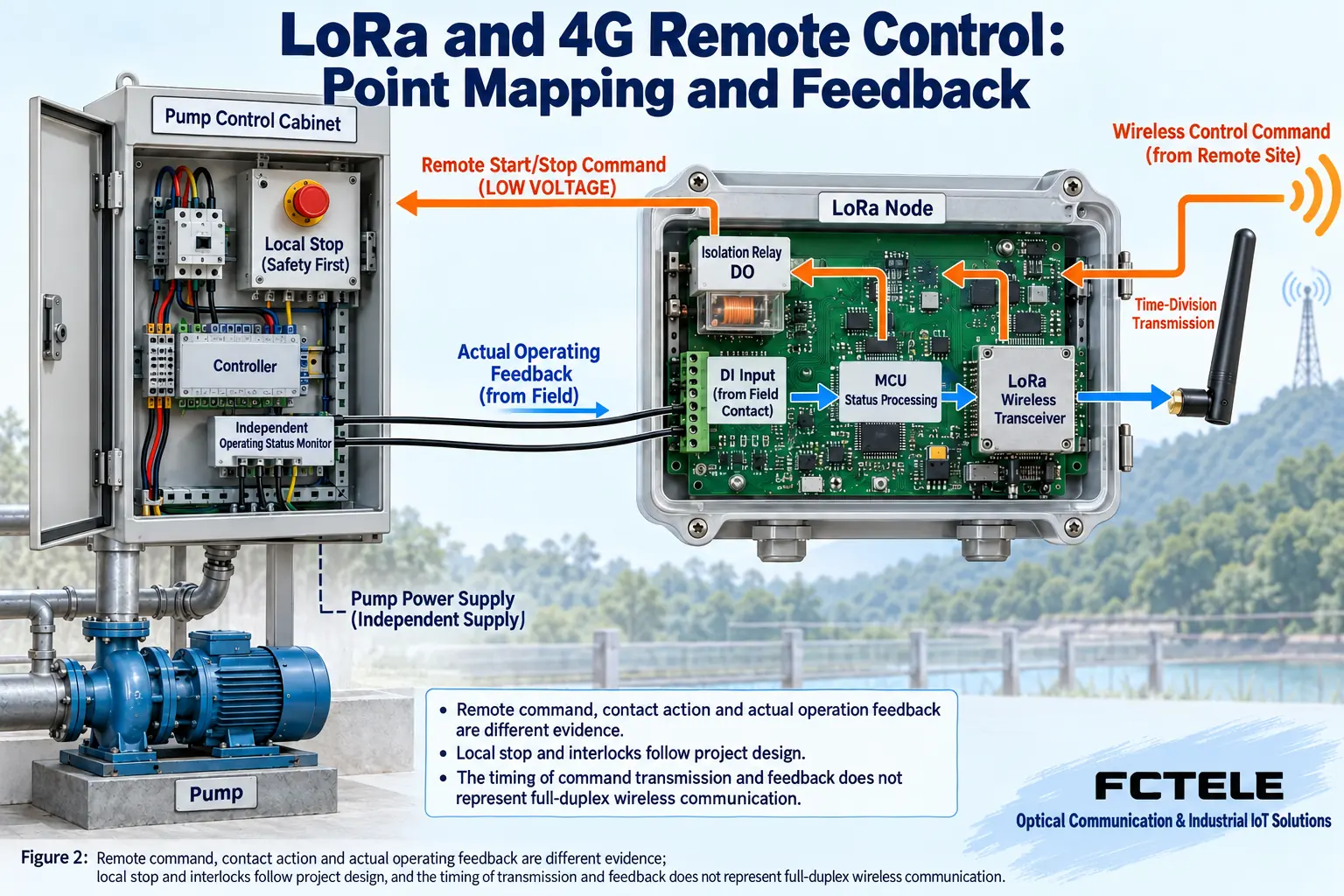
The control link issues intent from the platform, passes through the network and nodes, and finally changes the corresponding output. The system should separately confirm command reception, output contact action, and the actual state of the field device. The relay having operated does not mean the pump is running; it may also be affected by stop conditions, contactors, protection circuits, or equipment failure. Confirmation should be established using actual operating feedback or other suitable detection, not merely by echoing the command just sent.
Command validity period, handling of repeated operations, permissions, and operation records are links that engineering needs to clarify, and not all LoRa terminals have these functions by default. Critical stops and interlocks should retain appropriate local measures according to risk assessment, and should not rely only on wireless or public networks. The figure shows the relationship between low-voltage control contacts and field feedback. It is a design explanation and does not replace actual electrical design or safety system certification.
6. How to avoid old data and old commands misleading after loss of contact
Loss of contact of a LoRa node and interruption of 4G backhaul affect different links. The gateway may still store the last state, and the platform may still display the last value. The interface should mark whether data is expired by combining the update time and communication status. Whether the node output holds, disconnects, or uses a preset value when contact is lost must be confirmed according to model options and field requirements, and the behavior after restart must also be tested separately.
Caching and recovery retransmission can only be counted in the solution when the device or software explicitly supports it and it is correctly configured. If there is no recording capability, changes that occurred during the interruption may not be recoverable, and the current value after recovery cannot be described as complete history. When communication is restored, also check the handling of expired commands and repeated commands to avoid directly applying telemetry data retransmission logic to device control. Each type of exception should clearly be handled by the terminal, the acquisition program, or the platform.
7. Deploy and accept a small site in stages
Assume a site first connects four running or liquid level contacts, establishes a short-distance, single-node baseline, and confirms the point table and state meanings; then add the remaining nodes and check wireless updates; then add 4G backhaul and platform reading, and check the fields, times, and states seen at both ends. The example is used to explain the method, not as a customer project or performance promise. When adding analog or control points, test the new interfaces and functions independently.
During installation, leave a suitable position for the antenna and avoid hiding wireless devices deep inside closed metal cabinets; confirm power supply, grounding, installation environment, and the wireless configuration used. Acceptance should at least compare the short link with the formal site, and a single node with all nodes in use, and check node power loss, 4G interruption, device restart, and communication recovery. Control tests should be conducted under approved and controllable conditions, and records of the correspondence between commands, field actions, and feedback should be saved.
Final delivery should include the device version, point table, wiring, wireless parameters, node addresses, network and protocol configuration, and exception handling records. The value of LoRa plus 4G is reasonable division of labor: a small amount of field status is aggregated first, then transmitted over the remote network, and the application software gives the data meaning. Only when each segment can be verified is it easy to locate faults and expand nodes, rather than treating “the wireless is connected” as the completion of the entire system delivery.
Sources: Feichang Technology FCT-303L ; FCT-K8L ; FCT-042909-4-1 ; Feichang Technology 4G router materials . The illustrations are general mechanisms and design examples and do not represent actual product internal structures, customer cases, or measured results.
Extended principle: How an industrial LoRa gateway works: wireless modulation, message handover, and parameter selection .
Supplementary verification materials: Semtech: The difference between LoRa and LoRaWAN ;
Common field questions
The LoRa node is connected to the gateway and 4G can access the internet. Why does the platform still not have correct data?
The two links being connected only satisfies the transmission conditions. The gateway output method, acquisition program, and platform point table still need to match. Check point by point according to node identity, DI/DO or analog type, registers, and update cycle. Names such as Modbus TCP and MQTT cannot prove that any devices can directly exchange data with each other. The required polling, conversion, and reporting should be undertaken by devices or software that explicitly support them.
Can all terminals marked LoRa communicate with the same gateway?
Do not assume so. LoRa modulation does not equal a complete application protocol, nor does it automatically equal LoRaWAN; wireless parameters, frequency band, version, networking method, and point table all affect interoperability. The different digital input or mixed-quantity products listed by Feichang Technology should have their compatibility scope confirmed according to their respective materials. Do not combine the maximum capabilities of multiple pages into one verified solution.
The platform shows “control successful.” How do you confirm that the field device actually operated?
Distinguish three types of evidence: the command has been received, the output contact has changed, and the device is actually running. Relay operation may still be blocked by field interlocks or faults, so appropriate real feedback is required. Also agree on command validity period, loss-of-contact state, and recovery handling to prevent old commands from being replayed. Critical interlocks should not rely only on wireless or public networks, and tests must be completed under approved and controllable conditions.
Continue reading: The link light is on but old data is read: how industrial communication heartbeat, timeout, and watchdog judge online status ; How a serial server performs remote monitoring: data validity, disconnection recovery, and control confirmation ;
Translated from the Chinese technical article. Source first published: 2026-09-11. Source last revised: 2026-10-15T19:44:23.840277+08:00. Read the Chinese source
