


Industrial Ethernet switches are often used in field networks for manufacturing, transportation, energy, water, and other sectors, connecting PLCs, HMIs, cameras, and monitoring devices. These industries share similar Ethernet foundations, but their requirements for environment, power supply, real-time performance, redundancy, and maintenance differ. A single “industrial-grade” device cannot unconditionally cover all scenarios.
Manufacturing floor: separate control and maintenance needs
PLCs, HMIs, and robots on a production line need reliable data connections. The switch is responsible for forwarding between ports, but control performance also involves terminals, protocols, network load, and applications. Using ordinary Ethernet ports does not mean that all requirements of a specific real-time industrial protocol have been met.
Traffic such as device access, engineer maintenance, and video surveillance may share the network. Ports and VLANs should be planned, and access policies should be clearly defined. Logical isolation is not the same as physical isolation, and it cannot replace identity and permission management. Changes should be made during maintenance windows, with configuration backups and rollback preparations.

Transportation and security: aggregate traffic and remote power supply
Road cameras, roadside devices, and station control may connect to the center via optical fiber. Link distances, optical module pairing, and uplink capacity should be checked, and the actual bitstream of multiple video channels should be calculated. Optical fiber provides a transmission channel, not PoE power for remote devices.
Field cabinets should pay attention to cabinet temperature rise, condensation, dust, and surge conditions. Even if a switch has an industrial environment adaptation design, external protection cannot be ignored. PoE cameras may have higher power demands when starting at night or in low temperatures, so evaluation should be based on maximum demand and device budget.
Energy sites: reliability comes from system paths
Monitoring and control networks may require redundant power supplies or links, but redundancy cannot be just drawing two lines. Check whether the upstream power supplies are independent, whether the two links pass through a common failure point, and whether the protection protocols are compatible. A device having dual inputs does not mean the entire system has no single point of failure.
Electromagnetic and business requirements in energy scenarios should be checked against project standards and model reports. The environmental capability of a certain industrial switch cannot automatically be inferred as suitable for all sites, nor can it be claimed to have a specific industry certification without document confirmation.
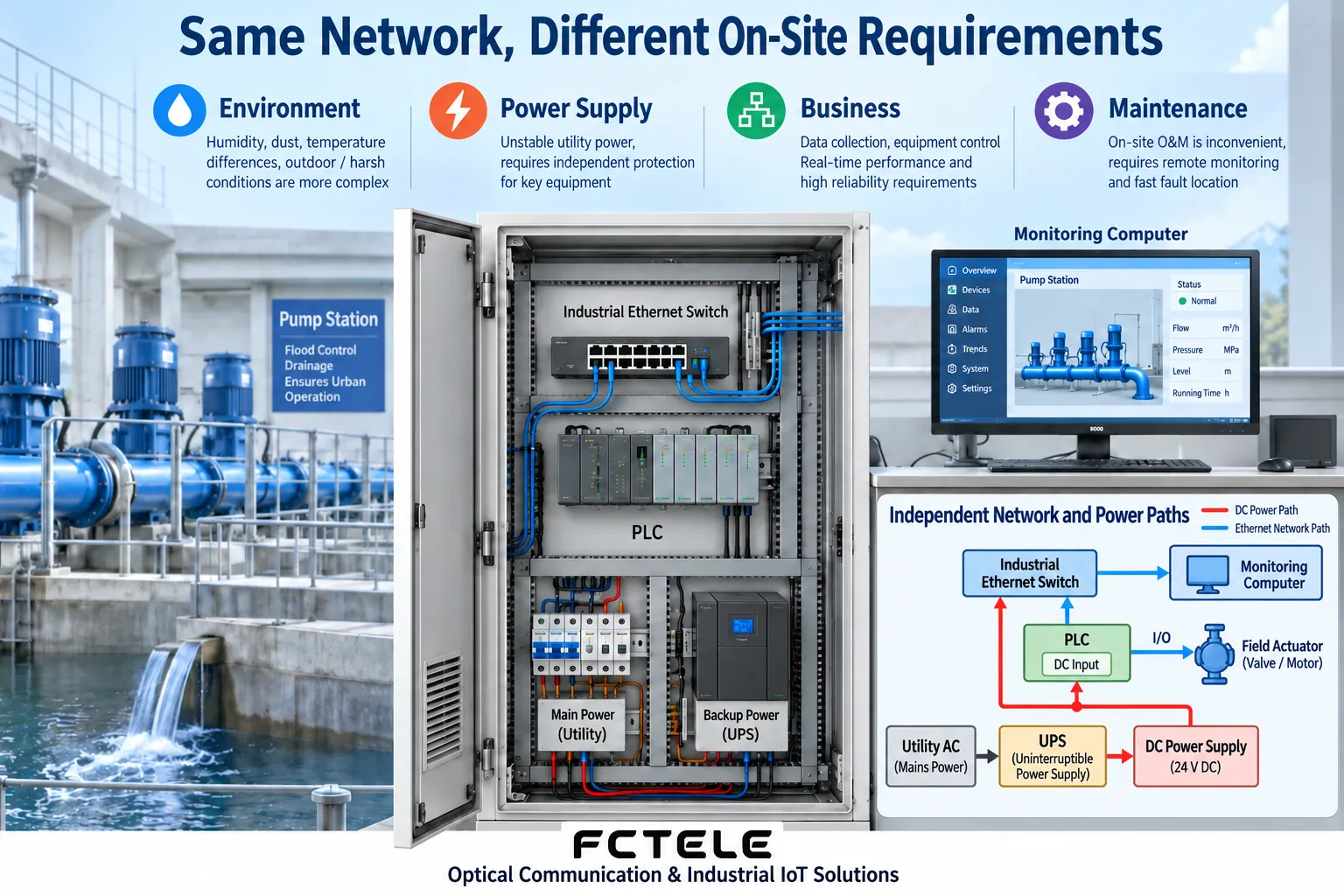
Water and remote sites: maintainability is more important than the number of functions
Pump stations and dispersed monitoring points may be unattended, requiring remote observation of ports, power, and alarms. Managed devices can provide corresponding status, but network reachability and correct permissions are required. Opening only management services without access restrictions may increase risk.
Field communication may also involve serial ports and gateways. The switch is not responsible for automatically interpreting all instrument protocols; it should be clear which device performs protocol conversion. Network faults and instrument data anomalies should be judged in layers to avoid misdiagnosing application field errors as switching problems.
From industry names back to specific conditions
Selection records should include business protocols, port count, speed, uplink, environment, power supply, management, and maintenance methods. When a ring network is needed, clarify the applicable protocol and test objectives; when real-time performance is needed, check the complete system requirements, not just the product title.
Acceptance testing should use actual devices and load tests, observing recovery, logs, and long-term operation baselines. Specific Feichang Technology models can be checked in the Product Center. Industry applications are the entry point for requirements; what truly determines whether a device is suitable is clear conditions and verifiable validation results.
Even within the same industry, conditions may differ: clean workshops, outdoor sites, and central computer rooms cannot share a single general environmental assumption. Writing the installation location into the equipment list helps maintain consistent conditions during selection, acceptance, and later replacement.
Translated from the Chinese technical article. Source first published: 2019-07-18. Source last revised: 2026-10-13T23:36:13+08:00. Read the Chinese source
