


The right industrial switch functions depend on the customer’s task. Connecting equipment, separating services, handling congestion, limiting unwanted multicast replication, providing backup paths and managing access are different requirements. Not every switch supplies them, and a feature name does not mean it is configured correctly. This article explains VLANs and queues to support selection rather than pile up abbreviations.
Start with the Layer 2 switching task
A switch receives Ethernet frames, learns source MAC locations and selects egress from destination addresses and configuration. Unknown destinations, broadcast and multicast have their own rules. A management IP lets administrators configure the device; it does not prove routing for other subnets. Cross-subnet communication normally needs appropriate routing capability and permitted policy.
Unmanaged products suit some fixed connections; managed products expose more configurable behavior and evidence. The question is whether the task needs those controls, not whether management is inherently faster. Complex, unmaintained configuration can cause faults. Include available staff and manuals in procurement.
How VLANs separate services
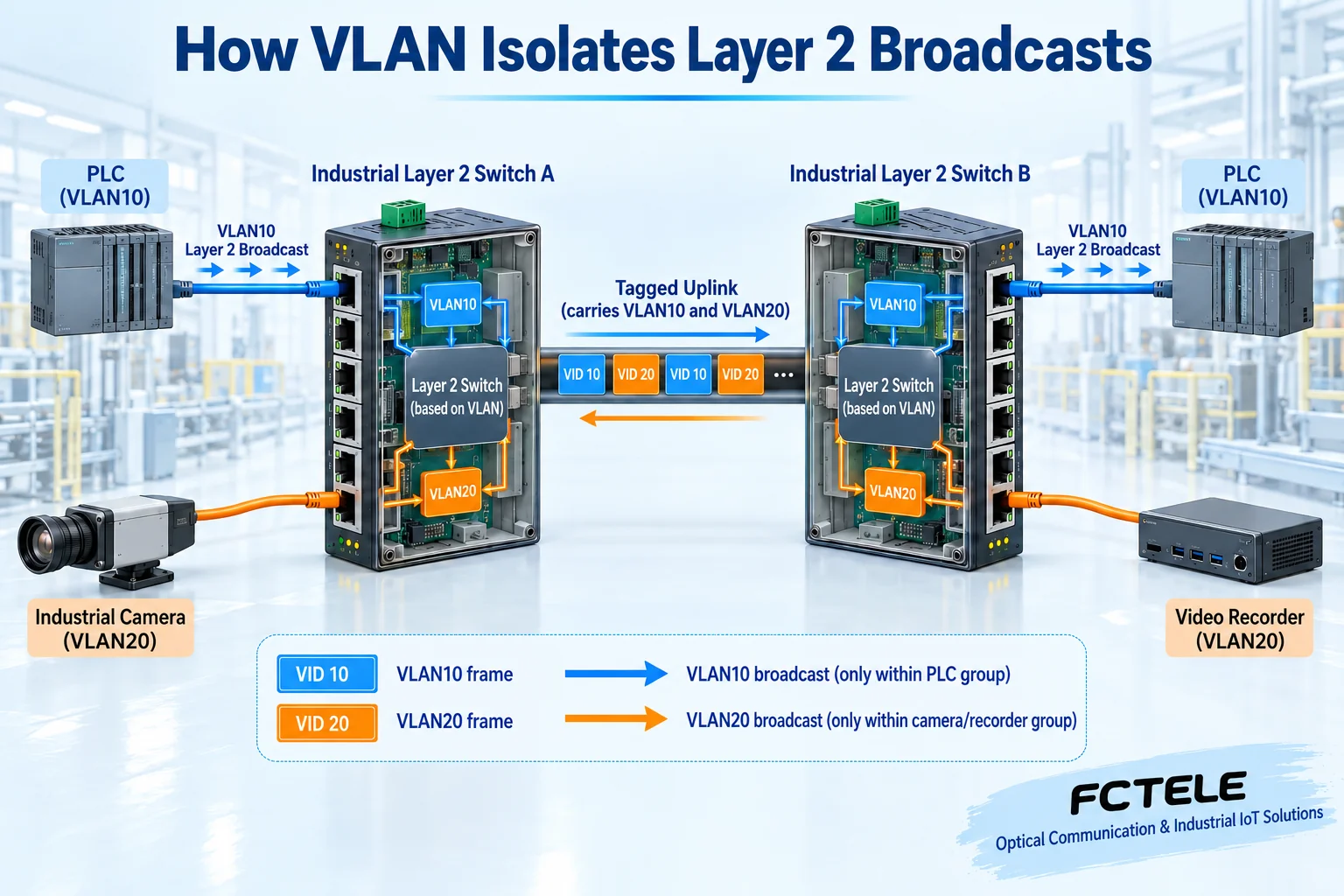
A VLAN divides physical switching into distinct Layer 2 broadcast domains. Membership and permitted uplink groups follow configuration. An ordinary endpoint can send untagged frames; ingress rules assign their VLAN. A shared inter-switch link commonly uses tags to identify different groups.
For example, PLCs use VLAN 10 and cameras VLAN 20. With correct Layer 2 configuration, control broadcasts remain in their group rather than enter video merely because switches are shared. VLANs are neither physical isolation nor encryption. Permitted cross-group routing still needs routing and access policy. IP subnets and VLANs are related but different concepts.
Passing tags is different from configuring VLANs
Some media converters pass tagged frames without creating VLANs or managing membership. Ask about required ingress classification, egress tags, allowed membership and scale. Long-frame support or 802.1Q transparency alone does not prove every configuration function.
Align allowed VLANs and tag conventions at both uplink ends. Access ports also need correct ingress default membership and egress tag removal. A VLAN number on a screen is not sufficient. Back up configuration and plan a window first; changing a management port’s VLAN can remove access, so prepare local recovery.
QoS schedules a congested egress
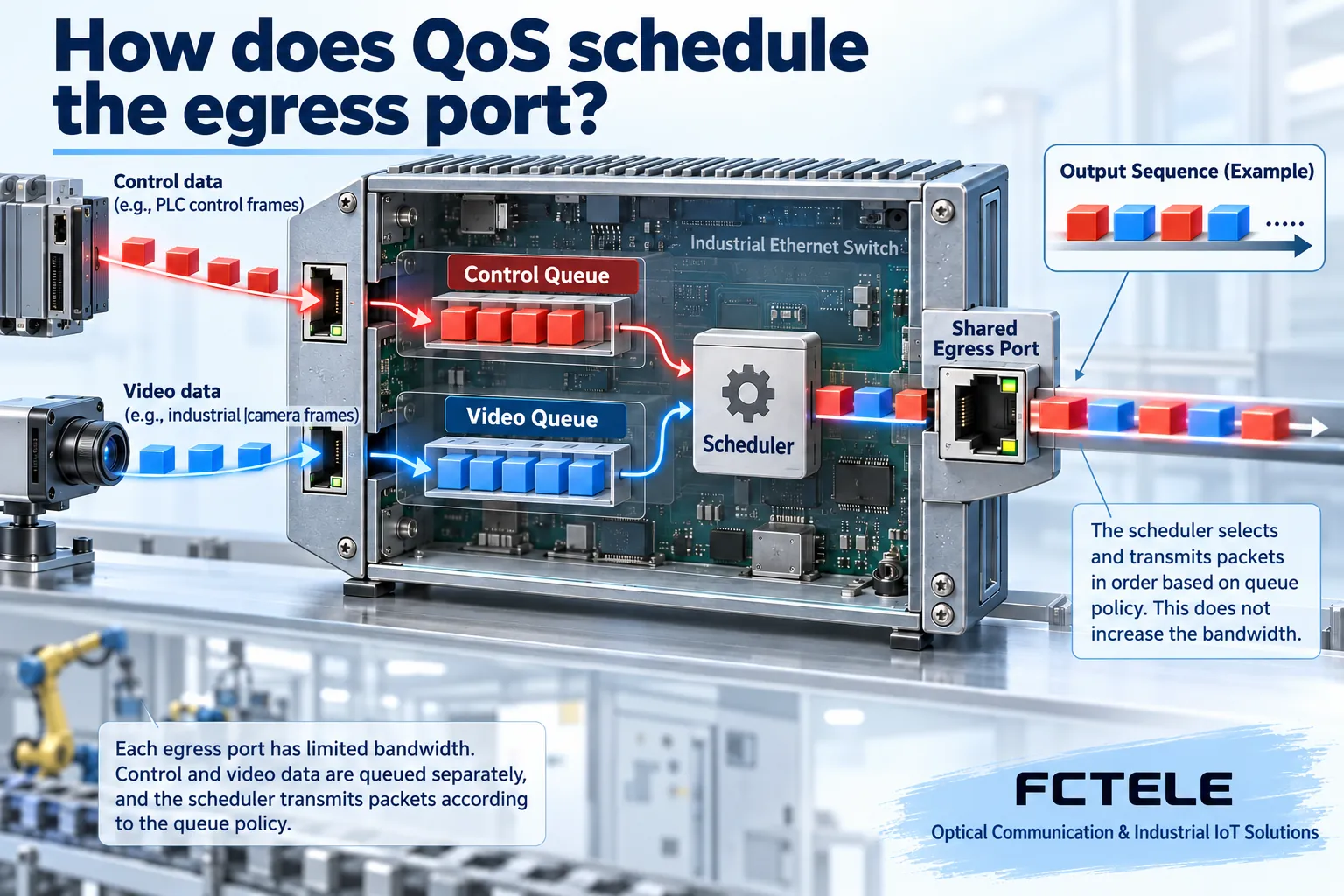
Quality of Service, QoS, classifies traffic and applies configured queues and scheduling. Supported rules may use the ingress port, tag priority or IP markings to select a queue. A scheduler chooses which queue transmits next over a shared egress, allowing different handling of control messages and bulk video.
QoS neither adds capacity nor creates zero delay. Sustained overload can still lose frames, and incorrect prioritization can starve lower-priority traffic. Verify whether the full path preserves and interprets markings, then test actual load. Enabling priority on one switch is not a deterministic-delay guarantee.
Multicast control directs data to interested receivers
Multicast serves a group; video and some discovery systems may use it. IGMP Snooping observes relevant membership information to help determine receiver ports. Querier presence, protocol versions and aging also matter. A multicast address alone does not tell a switch every interested receiver.
Without appropriate queries and membership maintenance, learned interest can age out and traffic may behave unexpectedly. Confirm versions, unknown-multicast handling and any required querier capability. In a test network, observe joins, leaves and restarts. Other industrial control protocols can use different multicast mechanisms; IGMP is not a universal solution for every protocol.
Ring protection first prevents loops, then handles failures
An unprotected physical Layer 2 loop can repeatedly circulate broadcasts. STP, RSTP or another suitable mechanism controls forwarding to create a loop-free active path. Standby connections remain physically connected. A supported protocol rearranges paths after a failure; actual recovery requires topology-specific validation.
Standard and proprietary ring systems are not interoperable merely because both are called ring protection. Confirm every node’s mode, roles, scale and settings. Measure application recovery as well as protocol state. A protocol name does not replace timing acceptance, nor does one vendor result create a universal requirement.
Choose management and security separately
Web, CLI and SNMP are management methods, not security by default. Verify protected transport, account privileges, logs, backups and software support. Disable unused services according to site policy and restrict management sources. Do not expose management to uncontrolled networks or include actual passwords in examples.
Access rules can permit or block supported matches; fields and enforcement depend on model. VLAN isolation, privileges and filtering have separate boundaries. Enabling one does not establish absolute security. Test necessary traffic, prohibited paths and configuration retention after restart.
Match actual FCTEL models to these tasks
FCTEL’s managed mini four-copper/two-optical product page lists VLANs, IGMP Snooping, DSCP, multiple queues and STP/RSTP. For a small network separating control and video, managing multicast and providing a controlled backup route, those are a basis for detailed confirmation. Do not borrow managed capabilities for an unmanaged model.
A feature list is not a full configuration procedure. Check the delivered firmware manual and interface. Do not add undocumented encryption or security protocol claims. Power and PoE are separate ordering dimensions rather than automatic inclusions in every managed version. Confirm the optical-port/module combination too.
Write procurement and acceptance in customer-task terms
Replace need VLAN with which endpoints must be separate and which may communicate across subnets. Specify which messages and load conditions need QoS behavior. Define ring nodes, failure points and permitted application interruption. Each function should correspond to configuration and a reproducible result.
Save topology, port tables, versions and backups. Test in isolation before approved deployment. Diagnose interfaces, membership, queues and logs instead of blindly restarting or opening every policy. Features that can be understood, maintained and accepted matter more than a long list.
References:IEEE VLAN and bridging standard information;FCTEL managed mini four-copper/two-optical product. Figures illustrate generic mechanisms, not product internals or measurements.
Translated from the Chinese technical article. Source first published: 2024-03-04. Source last revised: 2026-10-13T14:22:45+08:00. Read the Chinese source
