


In rail transit, industrial switches mainly solve how terminals reliably transmit data between each other. Passenger information screens, fare collection and ticketing equipment, and station access control may all connect to the network through them, but the three types of services have different purposes, permissions, and acceptance methods. You cannot say that train signal safety, fare settlement, and video playback are all guaranteed just because an industrial switch is installed. This article starts from the station’s non-safety-critical services and explains the process of forwarding, partitioning, and multicast; it does not replace the specialized design of train control systems.
1. Displays, gates, and access control do not send the same kind of service
Passenger information systems are often abbreviated as PIS, used to publish arrival information, service notices, or multimedia content. The server hands the content to the network, and the terminal receives it, decodes it, and displays it. The switch forwards Ethernet frames, which are data units with address and other information; it is not responsible for generating arrival messages, nor for video decoding. A stuttering picture may come from the server, codec, receiving terminal, or network, so you should not replace the switch first just because you see a fault.
Automatic fare collection systems are often abbreviated as AFC. Terminals hand transaction or operation records to the business system, which completes billing, settlement, and permission processing. The switch cannot judge whether the fare amount is correct. Access control is likewise judged by the controller and management system for personnel permissions; if the on-site controller only has a serial interface, a suitable gateway is also needed, and the serial signal cannot be directly connected to an Ethernet port. Whether offline passage is allowed and how to handle a network outage should be decided by the business design.
2. How the same switch distinguishes services
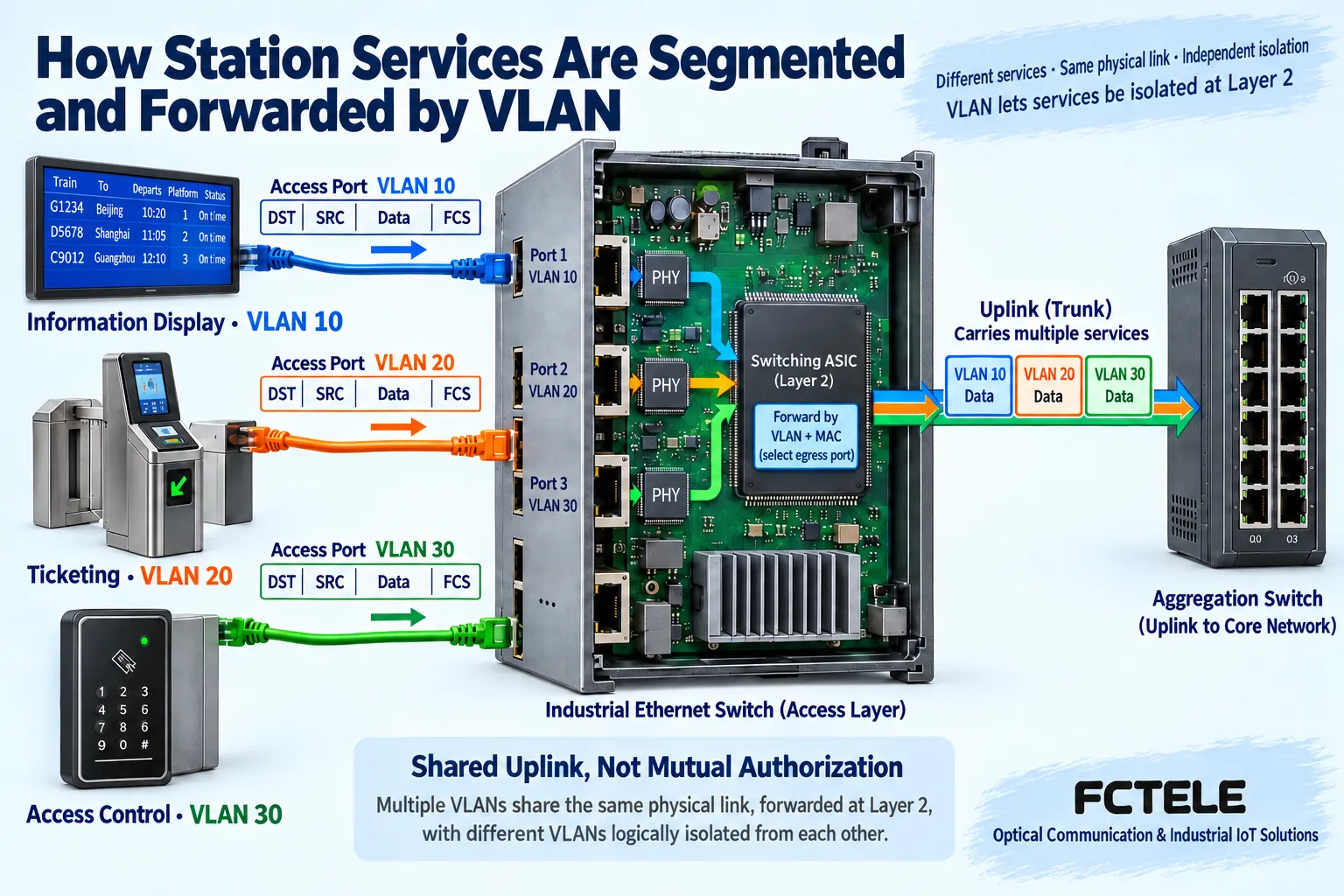
Suppose a teaching network puts information screens into VLAN 10, fare collection and ticketing equipment into VLAN 20, and access control into VLAN 30. A VLAN is a virtual local area network, used to divide the Layer 2 forwarding range. Terminal access ports are assigned to the corresponding VLAN according to configuration; an uplink port carrying multiple VLANs can add tags to frames, and the next device continues processing according to the tags and port rules. These numbers are only examples, not rail project regulations.
Internal forwarding also needs to combine the destination MAC address and the VLAN it belongs to. Even if two terminals are connected to the same chassis, it does not mean they can directly access each other across VLANs. Crossing network segments usually requires a device with routing functions and processing according to authorization rules. However, a VLAN is not equal to a firewall, and even less equal to data encryption; management accounts, access control, auditing, and application identity verification still need independent design.
3. When multiple information screens play the same content, why manage multicast?
Sending content to screens one by one is called unicast, and the sender establishes a corresponding data stream for each receiver. IP multicast lets receivers join a group, and the network distributes according to the group’s reception relationship. Whether it is suitable also depends on whether the content system and terminals support it; you cannot turn unicast video into multicast just by enabling an option in the switch.
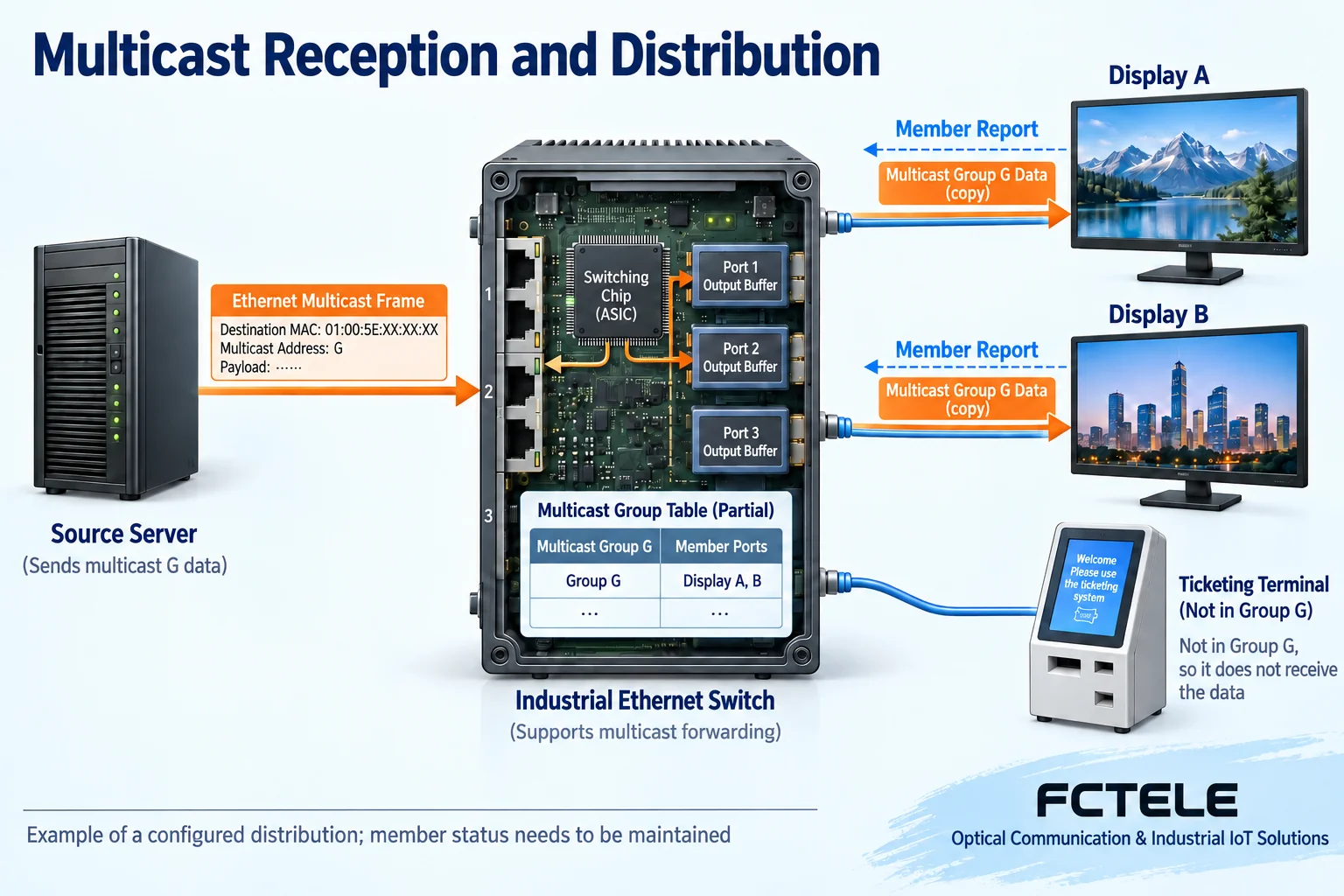
IGMP is the protocol by which IPv4 receivers express group membership. A switch with IGMP Snooping observes these messages, forms a relationship between groups and outgoing ports, and then sends data for known groups to the ports that need it. A querier asks about membership, and state also ages out, so the querier, version, VLAN range, and state maintenance after topology changes must be checked together. Different implementations may handle unknown multicast differently, and you cannot simply discard all unknown data.
In the figure, screens A and B have joined the same group, so the switch copies data to their outgoing ports; the ticketing terminal is still connected, but it does not belong to this group. This does not mean it has no traffic at all. If membership is wrong, unnecessary flooding may occur, or screens that need to play content may not receive it. When troubleshooting, you should check the membership table, outgoing port counters, and terminal reception status, not just the network port lights.
4. A sturdy interface does not mean all rail requirements are met
The environments of station cabinets, in-vehicle equipment, and outdoor facilities are different. Selection must separately check installation space, connectors, vibration, power, and electromagnetic environment. M12 is a type of connector name, and it does not mean all codings and pin counts can be plugged into each other. Thread locking helps maintain the connection, but you cannot infer from this that the device has completed a certain railway certification. Protection ratings also have specified test conditions and cannot be interpreted as safe under any water pressure or any duration.
Feichang Technology Product Center’s M12 IP68 Protected Managed 16-Port Gigabit Electrical Switch documentation lists functions such as 16 10/100/1000M network interfaces, 8-pin A-Code M12, VLAN, IGMP Snooping, and management diagnostics, and introduces application directions such as PIS. It can serve as a candidate for checking these requirements, but it cannot be treated as proof that the entire series supports them or has passed all rail-specific verification. Power interfaces and network interfaces must be identified according to the specific manual, and you must not rewire them yourself based on appearance.
5. Acceptance should follow the business, not just do connectivity tests
First establish a port and VLAN list, then use authorized test terminals to verify paths that should connect and should not connect. Information screens should check correct programs, reception continuity, and synchronization requirements; fare collection and ticketing should check transaction record completeness and duplicate processing; access control should verify normal authorization and the approved network outage handling process. A successful ping only shows that the corresponding test packet is reachable; it does not mean all three applications are normal.
Shared uplinks also need to consider concurrent traffic. Video bursts may occupy buffers and increase queuing time for other services; priority can change service order but does not increase physical bandwidth. Dual power supplies, ring networks, or link aggregation also solve different faults, and the specific model and configuration must be checked. Any fault injection, power-off, or cable-pull test should be performed in an isolated environment or an approved maintenance window, not attempted on an operating signal or control link.
Finally, save firmware, configuration, membership tables, port statistics, and application results, and record when the anomaly occurred, which service, and which outgoing port. Being able to explain the results segment by segment from terminal sending, switch forwarding, to application reception is more valuable than saying “industrial-grade supported” or “network normal.”
Reference note: The multicast mechanism refers to RFC 4541 , and product capabilities are checked against the above Feichang Technology details. The two figures are general principle illustrations, not actual measurements, not the internal structure of a specific model, and do not indicate that a safety-critical system has been approved.
Translated from the Chinese technical article. Source first published: 2021-07-21. Source last revised: 2026-10-13T11:20:43+08:00. Read the Chinese source
