


Industrial switches and mining switches can have similar Ethernet forwarding functions, but they cannot be directly equated. Temperature resistance, interference resistance, or a metal enclosure only describe certain working conditions; they cannot by themselves prove that the device is suitable for locations where there is an explosion hazard. When choosing mining equipment, you must check not only the communication service, but also the specific place of use, the product identity, and the applicable safety requirements. The original text treats “mining usually uses industrial grade” as a selection conclusion, and this statement is not enough to support actual deployment.
1. Industrial switches first solve how data is forwarded
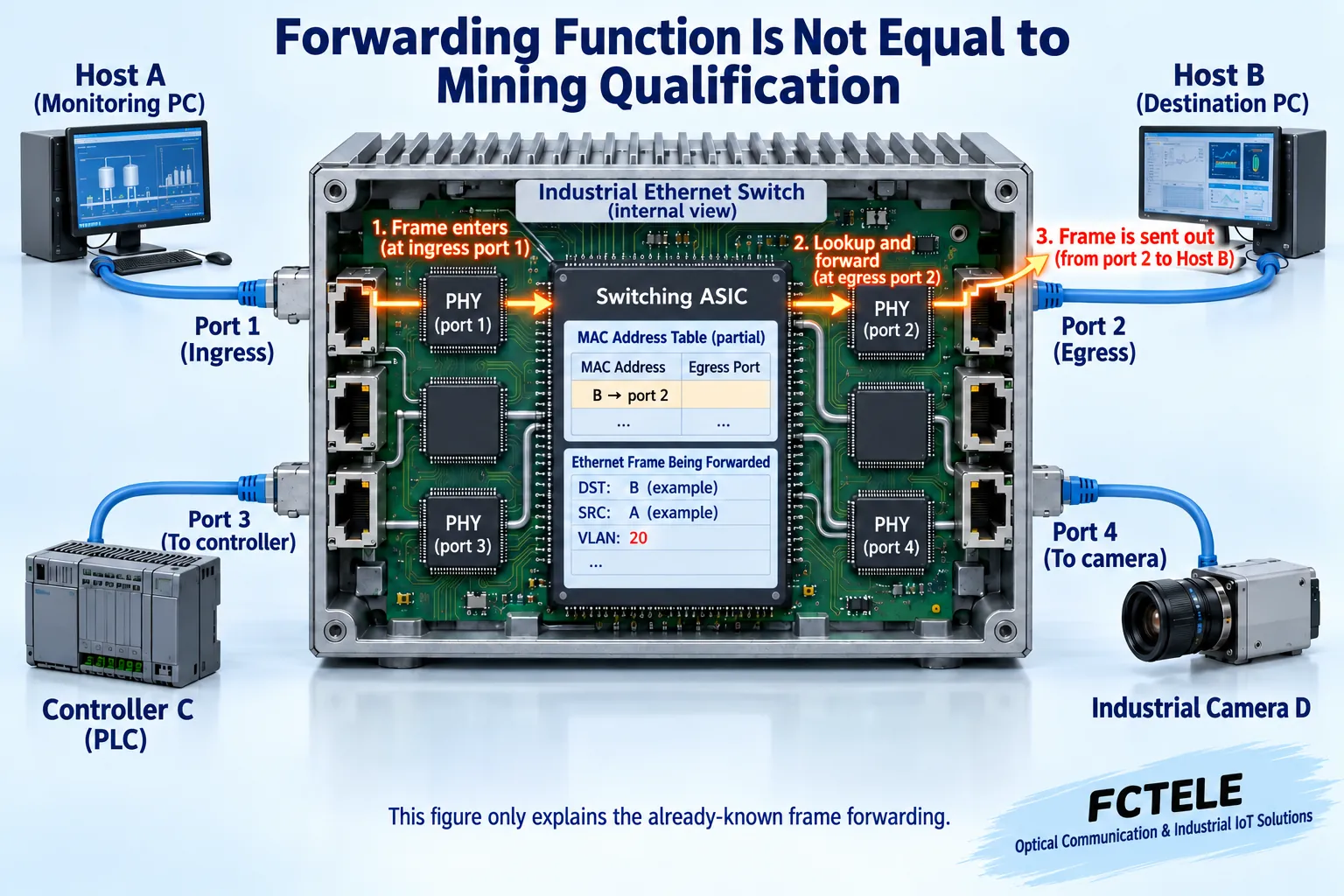
A camera, monitoring host, or controller assembles service data into Ethernet frames and sends them to a switch port. The switch can learn the relationship between a frame’s source MAC address and port, then combine the destination address, the VLAN it belongs to, and the configuration to choose an exit. A MAC address can be understood as the link-layer identifier that recognizes a terminal; a VLAN is a configuration that divides the Layer 2 forwarding scope. They determine where data goes, not which dangerous environment the device can be used in.
A known-destination unicast frame is usually forwarded from the corresponding exit; unknown-destination, broadcast, or multicast frames may be distributed according to their own rules. A switch is not a “security judge” that directly understands all services, does not automatically identify whether a measured value exceeds a limit, and does not confirm for the application whether a control command is correct. The reliability of a monitoring or control system also involves terminals, protocols, business software, and the overall design.
2. Environmental adaptability and explosion protection are different inspection questions
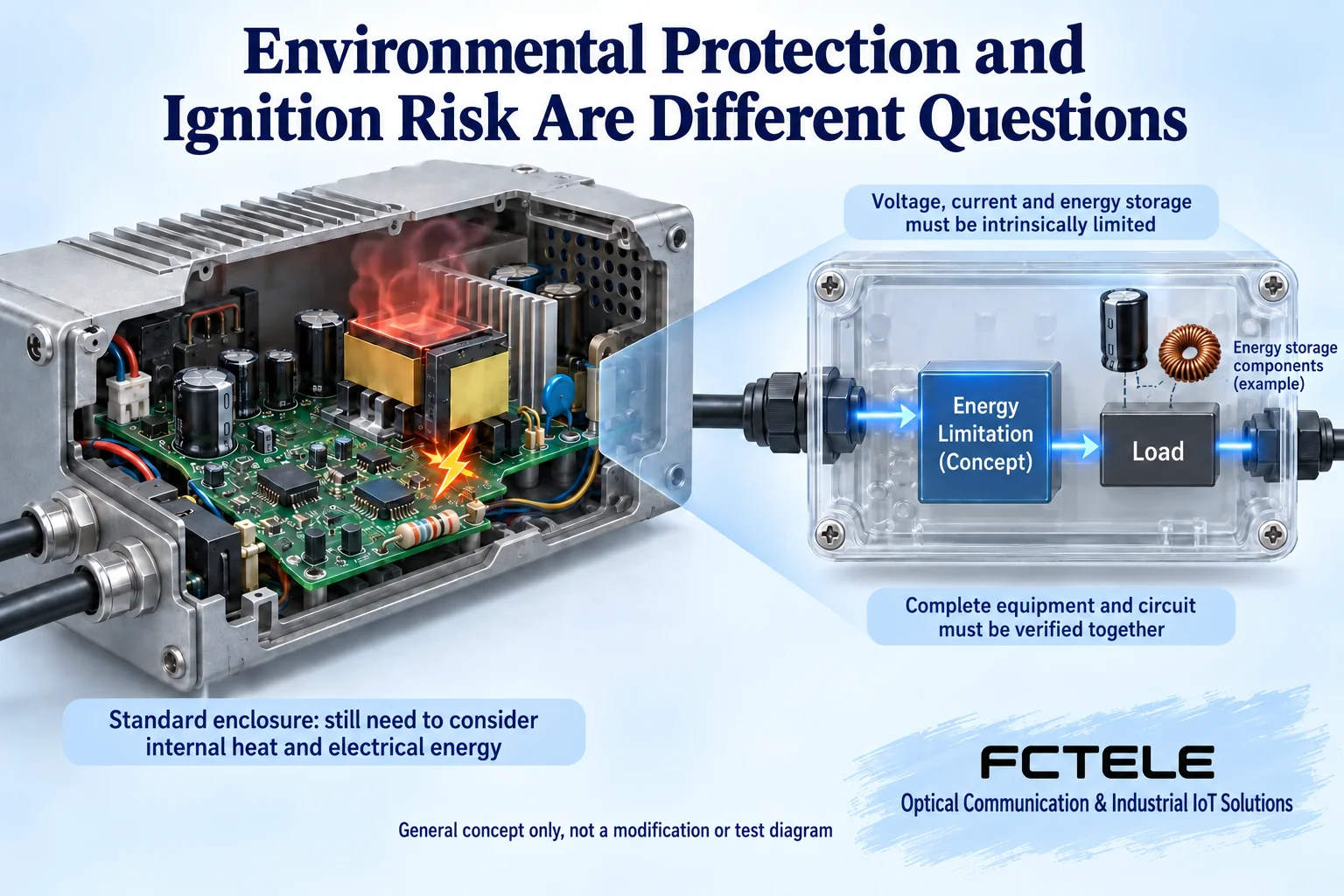
The operating temperature range answers whether the device can run normally under specified conditions; electromagnetic compatibility answers how the device withstands or limits the corresponding electromagnetic influence; the enclosure protection rating answers the protection conditions against solid foreign objects or water entry. All are important, but they cannot replace one another. For example, “can operate in a high-temperature environment” does not mean the device surface temperature will not become an ignition source for a specific hazardous atmosphere.
An IP rating is not a general explosion protection conclusion. An ordinary enclosure can be dustproof or waterproof, but it may not consider internal sparks, hot surfaces, and ignition risk under fault conditions. Conversely, discussing an explosion-proof structure cannot ignore protection, heat dissipation, and communication requirements. Whether it is qualified must correspond to the complete product and the approved conditions of use, not be guessed from the color, weight, or number of heat sinks on the enclosure.
3. Why explosion protection types cannot be obtained by adding a box on site
Different protection concepts solve risk in different ways. Flameproof type emphasizes a designed and verified enclosure, joint surfaces, and cable entries so that when an internal ignition occurs, it does not spread outward as a hazard. Intrinsic safety type emphasizes limiting the energy of the entire related circuit and must consider connected equipment and wiring. This only explains the principle; you cannot manufacture, rewire, or inspect explosion-proof equipment yourself based on this.
Putting an ordinary industrial switch into a box that looks sealed will not automatically give it mining qualification. The combination of power supply, interfaces, cable entries, heat, and controlled components all affects the suitability of the complete device. Even if only the power supply or terminals are changed, the already-verified conditions may change. A “normal communication test” cannot replace a safety identity check, and you must not open the device while energized to observe the inside.
4. From product name back to verifiable evidence
First confirm the installation location and environmental requirements, then check the manufacturer, complete model, version, nameplate, and corresponding documents. When coal mine explosion-proof electrical equipment is involved, the current “Coal Mine Safety Regulations” have clear requirements for product documents accepted at the mine, consistency of safety marks, and explosion-proof inspection before going underground. You cannot judge only by the words “mining” or “industrial grade” in a product title or by a salesperson’s verbal explanation; specific projects should still be reviewed by qualified personnel according to applicable regulations.
At the same time, confirm whether the external power supply, connected terminals, optical modules, and installation method are within the permitted configuration. Evidence should correspond to the actual item received, and a report for a similar model cannot be used as a substitute. Ordinary industrial specifications, a single test report, and proof of suitability for a complete device have different scopes; seeing one mark should not lead you to infer on your own that it covers all locations and configurations.
5. What Feichang Technology materials can explain, and what they cannot
The Feichang Technology product center’s Managed DIN-rail industrial switch with four 10G optical ports and eight Gigabit Ethernet copper ports lists rail structure, optical and electrical interfaces, VLAN, routing, and management and maintenance functions. These materials help check Ethernet access, aggregation, and diagnostic requirements, but this article has not obtained evidence of it as a complete mining explosion-proof device, so it is not recommended on this basis for underground locations requiring the corresponding qualification.
On the surface or in other locations confirmed by the project, protection, power supply, and service capability should also be checked separately. Optical fiber can isolate certain electrical conduction paths, but optical equipment and optical radiation themselves still have applicable boundaries; using optical ports does not mean the entire system is naturally intrinsically safe. Dual power supplies, ring networks, and alarms also cannot replace on-site safety monitoring and protection systems.
6. Communication acceptance and safety acceptance should be recorded separately
Communication checks can verify ports, VLANs, packet loss, latency, and application data integrity in an isolated test environment, and save the configuration and test conditions. Safety checks then verify the physical item and documents according to the approved process, without opening covers, drilling holes, replacing parts, or changing protective devices on your own. For a safety monitoring or control network in operation, do not test by randomly unplugging cables or cutting power.
If a model, wiring, or document inconsistency is found, unauthorized installation or modification should be stopped and handed to the responsible personnel. Clearly explaining “frames can arrive,” “application results are correct,” and “device identity and conditions of use match” separately is more reliable than generally calling it a mining industrial switch.
7. Mining applications: switches transmit data, they do not make safety judgments for the system
Mine monitoring, video, and dispatch terminals can transmit their own services through Ethernet switching, but installation in a surface office, equipment room, or underground location constrained by specific safety conditions are different issues. First define the use area, then review the complete device identity and permitted configuration; you cannot infer from the fact that an industrial switch was used on the surface of a project that the same model can go directly underground.
For example, a monitoring terminal confirmed by the project sends measurement messages to a service server, and the switch only forwards them according to the supported network rules. Alarm thresholds are judged by the corresponding monitoring system, data analysis is handled by software, and dispatch and emergency handling are still completed by established systems and processes. A network connection is part of the information path, not a provider of all mine safety protection, and it certainly cannot promise that the switch itself recognizes every type of danger.
Camera traffic and periodic collection may merge at a common uplink. If a business peak causes the queue to grow, latency or packet loss may occur even when the average load is not high; the uplink capacity, segmentation, and maintenance method should be checked according to the real concurrent combination. Using VLANs, priority, or redundancy functions must be based on device support and system design; they cannot automatically eliminate common power loss, fiber breaks on the same path, and terminal faults.
Mining deployment also has to face dust, humidity, corrosion, vibration, and power supply conditions, but ordinary industrial environmental parameters cannot replace the corresponding safety suitability evidence. During operation and maintenance, keep device documents, configuration, and communication baselines separately; troubleshoot according to the approved process, and do not randomly unplug cables, replace power supplies, or open covers while energized on a network that is carrying monitoring and protection duties. Only in this way can the application value and the boundaries of device capability be explained together, instead of treating “mining” as a name that covers all risks.
Document note: protection concepts refer to IECEx conference protection technology notes , and are not used as an access basis for Chinese projects; laws, regulations, and specific project requirements take priority. The two figures are general teaching illustrations, not measured tests and not explosion-proof design drawings.
Translated from the Chinese technical article. Source first published: 2019-07-18. Source last revised: 2026-10-13T07:56:28+08:00. Read the Chinese source
