


MR-Ring is the name of a private Ethernet ring network solution and should not be equated with standard MRP or the ring network functions of all vendors. Its concept is to limit one backup data path during normal operation to avoid loops, and to use the backup path to restore connections when a fault occurs. The actual roles, detection methods, compatibility, and recovery performance must be checked against the corresponding manufacturer, model, and firmware.
First, solve why the ring cannot simply be fully connected
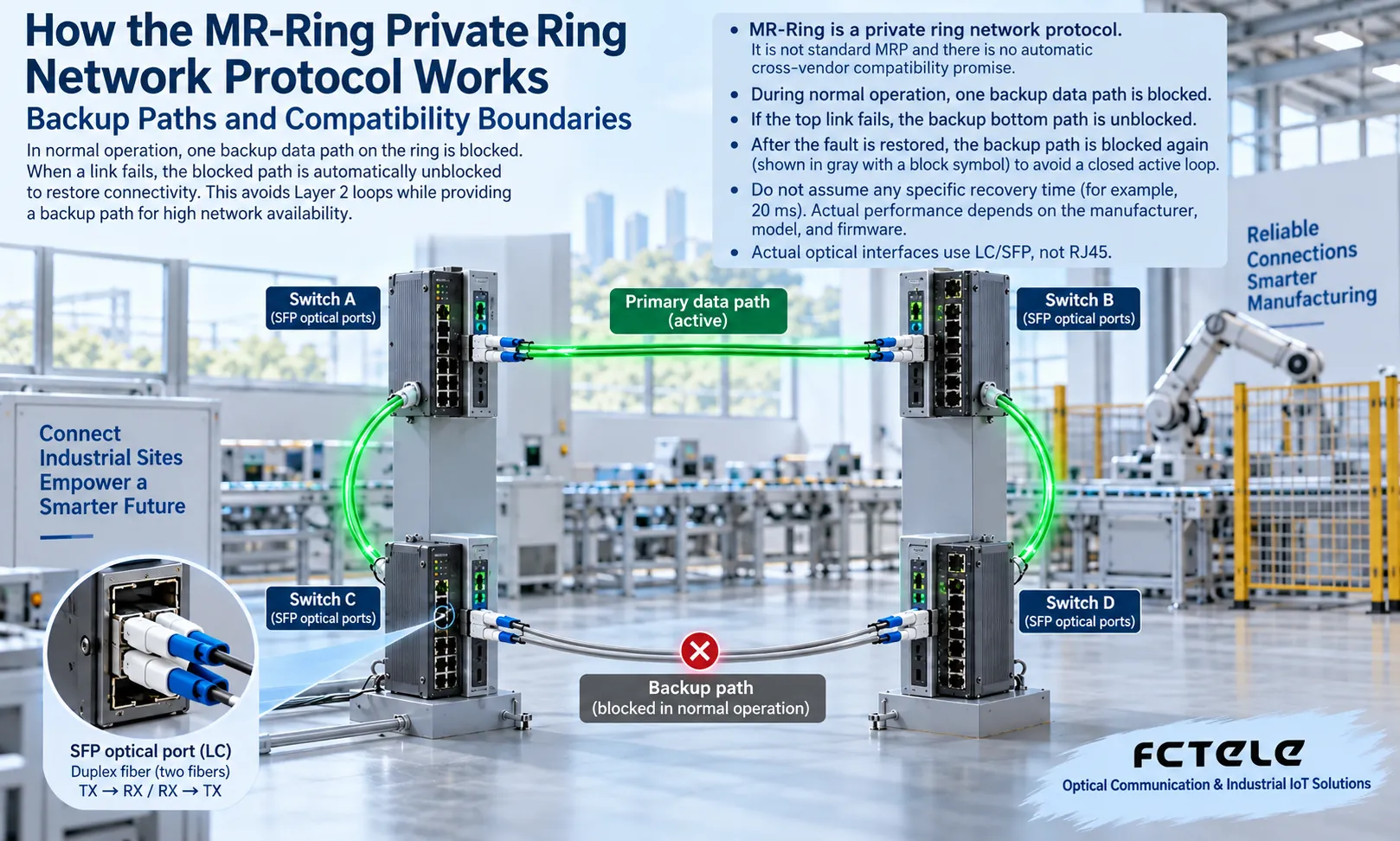
Connecting switches end to end provides a physical backup path, but Layer 2 packets may be repeatedly forwarded along the loop. Broadcast traffic and traffic with unknown destinations may especially be copied continuously, causing a storm. Therefore, the physical closed loop and the logical forwarding path need to be understood separately.
What the ring network protocol manages is this set of backup paths. It is not that simply adding a cable automatically provides reliability. In the normal state, a path with no data forwarding loop must be maintained, and switching occurs after a fault. Exactly which frames are blocked and how control packets are handled are determined by the implementation and configuration.
Why similar names may still be incompatible
The materials on this site introduce MR-Ring as a manufacturer’s private solution, but they do not provide protocol specifications sufficient to confirm interoperability across all current models. The Ring in the name cannot be understood as a universal interoperability mark, nor can it be directly regarded as IEC standard MRP.
A private ring network may use vendor-defined detection, roles, and control packets. Different series or firmware from the same manufacturer also need confirmation of supported combinations. One device promotional page cannot be used to make a compatibility promise for all devices. This article does not attribute MR-Ring capability to unverified Feichang Technology models.
What happens after a fault is not an automatic teleport
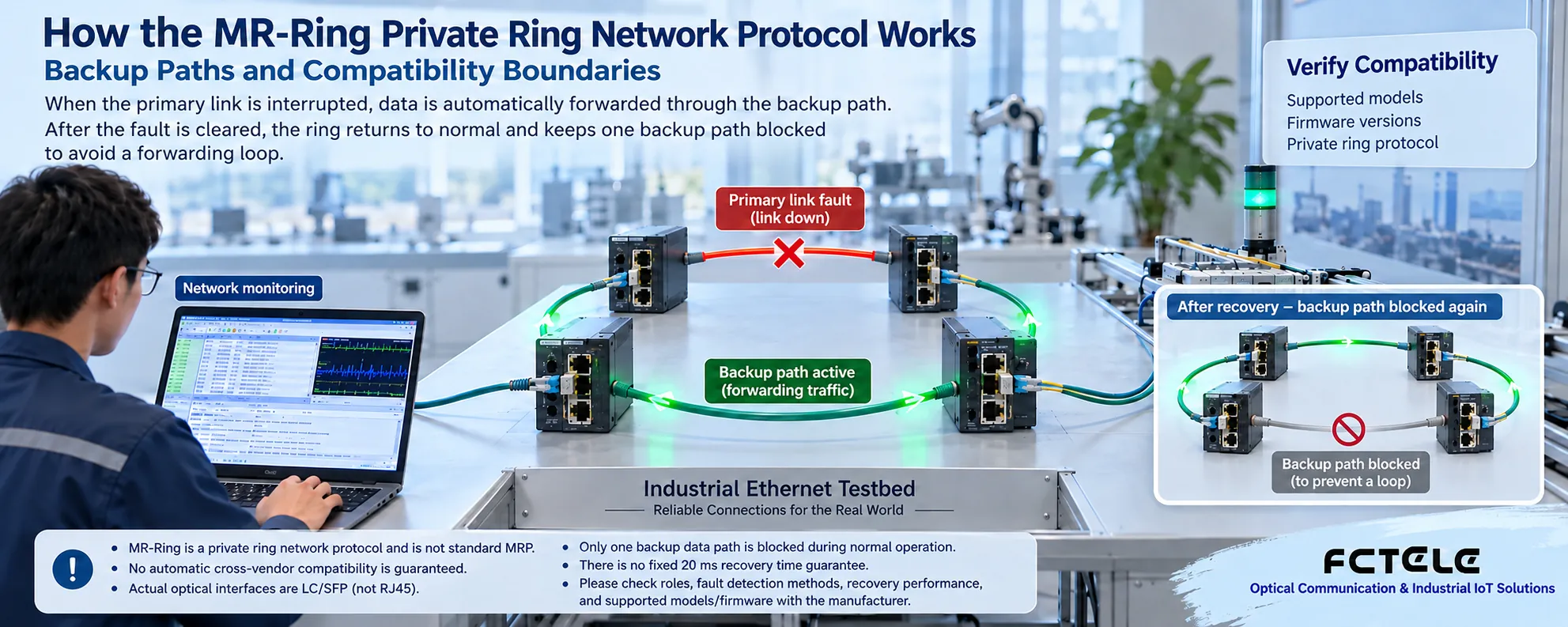
When devices participating in the ring network detect a specified fault, the relevant control process adjusts the backup path, and the network may also need to relearn its forwarding table. After that, terminals and applications resume communication. Link switching, network forwarding recovery, and application recovery are three different observation points.
Port down, device power loss, and unidirectional link faults may not necessarily trigger the same process either. Undetected faults, faults not covered by the protocol, and power problems outside the nodes cannot be assumed to be solved by ring protection. Tests must be designed separately according to actual requirements.
Recovery time must come with test conditions
If latency figures in historical materials lack the model, firmware, number of nodes, topology, and load, they are not sufficient as a guarantee for a new project. This article does not continue to cite a fixed millisecond promise that has not been currently verified, and even less does it interpret it as absolutely no packet loss or absolutely no telephone interruption.
Testing should record the time the fault occurs, the time forwarding recovers, and the time the application recovers at the same time, and explain the sampling method and service direction. Collect multiple fault points and multiple results, and pay attention to the longest recovery and anomalies, rather than only selecting the fastest screenshot.
Ask five things clearly before production access
Confirm the supported devices and firmware, ring port configuration, role assignment, allowed topologies, and hybrid connection boundaries, then confirm whether there are conflicts with spanning tree, VLAN, or other redundancy mechanisms. Do not try to mix two ring network protocols on a production site to guess compatibility.
Save the topology and configuration, and explain how to break the ring, replace nodes, and roll back during maintenance. If the two links pass through the same power supply, the same device, or the same conduit, they may also have common faults. A single fiber break test cannot cover all risks.
Acceptance after repair is equally important
After restoring the faulty link, check whether loop-free forwarding is re-established, and whether there are multiple oscillations, continuous packet loss, or abnormal flooding. Observe key terminals, rather than only recording that the ring network interface shows normal. All tests that may affect the live network should be performed within an approved window.
If the supplier cannot provide clear support and test materials, first choose a solution that can be verified, and do not rely on a private name. It can be combined with RSTP principles to understand loop removal and backup paths, but the two are not protocols that can be directly interchanged.
Translated from the Chinese technical article. Source first published: 2021-08-30. Source last revised: 2026-10-13T20:58:17+08:00. Read the Chinese source
