


When there are PLCs, instruments, cameras, and host computers on site, customers often treat an “RS-485 hub” and an “industrial switch” as two different-speed branching devices. In fact, they serve completely different communication systems:An RS-485 hub handles serial differential electrical signals and bus segmentation, while an industrial switch handles Ethernet frames and MAC address forwarding. They cannot replace each other, but they can be used together in the same industrial network. This article uses engineering language to clearly explain the boundaries, application scenarios, and selection methods of the two.
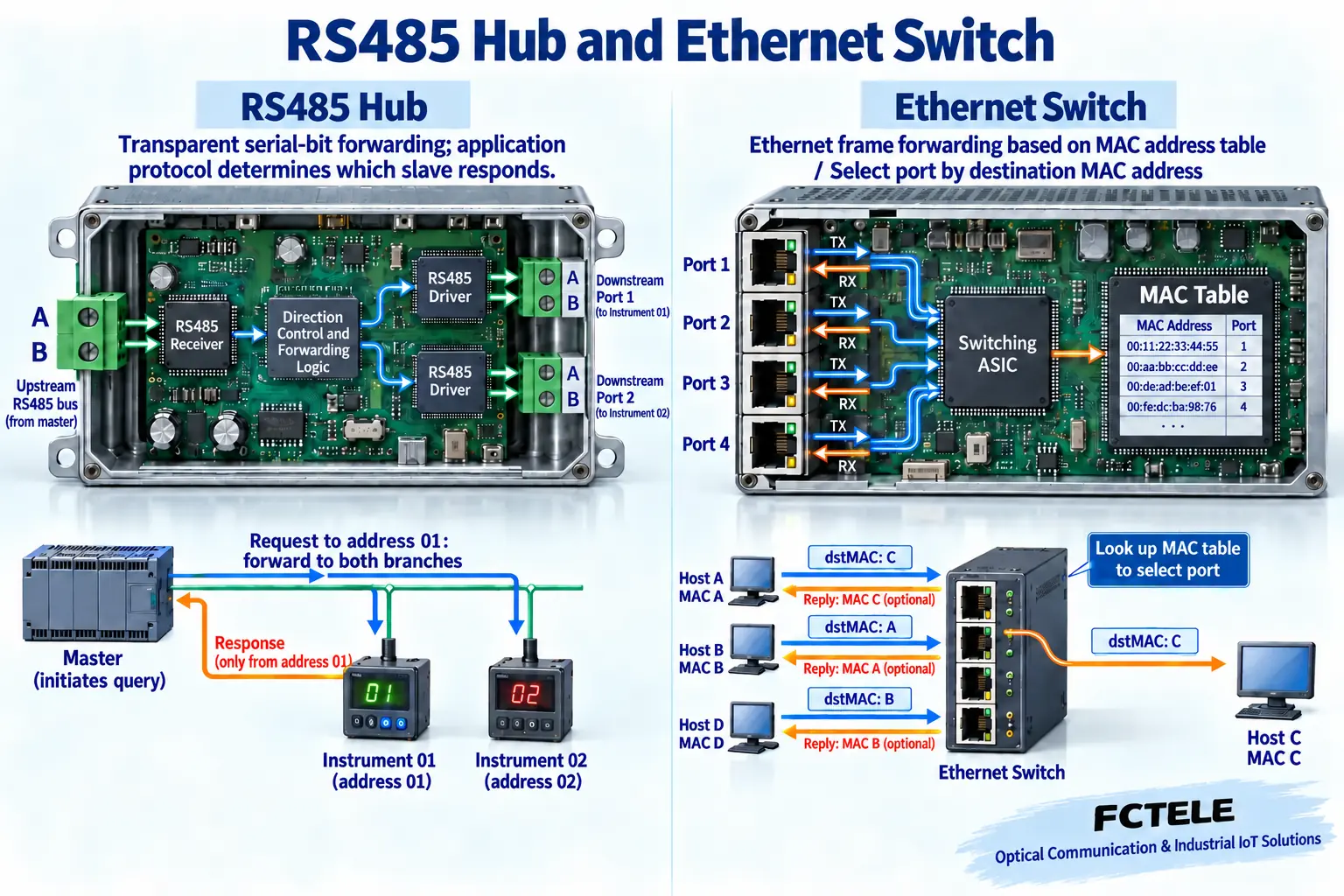
1. First remember the most critical difference: they are not at the same communication layer
RS-485 is a physical layer electrical standard. It specifies how the A/B differential lines transmit voltage signals, but it does not specify data content. Protocols such as Modbus RTU, DL/T 645, and Profibus DP can run on the corresponding serial links. An RS-485 hub is also called a 485 HUB, 485 repeater, or bus splitter. It receives one serial signal, and after reshaping, amplification, and isolation, distributes it to multiple independent branches. It usually does not recognize IP addresses, and it does not select forwarding ports based on MAC addresses.
Industrial switches serve Ethernet, and their ports are generally RJ45 electrical ports or SFP optical ports. They learn MAC addresses and forward Ethernet frames to the correct port; managed products can also provide VLAN, QoS, ring networking, multicast, port mirroring, and network management. In other words: what a 485 hub improves is the electrical quality and topology of the serial bus, while an industrial switch organizes Ethernet-based data communication.
| Comparison item | RS-485 hub | Industrial switch |
|---|---|---|
| Common interfaces | A/B or A/B/GND terminals, RS-485/422 | RJ45 Ethernet ports, SFP optical ports |
| Processing object | Serial differential electrical signals, character frames | Ethernet frames, MAC addresses |
| Typical protocols | Modbus RTU, DL/T 645, etc. | Modbus TCP, Profinet, EtherNet/IP, etc. |
| Core function | Repeating, isolation, star branching, fault segmentation | Interconnecting Ethernet devices, traffic forwarding, and network management |
| Address mechanism | Determined by the station number in the upper-layer serial protocol | Communicates according to MAC/IP network mechanisms |
| Can it directly replace the other? | No. Similar interface shapes do not mean signal or protocol compatibility | |
2. When is an RS-485 hub most useful?
Traditional RS-485 recommends using one trunk line to connect multiple nodes in series, with terminating resistors configured at both ends of the trunk according to the design. On site, for construction convenience, many long branches are often pulled out, causing impedance discontinuity and signal reflection; if any branch short-circuits, is reversed, or suffers a surge, it may also drag down the entire bus. An RS-485 hub uses independent transceiving and isolation to divide one bus into multiple electrical branches, making star wiring a manageable engineering structure.
- Scattered instruments: Electric meters, flow meters, and temperature controllers are distributed across multiple workshops or floors, and wiring is needed from the control cabinet in different directions.
- Strong on-site interference: Common-mode interference is easily generated near inverters, motors, and high-voltage equipment, requiring optical isolation and surge protection.
- Many nodes or long distance: Signals need to be reshaped and bus segments extended, but the actual distance should still be evaluated based on baud rate, cable, and on-site noise.
- Fault isolation required: When a branch short-circuits, it is hoped that other branches continue communicating, making it easier to quickly locate the fault scope.
Special note: a hub adds electrical segments and drive capability, but it does not automatically increase serial protocol throughput. One master station still needs to poll each slave in turn, and the effective bandwidth of the same uplink channel is still limited by baud rate, frame length, response time, and retry count. The “multi-port” in equipment promotion cannot be understood as multiple slave stations being able to send to the same master station at the same time.
3. What tasks are industrial switches suitable for?
When PLCs, HMIs, industrial cameras, edge computers, or servers provide Ethernet interfaces and communicate over an IP network, an industrial switch should be selected. It not only adds network ports, but also allows each port to send and receive data independently; managed devices can divide control, video, and management services into different VLANs, use QoS to guarantee critical messages, and achieve link redundancy through RSTP, MSTP, or ERPS.
Compared with ordinary office switches, industrial switches pay more attention to wide temperature range, power redundancy, fanless design, vibration resistance, surge resistance, and industrial electromagnetic compatibility. When cameras need power, the PoE standard, single-port power, and total device power budget should also be checked; for long-distance uplinks, SFP rate, single-mode/multimode, wavelength, transmission distance, and optical power budget should be checked.
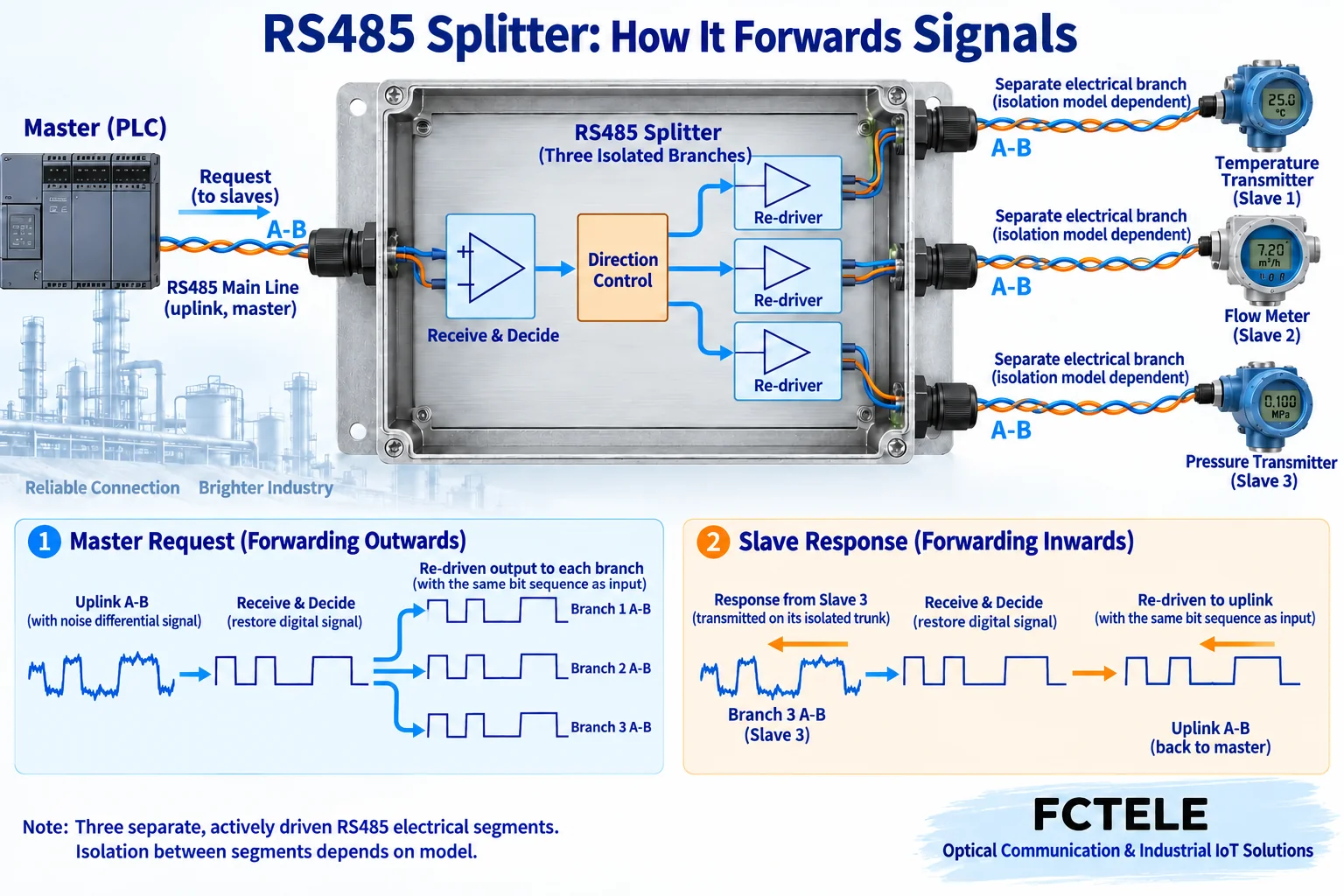
4. Two hypothetical application scenarios to understand how to choose at a glance
Case 1: 20 Modbus RTU instruments distributed in four areas
The host computer polls 20 RS-485 instruments through the PLC serial port. The four areas have different wiring directions, and an occasional short circuit in one area causes all instruments to go offline. The core problem here is RS-485 branching, signal quality, and fault isolation, so a 1-in-4-out or multi-channel isolated RS-485 hub is suitable. The four areas enter independent branches, and during debugging they can be disconnected one by one to locate the problem. If the host computer must access through Ethernet, add a serial server or Modbus gateway on the master side, rather than directly connecting A/B lines to an industrial switch.
Case 2: PLC, touch screen, and 8 cameras need to be connected to the control center
These devices all use RJ45 Ethernet. Among them, video traffic is large, control messages are sensitive to latency, and a fiber optic ring network is required. In this case, a managed industrial switch with gigabit uplink, VLAN, QoS, and ring network functions should be selected. An RS-485 hub cannot connect network cameras, nor can it perform Ethernet bandwidth management. If there are still a few old RS-485 instruments on site, the instruments can first connect to an RS-485 hub, and then connect to the switch through a serial server/gateway.
5. Common mistake: “can be plugged in” does not mean it can communicate
- Treating RJ45 as Ethernet: Some 485 devices also use RJ45 sockets, but their pins transmit serial signals. Connecting them to a switch may fail to communicate, and there may even be electrical risks. The pin definitions must be checked.
- Treating an RS-485 hub as a protocol converter: An ordinary transparent hub will not convert Modbus RTU to Modbus TCP; when protocol conversion is needed, an industrial gateway should be selected.
- Thinking that more ports means faster speed: Under polling by the same master station, adding branches does not equal increasing total throughput. The polling cycle and worst-case retry time should be calculated.
- Ignoring termination and bias: Terminating resistors should be configured according to topology, impedance, and device instructions, and not every node should have them installed. Repeated termination will increase the drive load.
- Looking only at distance and not the environment: Baud rate, wire diameter, shielding grounding, node load, isolation method, and surge level all affect reliable distance.
6. What parameters should be provided to the manufacturer when selecting?
When choosing an RS-485 hub, you should provide the number of uplink and downlink ports, two-wire/four-wire mode, baud rate range, whether the protocol is transparent, isolation requirements, maximum distance, number of nodes, terminal form, power supply, installation method, and operating temperature. If there are dual masters, cache forwarding, or primary/backup links, the communication timing must also be clarified, and it is not enough to just write “485 interface”.
When choosing an industrial switch, you should provide the number of 100M/gigabit/2.5G/10G ports, electrical and optical port types, PoE power, VLAN and QoS requirements, ring network protocol and expected recovery time, management method, power redundancy, wide temperature, protection rating, and certification requirements. When Profinet or EtherNet/IP is involved, the switch’s compatibility requirements for multicast, real-time services, and on-site controllers should also be confirmed.
7. Installation, commissioning, and acceptance checklist
- Confirm the RS-485 A/B definition, two-wire or four-wire mode, baud rate, parity bit, and station number to avoid opposite naming by different manufacturers.
- Use shielded twisted pair suitable for the impedance on the bus, implement shielding and grounding according to on-site specifications, and lay communication cables separately from power cables.
- Test no-load voltage, communication success rate, and error count branch by branch, then connect all nodes for long-term polling.
- On the switch side, check port speed, duplex, VLAN, ring network status, error frames, discards, and optical power.
- Simulate branch short circuits, device power loss, and network cable/fiber interruption, and record whether other services are affected and the recovery time.
8. How to find the product direction?
If you need to solve RS-485 star branching, repeating, isolation, and fault segmentation, you can look at Feichang Technology RS-485 hub/repeater; if on-site devices are already Ethernet-based and need optical/electrical ports, VLAN, QoS, and ring networking, you can look at industrial Ethernet switches/transceivers; if you need to connect serial devices to an IP network or complete Modbus RTU/TCP conversion, you should look at serial servers/industrial gateways. If the project includes all three types of devices, it is recommended to first draw the interface and protocol boundaries, and then select models separately.
Summary
An RS-485 hub is not a low-speed switch, and an industrial switch is not a multi-port 485 converter. The former solves the electrical segmentation, isolation, and topology problems of the serial bus; the latter solves Ethernet frame forwarding, bandwidth organization, and network management problems. When judging, first look at the on-site interface, then the communication protocol, and finally whether the problem to be solved is “signal quality” or “network forwarding.” If these three questions are clearly explained, most selection mistakes can be avoided.
Sources:Feichang RS485 hub product category;Feichang FCC-D4JM four-channel product description;Feichang FCC-D4M cached multi-master product description;Feichang FCC-D8J eight-channel specification;Feichang FC-D8JM intelligent eight-channel product description;TI RS485 Design Guide;Modbus Serial Line Specification entry. The diagrams explain general mechanisms; they are not actual PCBs, product physical objects, measured waveforms, or certification documents; model capabilities are subject to the corresponding materials and delivery version.
Translated from the Chinese technical article. Source first published: 2021-11-18. Source last revised: 2026-10-13T12:33:29+08:00. Read the Chinese source
