


First distinguish line rate from the speed a user actually gets
EPON and GPON are both point-to-multipoint optical access systems. The central office OLT connects to multiple ONUs or ONTs through passive splitters, and the terminals deliver the authorized services to the user electrical ports. Their differences are not only speed: the optical line rules, frame encapsulation, scheduling and management also differ. When choosing, you should confirm the specific standard and generation, then check the shared load on the same PON port, the uplink and the terminal interfaces. You cannot summarize all projects with a single multiplier.
The line rate of a PON port describes the speed at which this optical channel carries signals according to the standard. It is not equal to the dedicated application throughput of each ONU. Encoding, encapsulation, control, guard intervals and service limits all consume or constrain resources. Computer download speed also passes through the central office uplink, the service network and the user LAN and other stages; congestion at any one of them can become a bottleneck. Treating the nominal number directly as the promised bandwidth for each terminal will cause mismatches in procurement and acceptance.
How the two PON types let multiple terminals share the optical path
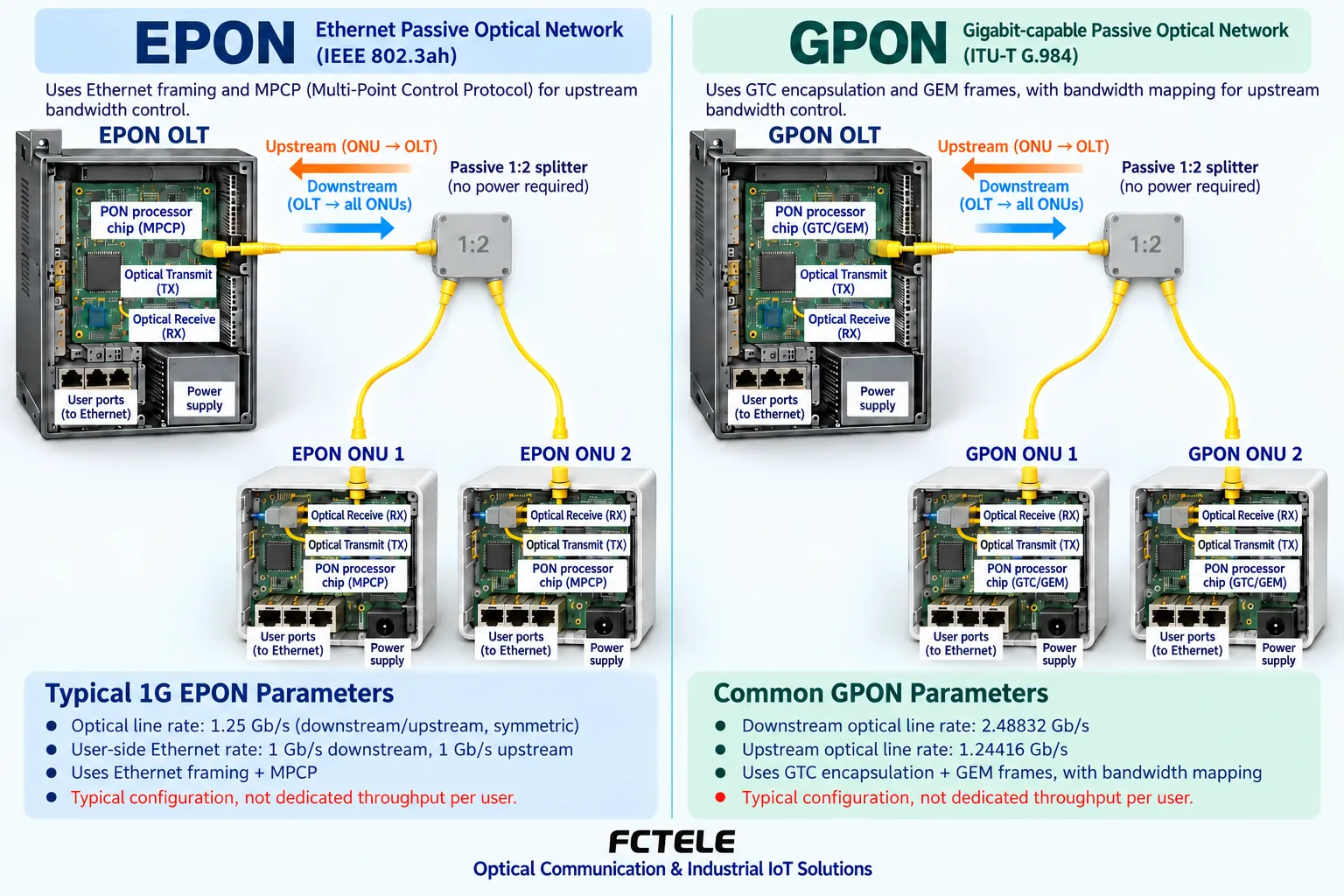
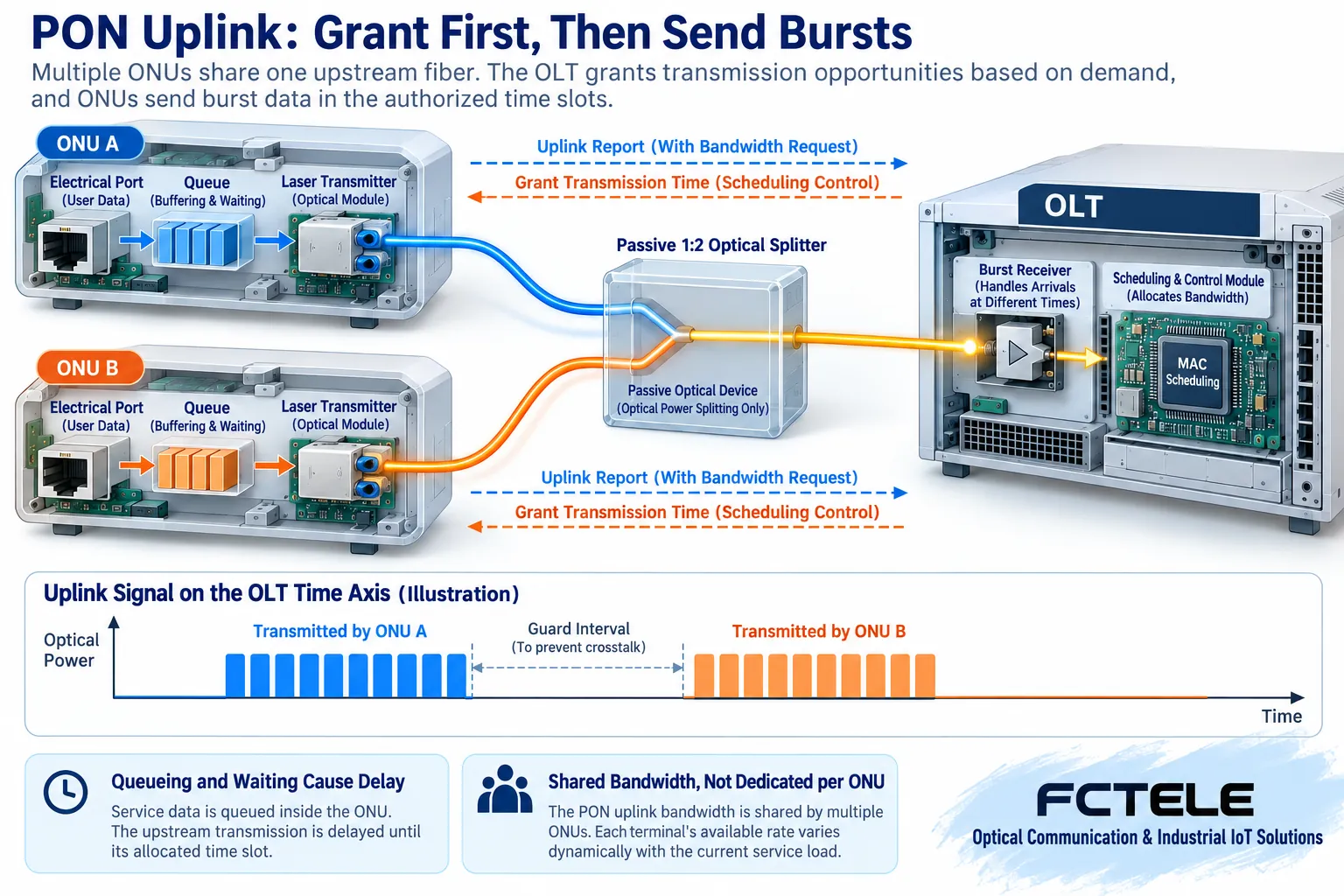
In the downstream direction, the OLT sends, and the splitter distributes the optical power to multiple branches. The ONU processes the services that belong to it according to the corresponding protocol; the splitter does not recognize MAC addresses, does not perform VLAN, and does not choose data for the ONU. In the upstream direction, each ONU shares the trunk back to the OLT and needs to send in the time slots arranged by the central office, so that normal services do not overlap in an unordered way. Both the OLT and the ONU have power supplies; only the passive optical distribution component in the middle does not need power.
EPON uses the Ethernet system and the multipoint control mechanism MPCP, and the related report and grant messages help coordinate transmission; GPON uses its own transmission convergence rules, commonly carrying services with GEM, and arranges upstream through corresponding bandwidth mapping. DBA means dynamic bandwidth allocation, which allocates resources according to queue demand and configuration. Both involve sharing and scheduling. You cannot write time-division transmission as unique to GPON, or say that EPON ONUs can send at any time simultaneously.
How should the typical first-generation rates be written
Taking classic 1G EPON as an example, with 8b/10b encoding the nominal optical line rate is 1.25Gb/s, and the underlying Ethernet data rate is 1Gb/s, commonly symmetric in upstream and downstream. Here the 1Gb/s is still not the file download rate after deducting all network and service overhead. 10G-EPON belongs to another generation of specifications, and you cannot mix it with 1G EPON in the same row and then declare that the whole system is always slower.
A common GPON configuration is 2.48832Gb/s downstream and 1.24416Gb/s upstream; G.984.2 also defines other line rate combinations, so this article uses “common configuration” rather than “all GPON”. XG-PON, XGS-PON and others are later systems and should not be written as “GPON 2.0 is ten gigabit”. When comparing, write the complete standard, upstream and downstream line rates, user ports and optical budget category in the same table, to avoid confusing line rate, Ethernet interface rate and actual throughput.
Calculate concurrent demand; do not mechanically divide by the number of ONUs
Suppose several cameras continuously upload through different ONUs. First count the peak effective bit rate, bursts and management traffic, then evaluate the upstream resources and the central office uplink. A terminal electrical port can negotiate gigabit, but that does not mean all ONUs get gigabit upstream at the same time. You also cannot treat total capacity divided by the number of terminals as a fixed guaranteed value: actual configuration, service guarantees, queues, grants and oversubscription methods will change the available resources. This example is only a design method, not a customer test result.
Video and control services have different directions and tolerances. Video usually pays more attention to continuous upstream capability, while control applications also care about latency, jitter and recovery from abnormalities. Priority can change the processing order during contention, but it does not create capacity out of nothing, and you cannot prove deterministic control capability just by a QoS switch. You should provide application indicators under full load and test on the selected OLT, ONU and firmware combination. You cannot treat a standard name as a zero-latency promise.
After matching device standards, you still need to confirm service interworking
An EPON ONU cannot connect to a GPON OLT just because it uses the same optical connector; ordinary Ethernet optical modules also do not replace PON transceiver and protocol processing. Multi-standard terminals should have their actual mode, firmware, certification and central office support checked. Optical power being within the normal window only shows that one of the optical layer conditions is met; registration, management and user services may still fail. Cross-vendor interworking should use verified combinations, and “supports the standard” should not be interpreted as configuration-free universal use.
The service checklist should at least include ONU authentication, VLAN mapping, multicast, rate limiting, management access, and the required bridging or routing functions. The OLT management interface is not equal to the user service uplink, and a terminal obtaining an address does not prove that all services are connected. When using an operator line, the service provider confirms the activation conditions; for self-built systems, configuration, version and authorization records should also be kept, and authentication information should not be exposed in public reports.
Use product materials to form a conditional checklist, not to apply slogans
The Feichang Technology official website lists EPON/GPON OLTs and ONUs separately, corresponding to the central office and on-site access roles. The FCX-9001 entry describes EPON central office and DBA, ONU management functions, and the FCX-8001 entry lists PON access and multiple gigabit electrical ports, and provides optional PoE configurations. These materials can serve as an entry point for inquiries, but you cannot infer from them that every terminal supports all standards, that every electrical port has dedicated capacity, or that PoE is standard on all versions.
If the protocol, wavelength or splitting parameters on the web page are mixed together, you should obtain the formal specifications and module list of the delivered model when ordering, and not piece together a definite configuration by yourself. Write the required standard, OLT and ONU models, firmware, splitting, optical budget and actual load to the supplier, and ask them to confirm item by item. Total cost also includes equipment room ports, on-site power, maintenance and expansion, and you cannot assume it must be more expensive or necessarily more cost-effective just because of the GPON name.
Acceptance goes from the optical layer all the way to the application layer
First record the splitter, optical cable and connector losses, and check the receive and transmit windows and maintenance margin of the farthest and nearest branches. Then confirm ONU registration and service templates, and verify VLAN, rate limiting and management permissions port by port. Finally, let the terminals within the design scope work at the same time, measure bidirectional effective throughput, queuing latency, jitter and errors, and keep a comparison between single-terminal and concurrent tests. The test should state the ports, time, load and measurement method.
Fault testing is performed during the maintenance window, checking separately the effects and recovery after abnormalities in the branch line, the common trunk and the device power supply. Do not look directly into the optical port, and do not repeatedly change the whole system configuration for one slow measurement. In the end, you should be able to state clearly: which generation of PON was chosen, which resources are shared, which interfaces the target services pass through, and how the devices interwork. Such a delivery record is more reusable than the sentence “GPON is several times EPON”.
Sources: IEEE 802.3ah ; ITU-T G.984.2 ; RFC 4837 ; Feichang FCX-9001 ; Feichang FCX-8001 . The figures are general mechanism illustrations, not specific model photos, PCBs, measurements or customer cases; selection is based on delivery materials and on-site verification.
Common on-site questions
If every ONU has a gigabit electrical port, does each one have its own dedicated gigabit PON upstream?
No. Multiple ONUs share the corresponding PON resources, and the central office uplink, scheduling and service templates also affect the available capacity. The electrical port negotiation rate is not equal to the application throughput each one gets at the same time. You also cannot mechanically divide the total rate by the number of ONUs as a fixed guaranteed value; you should measure according to traffic direction and final concurrent load.
If EPON and GPON have the same optical connector and normal optical power, can terminals be mixed?
They cannot interwork based only on these conditions. The optical-side rules, registration, management and service encapsulation differ; multi-standard devices also need their actual mode, firmware and central office support confirmed. First verify the exact OLT and ONU combination, then check authentication, VLAN and user services. Ordinary Ethernet SFPs also cannot replace PON protocol processing.
Can the comparison of EPON and GPON be written as one fixed speed multiplier?
It is not advisable. You should specify the standard and generation, and list upstream and downstream line rates, user ports and effective throughput conditions separately. The encoded line rate of classic 1G EPON differs from the Ethernet rate, and GPON also has defined different combinations; 10G-EPON, XGS-PON and others cannot be mixed in the same generation comparison. In the end you also need to check the shared upstream and actual application latency.
Continue reading: How to deploy industrial PON: OLT and ONU pairing, optical budget, service mapping and acceptance ; How does network HD surveillance run over fiber? IP cameras, bandwidth and on-site power ;
Translated from the Chinese technical article. Source first published: 2024-10-22. Source last revised: 2026-10-15T22:31:43.863560+08:00. Read the Chinese source
