

+8618758069661 [email protected]
Product Search Guide: space = AND, | = OR, ! = NOT

Got any Questions? Call us Today!

+8618758069661

Or leave us a message

Online Message

How Switches Are Classified: Protocols, Forwarding Layers, and Device Forms

Views: 121 +2Original by FCTELEAuthor: FCTELE Technical Team
AT A GLANCE

Why is industrial managed Gigabit switch an incomplete purchasing specification?

Those labels describe only some dimensions of the device. First identify the service protocol, then specify the required forwarding functions, port mix, management access, power and installation conditions. Several classifications can apply to the same switch, and none establishes every feature. Verify a model-specific function and acceptance checklist rather than interpreting classification names as a universal performance hierarchy.

Three mechanisms and their verification boundariesFollow the signal, then verify the actual service

01Identify the network protocol

Identify the network protocolEthernet and Fibre Channel use distinct service mechanisms.EthernetFrameLANFCFCFabricDifferent host and protocol processingCommon package ≠ common protocol

Ethernet and Fibre Channel use distinct service mechanisms.

02Separate switching and routing

Separate switching and routingMAC forwarding serves a VLAN; a configured Layer 3 function connects IP networks.VLAN ARouteVLAN BMAC forwarding within each VLANIP routing and policy between networksVerify the required supported functions

MAC forwarding serves a VLAN; a configured Layer 3 function connects IP networks.

03Check management responsibility

Check management responsibilityControl settings and the service path are different parts of the network.ControlABService path

Control settings and the service path are different parts of the network.

Swipe to compare the three diagrams →

Conceptual teaching illustrations—not measured waveforms, installation wiring or the internal architecture of a specific product.
  • Identify the network protocol

    Match the complete network standard before selecting optics.

  • Separate switching and routing

    Check route, interface and policy requirements.

  • Check management responsibility

    Verify configuration backup and recovery as well as forwarding.

Selection and verification checklistExpand the checks and related guides
Checks for this service and its actual operating conditions
CheckWhat to confirmHow to verify
Identify the network protocolEthernet and Fibre Channel use distinct service mechanisms.Match the complete network standard before selecting optics.
Separate switching and routingMAC forwarding serves a VLAN; a configured Layer 3 function connects IP networks.Check route, interface and policy requirements.
Check management responsibilityControl settings and the service path are different parts of the network.Verify configuration backup and recovery as well as forwarding.

Switches can be classified by the protocol they carry, forwarding layer, management capability, port speed, power supply, and installation environment. These dimensions can overlap: one device can be industrial, managed, Layer 2, gigabit, and PoE at the same time. Ethernet switches, storage switches, and telephone exchange systems also cannot be arbitrarily interconnected just because they share similar names.

Step one: first define which kind of network is being discussed

What is usually called a network switch mostly refers to Ethernet equipment, connecting terminals according to the corresponding link rules. Fibre Channel storage switches serve the corresponding storage network, and telephone exchange systems serve voice services. Their interfaces, protocols, and functions are different, and they should not be considered replaceable just because of the word “fiber.”

Even if optical connectors or module shapes are the same, that does not prove the service standards are the same. A procurement requirement should first state the protocol and purpose clearly, then discuss speed, distance, and port count. Otherwise, later model screening may deviate from the target from the very beginning.
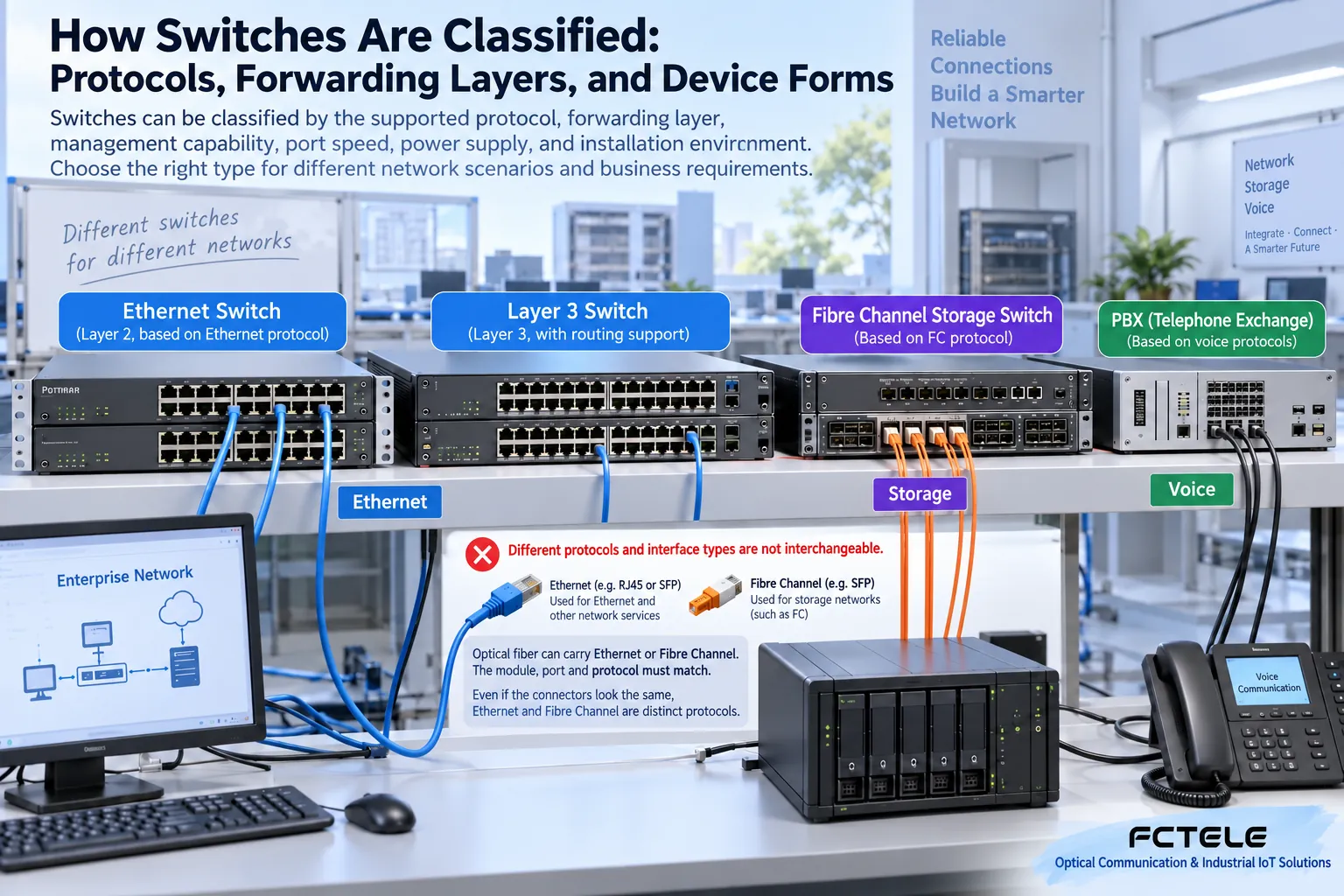
Ethernet, storage networks, and voice switching serve different purposes. Appearance or optical interfaces cannot replace protocol confirmation.

Layer 2 and Layer 3: the difference lies in forwarding decisions

Layer 2 Ethernet switches mainly forward frames based on MAC addresses and broadcast domains. Layer 3 switches can also have IP routing capabilities. When accessing different network segments across VLANs, corresponding Layer 3 interfaces, routing, and permissions are usually required. Simply creating two VLANs will not automatically complete this.

Layer 3 devices do not necessarily support all routing protocols or security functions, and Layer 2 devices may have fairly rich management and filtering capabilities. They should be compared according to a function checklist, not by understanding “number of layers” as an absolute performance ranking.

Managed and unmanaged: the difference lies in configurability and observability

Unmanaged devices are usually used for basic access and have fewer management entry points; managed devices can provide ports, VLANs, logs, and other settings. Which specific functions are available is determined by the model. When remote troubleshooting is needed, status, counters, and backup capabilities may be more important than the number of ports.

Management capability also increases configuration responsibility. Incorrect VLAN, redundancy, or permission settings may affect services. A more complex device should not be assumed to be automatically more stable. Maintenance personnel should be able to save configurations and explain recovery methods.
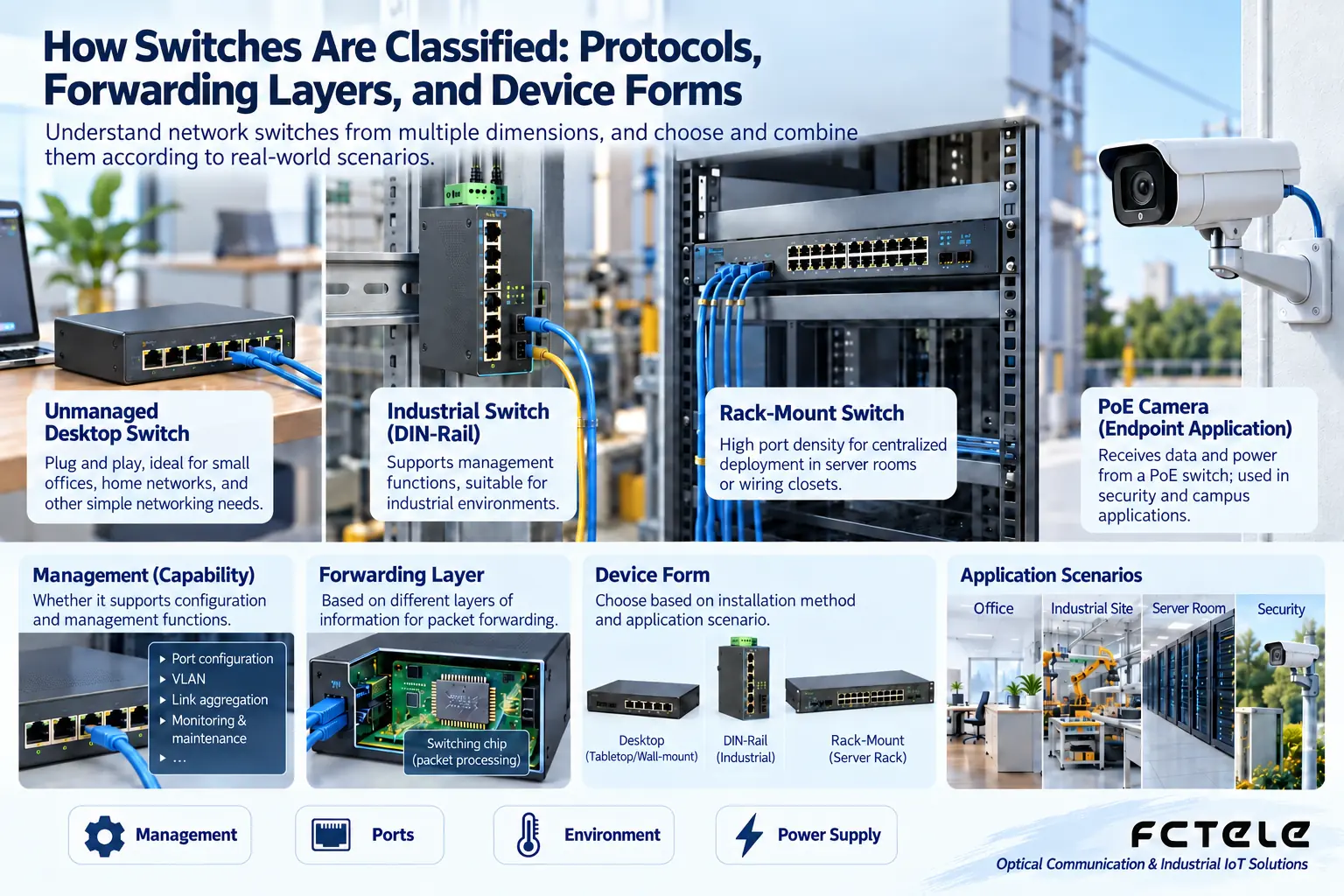
Management, power supply, ports, and environment are classification dimensions that can cross each other, not mutually exclusive product grades.

Port speed does not equal overall application speed

Fast Ethernet, gigabit, 10-gigabit, and similar terms describe the corresponding interface capabilities, and a device may mix multiple speeds. Uplinks, switching capacity, and forwarding conditions must also be checked. A 10-gigabit uplink port cannot be taken to mean that all terminals support 10-gigabit.

File transfer or video performance will be affected by servers, storage, terminals, and service traffic. Speed selection should be based on actual requirements and the complete path, not just buying the highest number.

PoE, form factor, and environment each have independent conditions

PoE means that compatible ports can supply power over copper cabling, and the power supply standard, per-port budget, and total budget need to be checked. It is not a default capability of all switches, and a fiber uplink will not carry PoE power to a remote end.

Box-type, DIN-rail, rack-mounted, and chassis-type mainly relate to installation, expansion, and maintenance. Industrial types focus on specific environments and power supply requirements, but suitability cannot be judged only by a metal shell or DIN rail. The host, modules, cabinet, and site conditions all need to be verified.

How to write an unambiguous selection description

For example, first state the Ethernet service, then list ports, uplinks, whether routing is needed, VLANs, PoE, and environmental conditions, and finally give management and acceptance requirements. To Product Center When comparing models, confirm each dimension separately.

Names can help establish a candidate range, but they cannot replace evidence. If a supplier only answers “industrial gigabit switch,” then protocol, port combination, power supply, configuration, and test conditions still need to be added before judging whether it truly solves the current problem.

Translated from the Chinese technical article. Source first published: 2019-11-08. Source last revised: 2026-10-13T22:35:50+08:00. Read the Chinese source

Common practical questions

Can an Ethernet switch replace a Fibre Channel storage switch with similar optical ports?

No. Optical connectors and module appearance do not establish protocol compatibility. Confirm the storage and Ethernet system requirements separately; a common enclosure or the word fiber does not make their forwarding mechanisms interchangeable.

Does buying a Layer 3 switch guarantee every required routing feature?

No. Supported protocols, software, licensing and performance vary. Verify the exact required functions and operating configuration rather than treating Layer 3 as an unlimited feature or speed grade.

Does a managed switch automatically make an installation more stable than an unmanaged one?

No. Management improves observability and configuration options, but incorrect settings can interrupt service. Compare the needed functions and the operator's ability to save, audit and recover the configuration for the actual installation.

Sources and applicable boundaries

These additions explain general mechanisms. Supported features, connection details and acceptance limits must be verified for the actual equipment, software and operating conditions; the diagrams are not measurements or certification evidence.

Share this article