


List services first, then decide on chassis and cards
When a site needs to keep telephones, E1, synchronous data or serial interfaces, but wants to share an IP network in between, you can compare a modular TDM over IP gateway with fixed-interface models. The main value of modularity is combining service cards that are explicitly supported into one device; it does not make any interface interchangeable, and it does not mean all services automatically use the same encoding or clocking. You should list the actual services first, then check the cards.
The requirements table should at least record interface type, quantity, endpoint role, rate, remote destination and acceptable interruption. Telephone interfaces and E1 ports are not at the same layer, and for serial interfaces you cannot judge only by the connector shape. The fact that a card has multiple ports does not prove that every port can use any mode; the fact that the chassis has empty slots does not mean total processing capacity and power resources are unlimited.
How service cards and shared transport divide the work
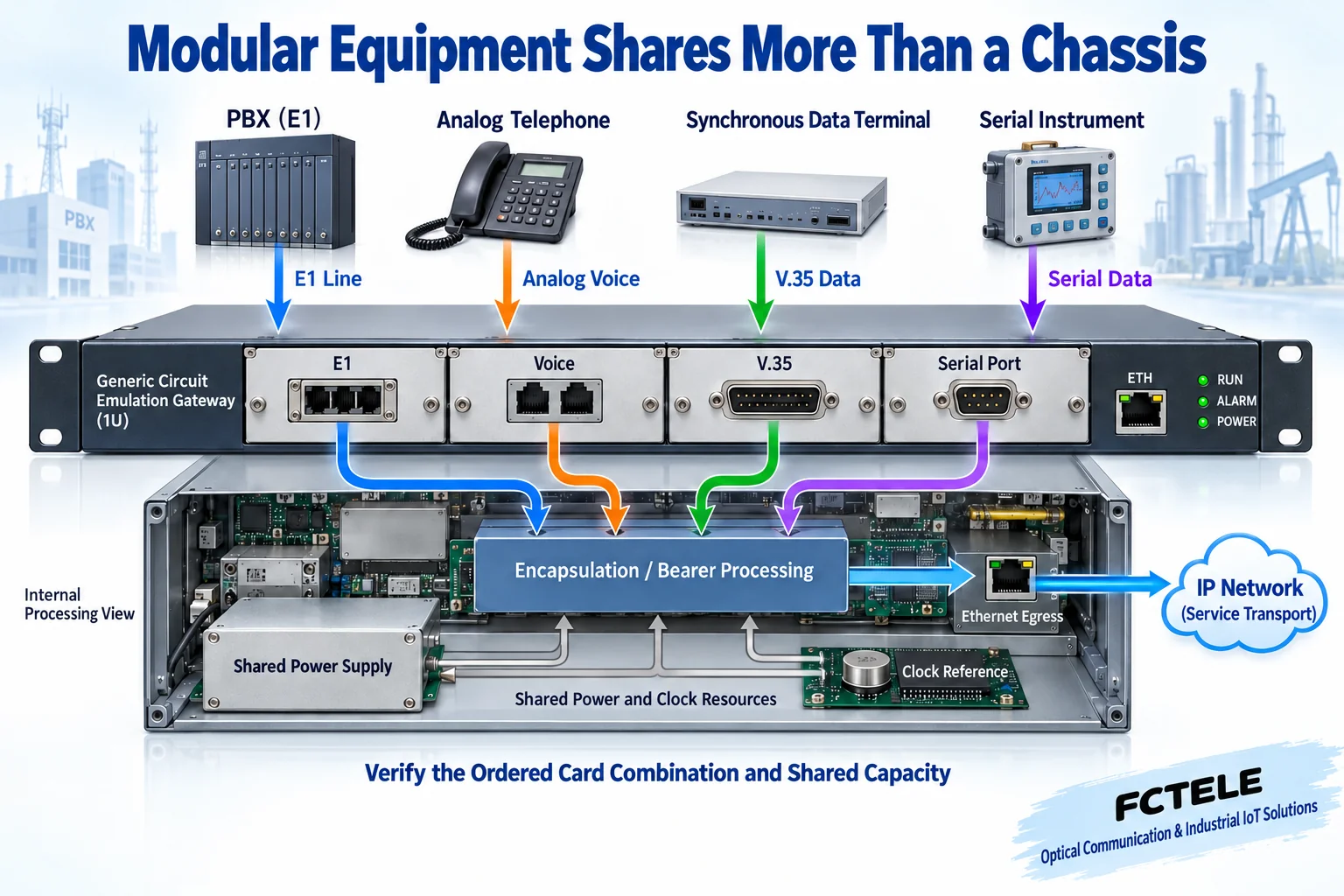
Service cards receive the signals of the corresponding interfaces and take part in the required interface processing; the shared functions then organize transport according to the configuration and send it to the IP side. The remote end delivers the corresponding interface according to the matching service and channel relationship. The modules, shared encapsulation, clock and power in the figure are a general functional illustration; they do not mean that a real chassis must distribute chips as shown, and they are not a wiring construction drawing.
Structured channel transport and whole-circuit transport have different objects of processing. Standards documents can help with understanding, but they cannot be used to declare on behalf of a product that it supports all standard encapsulations. Procurement must confirm the modes, packet length, mapping, frame and signaling settings, and firmware supported at both ends. The fact that something is also written as TDM over IP is not proof that service cards and gateways from different vendors can interconnect directly.
Which expansion options does FCT-M provide?
The Feichang FCT-M details list four slots and list card options such as E1, framed E1, FXO/FXS and other voice, V.35, and serial interfaces.
For example, telephone sets and PBX subscriber ports need matching FXS and FXO roles; V.35 also involves synchronous interfaces and clocking; for serial interfaces you must confirm the electrical standard and the service processing method. You cannot expand the card list into automatic recognition of any line, and it is not guaranteed that voice, E1 and serial ports all have the same transparency. This article does not use one generic plug-in card diagram to replace the manuals for each interface.
What to do when earlier and later documents disagree
The FCT-M product description and function paragraphs list a Gigabit Ethernet interface, while the technical parameter table still has a 100 Mbps interface description. This difference needs to be clarified according to the actual delivered version, and you cannot choose the higher number as a uniform promise for all variants. A solution diagram can express shared IP transport, but procurement and acceptance must state the actual ports and support conditions.
Settable packet length, VLAN and clock recovery are supported functions explicitly described on that page, but the range and configuration still need to be checked. Efficiency, quality and low-latency promotional claims on a web page cannot replace loaded testing, and they do not prove that all services are encrypted or lossless. If the manufacturer provides an updated datasheet, keep the version linked to the order so that inconsistent documents are not mixed when replacing spare parts.
Each circuit must correspond to the correct remote end
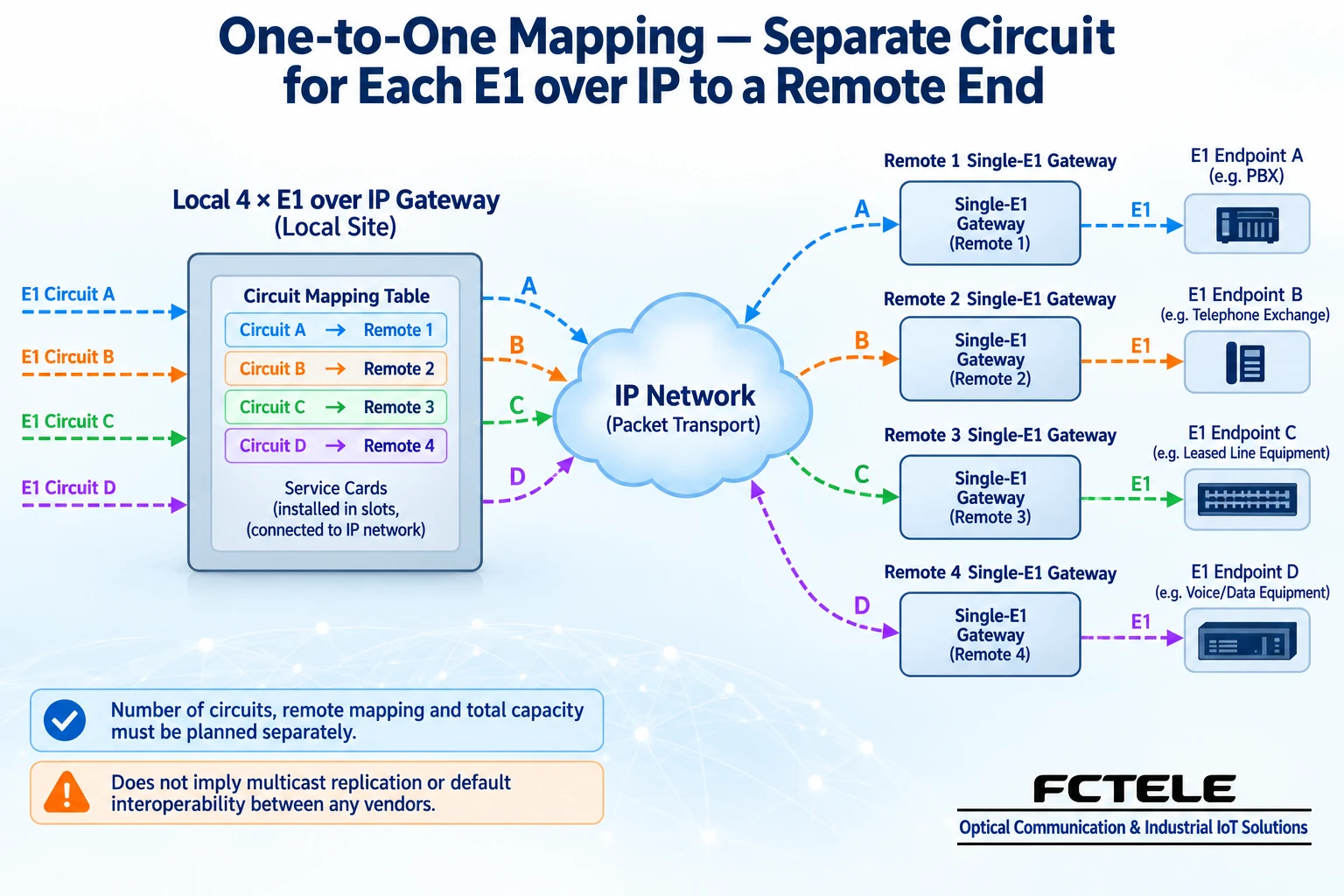
Point-to-multipoint usually means that different circuits are separately associated with their destination addresses and ports, not that the same circuit is automatically broadcast to all remote ends. The Feichang FCT-E4-M details describe four E1 channels, multiple destination IPs and port settings, and explain that it can combine with single-E1 remote ends to form a corresponding network. It is a specific mapping example of a fixed-interface product and cannot be directly turned into a capacity guarantee for any card combination of FCT-M.
During planning, establish an end-to-end record for each port: local service, transport identifier, destination end, remote interface, frame settings and timing. If one service is sent to the wrong remote end, the network side may still show that packets are normal. Testing must confirm the actual terminal identity and channel, then expand circuit by circuit; do not declare that all users are connected correctly just because the management platform shows online.
After modules are added, shared resources must be recalculated
The uplink, processing, power or clock resources shared by service cards may limit the overall combination. Continuous circuit load is different from management data that is sent only occasionally, and capacity must include encapsulation, link and possible secure tunnel overhead. The nominal rate of an uplink port does not equal usable service capacity, and multiple network outlets cannot be added together by rate without confirmation to become a guarantee for each circuit.
Adding cards also changes power consumption, heat, installation and maintenance requirements. Check power and environment according to the manual, and check latency, packet loss and E1 services under representative full-load conditions. Support for a certain power option does not mean that two on-site sources are truly independent; modules sharing a chassis may also be affected at the same time by a common power or control section failure. Modularity is not a guarantee that a single card failure will never affect other services.
Maintenance must not treat removable as hot-swap
The fact that a card can be replaced does not prove that live insertion and removal is allowed. You should confirm whether it is supported, the scope of impact, operating conditions and electrostatic requirements; when not specified, handle it according to the valid manual and maintenance process. Before upgrading or replacement, save the chassis, card and channel configuration, and prepare spare parts and rollback; do not pull out a card that is carrying services just to verify that modularity is convenient.
Fault location can distinguish a single channel, card, shared transport, clock and power. First compare other channels and alarms, record when the abnormality occurred, then arrange an approved isolation test. A common uplink interruption affects multiple channels, while a single remote end losing contact may affect only the corresponding mapping. Without evidence, do not attribute all phenomena to card damage, and do not directly clear the entire chassis configuration.
Deliver a combination record that can be reviewed
Deliver the chassis and each card’s model version, slot, interface, remote end, parameters and resource calculation together. First accept one representative group of channels, then complete parallel service verification according to the final card combination; check the permitted fault changes and configuration recovery. The example is only a planning method, not a statement that Feichang has completed a certain customer deployment.
When expanding, keep the original mapping and record changes and before-and-after results item by item. Whether cost is saved should compare equipment, cards, installation, spare parts and downtime impact, rather than automatically assuming it is cheaper just because the whole device does not need to be replaced. A suitable modular solution is a combination in which services, shared resources and maintenance boundaries are all clear and verifiable.
Documentation note: the principle diagrams have been checked against the technical content and are used to explain general mechanisms; they are not product photos or measured records. Specific interfaces, modes and capabilities are subject to the selected model, version and on-site verification.
Verification references: Feichang FCT-M modular multi-service circuit emulation gateway
Feichang FCT-E4-M four-E1 circuit emulation gateway
Feichang TDM Over IP product category
RFC5086: Structure-Aware Time Division Multiplexed Circuit Emulation Service over Packet Switched Network
RFC4197: Requirements for Edge-to-Edge Emulation of Time Division Multiplexed Circuits over Packet Switching Networks
Related technical topics: What happens when TDM over IP encounters path switching: RIP boundaries, out-of-order and recovery acceptance How to distinguish TDM from WDM: time slots, wavelengths and combined transport choices How to protect TDM over IP transmission: access control, IPsec and circuit quality acceptance
Common questions from the field
If a modular gateway has empty slots, can any service card be added directly?
No. The chassis and cards must be explicitly compatible, and permitted combinations are also limited by shared processing, uplink, power, heat dissipation and clock resources. First record each service interface, quantity and remote end, obtain the combination basis for the corresponding version, then perform parallel acceptance according to the final configuration. Empty slots and port quantity cannot replace proof of the whole device’s usable capacity.
The FCT-M documents mention both 100 Mbps and Gigabit, so can the solution be promised directly as Gigabit?
You cannot choose the higher value on your own. The supplier should clarify the interfaces and capabilities according to the actual chassis, cards and delivered version, and keep the datasheet linked to the order. Even if the uplink rate is clear, service capacity must still include encapsulation and shared resources. When the web overview, parameter table and physical version are inconsistent, confirm first before writing them into acceptance conditions.
If a service card can be removed, does that mean it can be replaced live without stopping services?
No. Removable does not equal hot-swap; the supported scope, impact, operating conditions and electrostatic requirements must be explicit. When not confirmed, implement according to the valid manual and maintenance process, back up the slot and channel mapping first, and prepare rollback. A common power or transport section failure may also affect multiple cards at the same time, and modularity does not guarantee that a fault is always limited to one card.
Continue reading: How does E1 over IP work? Encapsulation, buffering and clock recovery in circuit emulation ; What happens when TDM over IP encounters path switching: RIP boundaries, out-of-order and recovery acceptance ;
Translated from the Chinese technical article. Source first published: 2024-11-15. Source last revised: 2026-10-15T22:31:43.863560+08:00. Read the Chinese source
