


A special equipment room audio and video plan cannot simply say “just use a pair of VGA fiber optic extenders.” VGA handles one segment of image transmission, while sound, response feedback, observation video, and safety conditions need to be designed separately. MRI research scenarios especially need to be clear: ordinary fiber optic transmission capability does not equal being able to enter an MRI environment, nor does it prove the product has medical use qualifications.
1. First Break Functions into Actual Signals
The experimental images provided by the computer, the sound being played, operator communication, and subject button feedback are different signals. VGA images usually travel one-way from the control computer to the display endpoint, sound may need forward transmission or two-way communication, and feedback returns from the usage location to the control system. Each path should list its interface, direction, endpoint, and timing requirements. You cannot assume all functions are naturally connected just because they share the same fiber cable. Recording and stimulus display should also be described separately, and display output should not be treated as observation camera input.
2. What Happens Inside the VGA Link
A common digital extension solution has the transmitter receive analog RGB and sync, sample and organize digital data, send it over fiber to the receiver, and then rebuild the VGA output. What it extends is a specific display link; it does not determine image content, nor does it automatically record the exact time the display occurred. The device’s sampling, buffering, output, and endpoint display processing can all affect timing. When there is a timing measurement requirement, the actual link must be measured, and promotional “zero delay” claims cannot replace experimental records.
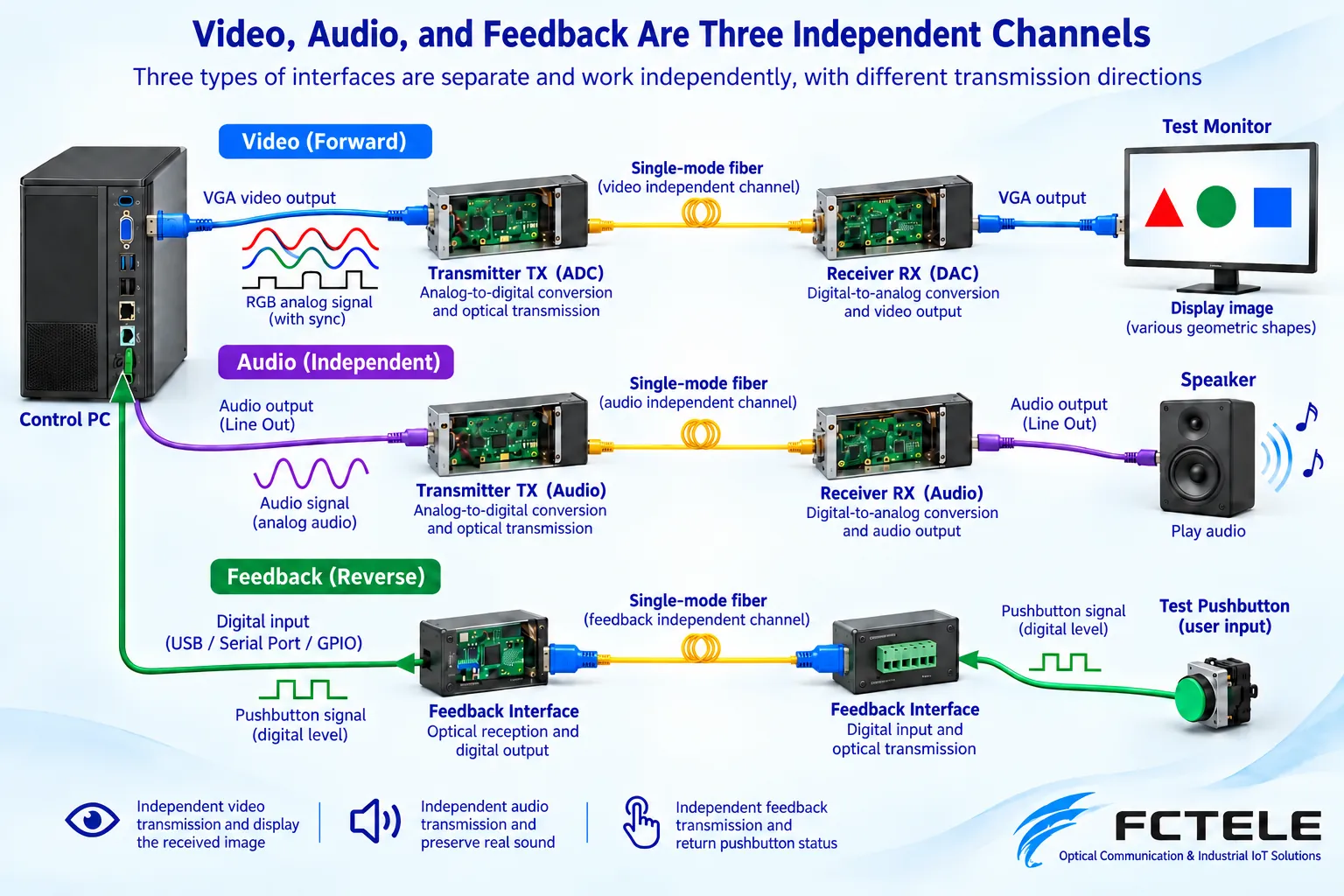
3. Why Audio and Feedback Need Separate Channels
The VGA interface itself usually has no audio or button feedback capability. Audio interfaces involve levels, bandwidth, and input/output types; feedback involves discrete contact signals, serial data, or other dedicated interfaces, and may also require software recording and timestamps. KVM allows a person to operate a computer, but that does not mean it can accurately record experimental response events. Whether each channel shares multiplexing equipment depends on verified product design; do not combine PS/2, USB, audio, and discrete contact signals under one word “control” and then omit specifications.
4. Why Fiber Helps, and What It Cannot Prove
Fiber optic media can reduce electromagnetic coupling on transmission lines and can also reduce conductive signal paths that need to cross zones. However, transmitters, receivers, housings, connectors, power supplies, and terminals may still contain metal and electronic circuits. Whether the whole system forms other conductive connections also requires checking power supply, cabinets, and additional cables. “The fiber itself is non-conductive” cannot be expanded into proof of whole-device insulation certification, non-magnetic certification, information encryption, or reliable operation in any strong magnetic field.
5. MRI Environments Must Have Safety Qualifications Confirmed Separately
MRI sites have static magnetic fields, changing magnetic fields, and radio frequency conditions. Equipment may be attracted, heated, interfered with, or have its function affected. FDA professional materials require checking the equipment’s safety information in the MRI environment, and an unknown status cannot be regarded as safe to use. MR Safe, MR Conditional, and MR Unsafe indicate different safety states; conditional use must also meet clear conditions. When ordinary communication equipment lacks the corresponding documentation, do not arrange for it to enter restricted areas. The site’s safety and engineering responsible persons should review the plan.
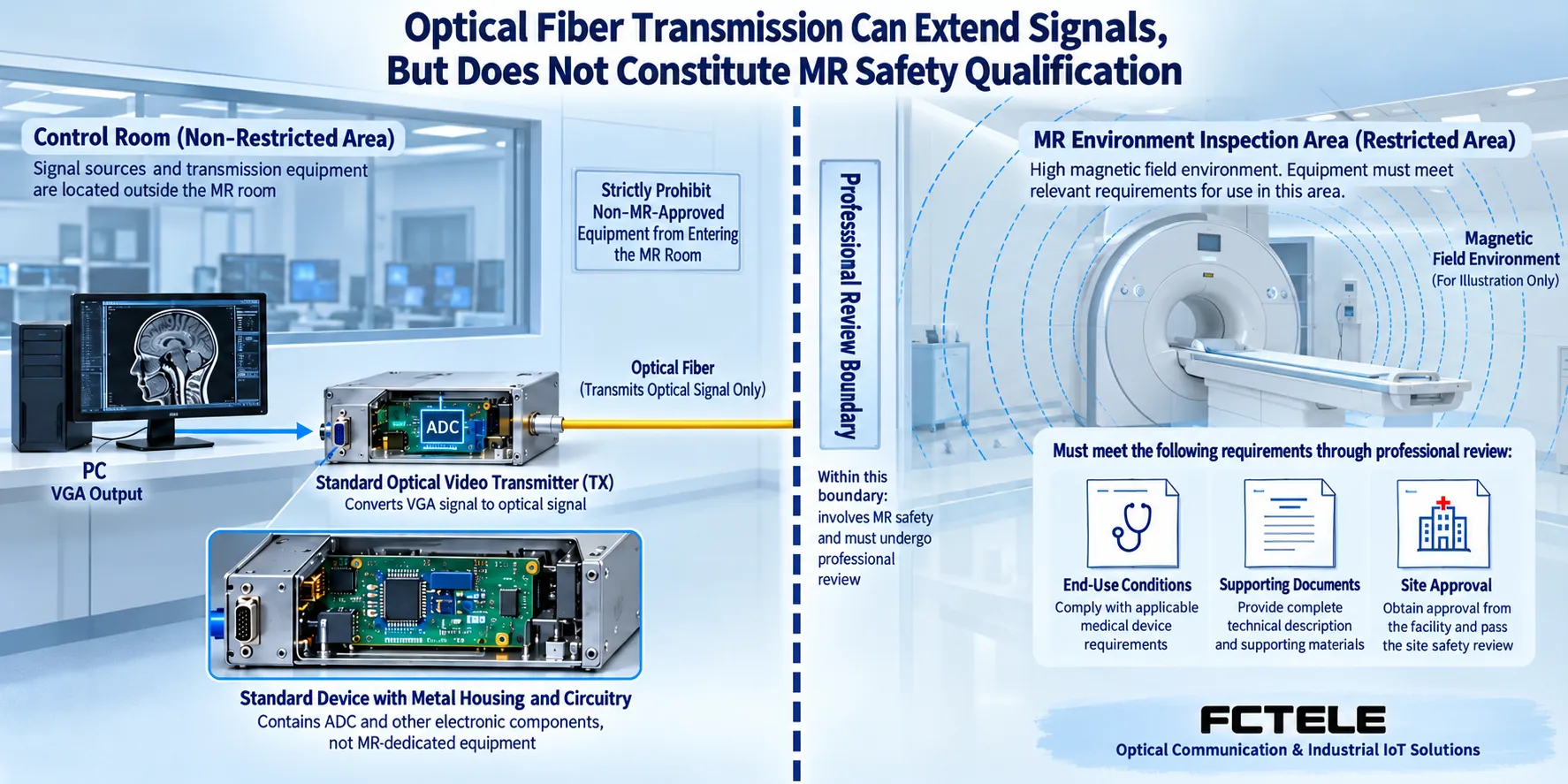
6. Who Decides Zone Boundaries and Wall Penetrating Routes
Where equipment is placed, which cables cross shielding boundaries, and how wall penetrating components are handled should be decided by a site-authorized professional team according to system requirements. This article does not provide construction instructions for bringing ordinary enclosures into the scan area, nor does it treat a diagram as an approved layout. Fiber crossing zones does not automatically guarantee shielding integrity, and endpoint display devices, audio devices, and other accessories still need to prove their own suitability. If the supplier can only provide general video specifications, the MRI condition remains an unconfirmed item, not something supported by default.
7. A Hypothetical Example of Channel-by-Channel Evaluation
Suppose a control system wants to send visual content, play audio, and record button returns. You can first verify three logical links on an ordinary lab bench: computer image to test monitor, audio source to test playback end, and button interface to recording software; check each input, output, and time record. This step only explains a functional check method; it does not prove the whole system can enter an MRI environment. Before entering a real site, safety review, qualified endpoints, and on-site authorization verification are still needed, and ordinary bench success cannot replace them.
8. Timing Acceptance Is More Important Than a Lit Screen
If the research task cares about stimulus and response time, computer events, actual image presentation, audio arrival, and feedback reception should be recorded separately, and the complete link and changes under different modes should be tested. Measurement tools, methods, and allowed ranges are determined by the task leader; this article does not provide unverified delay thresholds. Images should be checked for fine text, boundaries, and color; feedback should be checked for missed and repeated events; audio should be checked for direction and actual usability. After all channels pass separately, then evaluate the system’s combined result.
9. Feichang Technology Materials and the Applicable Boundaries of This Article
The Feichang Technology official website has categories for VGA fiber optic extenders and other dedicated transmission equipment. Specific models’ MRI safety, medical use, and precise timing performance should each have documentary evidence; general product categories and customer promotion cannot replace these conditions. This article is for understanding interface division of labor and documentation requirements, and does not involve diagnosis or clinical decisions. Before purchase, obtain documents for the exact model, configuration, and applicable conditions, and treat video extension and site safety qualification as two independent verifications.
Documentation review should also cover maintenance and replacement. One accessory passing under certain conditions does not mean the conditions still hold after replacing the power supply, cable, or monitor with an identically appearing one; model, hardware version, and installation location should all be traceable. Testing and troubleshooting within the site must be arranged by authorized personnel, and restricted-area equipment must not be moved without authorization just to troubleshoot communication problems. If the required safety documents cannot be obtained, keep the conclusion as unconfirmed and change the plan or continue verification; do not use anti-interference wording from manufacturer promotion to replace formal evidence.
Sources:Analog Devices: RGB graphics sampling and sync clock materials;FDA: Professional safety information for MRI environments;Feichang Technology: VGA fiber optic extender category entry. The principle illustrations are general mechanism diagrams, not actual products, measured waveforms, or certification documents.
Related topics:VGA fiber optic extender working principle;VGA selection checklist;VGA installation troubleshooting;Classroom and meeting room planning;Difference between SDI and VGA;HDMI and VGA interfaces;VGA to HDMI and image quality
Translated from the Chinese technical article. Source first published: 2019-09-20. Source last revised: 2026-10-13T13:19:24+08:00. Read the Chinese source
